article
Meteorizações, by Filipa César
“Filipa César’s latest exhibition, presented at Serralves and curated by Inês Grosso and Paula Nascimento, brings together more than fifteen years of research and stems from an ongoing body of work centered on Guinea-Bissau and its audiovisual archives, particularly what is known as “militant cinema.” This is not, however, a historical survey. Rather, it activates the image as a political praxis. This choice strips the museum of a meaning close to arkhé—simultaneously beginning and command—and reconfigures it as an archive in motion.”
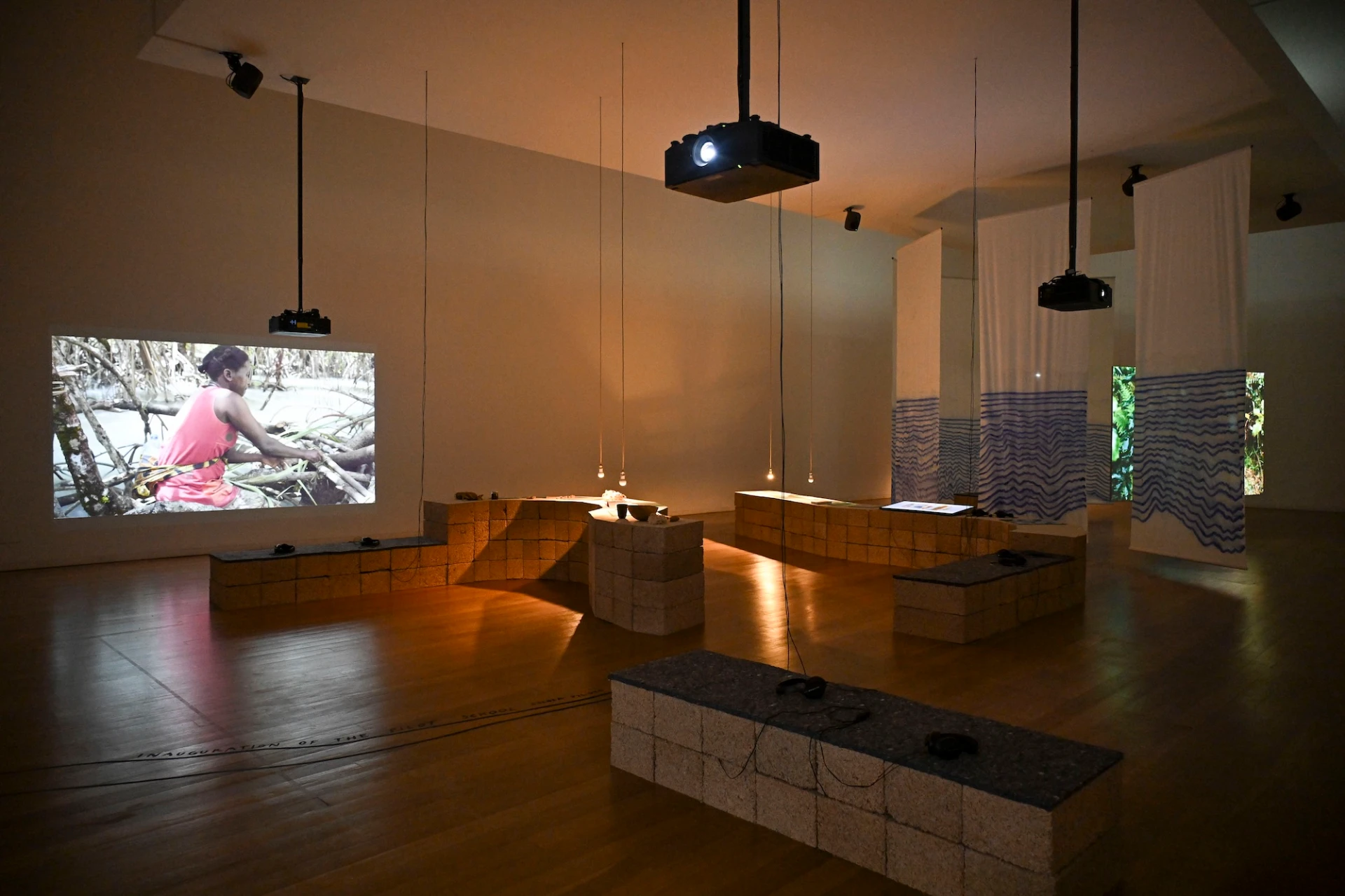
We step into the twilight as if entering a forest. With every step, we are greeted by the sound of water and the chirping of birds. The light is dim. The images appear on a grand scale. On each screen: bodies, voices, gestures. Acts of resistance are captured: those who stood up, those who asked questions, those who tell their stories. There is no obvious order. It is a space that demands time. It demands that we linger.
Filipa César’s latest exhibition, presented at Serralves and curated by Inês Grosso and Paula Nascimento, brings together more than fifteen years of research and stems from an ongoing body of work centered on Guinea-Bissau and its audiovisual archives, particularly what is known as “militant cinema.” This is not, however, a historical survey. Rather, it activates the image as a political praxis. This choice strips the museum of a meaning close to arkhé—simultaneously beginning and command—and reconfigures it as an archive in motion. Not a stable repository of memory, but a field where what has already been said, what has already been told, can be reopened. The journey through the corridors does not make history evident; it revisits it and demands its revision. Here, the act of entering requires another gesture, sankofa; returning not to confirm a narrative, but to question the power that establishes it. Learning from the past. Learning from the past. But before learning, one must ask: are we considering all sides? Who is included? Who remains excluded?
Filipa César offers us more than just a guide—she provides a map to navigate this story through moving images. The fragments are not merely told through the gaze. The ground itself becomes a record. Intersecting lines, inscribed dates, place names linking Lisbon, Bissau, and Cape Verde. History lies not only in the projected images and the objects that compose them (books, film reels, photographs, printed captions); it also lies beneath our feet. Walking becomes reading. We cross marks, tread connections, and move between geographies. We enter the cartography. We traverse history, whether through sight, hearing, or our own feet.
Memory does not hover; it materializes. If history is an archive, it is also an exercise of power. And every exercise of power entails some form of exclusion. Filipa César’s work evokes the era of colonialism, but it does not limit itself to addressing it. It questions our ability to act, as well as our capacity to entangle ourselves in the complexity in which we are embedded when part of a historical narrative. One does not speak over others but rather gives them a voice. Power structures and figures are reactivated that, because they are not institutionally legitimized, remain outside the dominant discourse. Through her work, Filipa César creates the conditions for voices to come together and be heard in the various testimonies and shared experiences.
The ability to isolate ourselves from the exhibition’s overall context—through headphones and small benches, as if we were in multiple movie theaters within the same room—alters the experience’s scale. There is no longer any ambient sound; the voice becomes direct and demands our full attention. The act of listening requires time. There is no distraction. There is closeness; closeness between those who move around and those who share the same bench. This closeness enables learning. There are signs we see but do not understand: the cloths. To know what their patterns and colors communicate is to enter another way of communicating. What appears to be form is language. What appears to be an ornament is code. These are produced, used, and circulate on a single ground. This is where Amílcar Cabral’s thought becomes unavoidable: the land’s defense. The land is a condition of existence and the foundation of a collective identity. There is no emancipation without territory, without ground beneath one’s feet.
But that ground is not stable. Its surface is formed by erosion, by the encounter between materials, by the passing of time – what Cabral called “weathering.” There is no pure soil; there is sedimentation. The exhibition emphasizes the archive’s materiality: an archive that is soil, a condition of identity and belonging. Soil is understood as a process, which is therefore not reduced to the simple opposition between true and false, just as history is not. It is not a synthesis. It is a tense construction, subject to erosion and recomposition. To remain in this interval is to refuse the comfort of conclusion. It is to accept that memory, like the earth, does not remain intact: it is worked upon.
Meteorizações, by Filipa César, is on display at the Serralves Museum of Contemporary Art in Porto through May 31.
BIOGRAPHY
Débora Valeixo Rana (b. 1990, Lisbon, Portugal) is a philosophy teacher living in Porto. She graduated in Philosophy from the Faculty of Letters of the University of Porto (2011) and has a Master's degree in Teaching Philosophy in Secondary Education (2019). Her academic and professional career reflects a deep interest in the intersection between Art and Philosophy, a dialogue that led her, in 2022, to take up a master's degree in Artistic Studies and Art Criticism at the Faculty of Fine Arts of the University of Porto.
ADVERTISING
Previous
article
31 Mar 2026
To understand or not to understand—that is the danger
By Laila Algaves Nuñez
Next
article
-6qspq.jpg)
07 Apr 2026
RedSkyFalls, Portugal at the Venice Biennale: An Interview with Alexandre Estrela
By Matteo Bergamini
Related Posts
article
17 SEP 2026
It´s a pink area, by Marc Kokopeli and Sydneys Schrader
By Débora Valeixo Rana
article
01 APR 2026
Meteorizações, by Filipa César
By Débora Valeixo Rana
article
06 FEB 2026
Traslados, by Marcelo Moscheta
By Débora Valeixo Rana
article
07 JAN 2026
A Morte Escreve a Floresta, by Nuno Henrique
By Débora Valeixo Rana