interview
Reading Images: Interview with Willem de Rooij
Just before the opening of his exhibition Hut Hut, as nightfall began to crystallise the glass walls of Lumiar Cité, I sat on a park bench with Willem de Rooij to talk about an artistic practice chiefly concerned with inquiring the images that shape our identities. For “we in the interpreted world are neither confident nor at ease,” as Rilke once wrote on the shores of the Gulf of Trieste, making a critical investigation such as de Rooij’s an indispensable exercise in understanding who we have become, and what we could yet be.
Tomás Camillis: In his text The Function of Criticism, T.S. Eliot writes that critical labor is the larger part of an author’s work. Eliot perhaps opened the 20th century to the method of pastiche, a preferred procedure of your own practice and one that demands a kind of erudition from the artist. In your own work, you seem to occupy a similar position, somewhere between the artist, the critic and the curator.
Willem de Rooij: When I first started showing my work in public in the early nineties, I encountered curators for the first time. At that time, after the Berlin Wall fell, art became understood as a global phenomenon. The function of the curator changed: they became more like authors. These newly emancipated curators had all sorts of interesting ideas about how to show artists’ works. Jeroen de Rijke and I experienced the tension between the desires of the curator and our own ideas of how to present our work, and these tensions regularly resulted in conflict. These conflicts then informed a method in which we started insisting on producing space around the work that we wanted to claim authorship over: the context in which the work is seen became part of our work, because we felt that that space was necessary to properly understand it. And not only the physical space, but also the larger context of education around it, in the way the work was written about or communicated. So today I don't see my work as curating, but it has developed through a complex relationship with the curatorial. I'm a collaborator; I started working with Jeroen de Rijke from the first day we met at the Rietveld Academy in Amsterdam, so I learned to make art and to be an artist through collaboration. Therefore, to have other voices present in the work is normal for me. For me, making art is very much a learning process, and I've been lucky enough to meet many inspiring collaborators, and amongst them also curators. Jürgen Bock here at Lumiar Cité is one—we developed this project largely together.
TC: The artist became less the originator of forms and more of a critical operator, whilst the curator became more like an author. In both, there’s this desire to question originality and objectivity, two ideas from certain modernist traditions that are now under heavy criticism. In your work, you also deal with this. Your main procedures are perhaps appropriation and collaboration.
WR: I don’t see originality as a driving force. For me, meaning is always constructed between two entities, in collaboration and exchange. I'm a Gemini, so the notion of two is very important to me. In the work, the presence of two entities means that something can happen in between them.When I started making art, Jeroen and I would make short films to be shown as installations in museums and galleries. So, editing became a formative method for me. For a project like Intolerance, I juxtaposed two groups of objects that are not, at first glance, related: a group of 18th-century feathered objects from Hawaii and a group of 17th-century Dutch paintings would not be combined in traditional museological contexts. But through this encounter, something happened between these two disparate clusters of objects.
TC: This critical approach towards culture is prevalent in your work, in how you explore the influence certain representations have towards us. Do you think it's still possible to do something like Cézanne tried to do, going outside the realm of culture and contemplating nature without social mediation?
WR: I'm not so driven by concepts of nature. A large part of the Netherlands has been produced by people. I was raised on man-made land, and my only strong relation to traditional ‘nature’ is with the North Sea. Sometimes I work with flowers, but I see them not as objects of nature, but of culture.I really think about the image through the lens of culture. I don’t think it is possible to have an untainted view of anything, because all our concepts are products of culture.
TC: In a lot of contemporary appropriation, there's this sense of irony. But in your work, you’re more interested in understanding, and revealing the structures underneath certain representations. It's almost a historical approach, but being an artist, there's also the desire to transform solidified interpretations. There’s, therefore, this duality in your work — a will to understand the historical structures of meaning and the desire to recreate context, deliberately misreading objects.
WR: Misreadings are productive because they force us to better define our own visions and understandings. I'm really trying to learn how images function. What helps me is to collaborate with specialists: for a project like Valkenburg, where I investigated the work of an 18th-century artist, I had the opportunity to invite a great number of authors and thinkers who bring together very diverse areas of knowledge related to the work of Dirk Valkenburg. Through knowledge that already exists, or through new knowledge produced by others, this creates a field for me to learn.
TC: And these two factors are mutually enriched in your work. You don’t usually downplay historical accuracy to misread something, but you also avoid laying too heavily on the original context, which would prevent other readings.
WR: Since I don't have the authority to decide which voice is more accurate, I prefer to bring together a multitude of voices and explore the multiplicity of possible perspectives. In the end, you arrive at a view and a product that are inconclusive. That is why a work like Intolerance is still active; I'm still invited to speak about it, and each time new questions arise. The basic premise of that project was a cluster of questions, and fifteen years later, it remains a cluster of questions. That is where its generative power lies.
TC: Studying your work, I remembered a short story by Borges called Pierre Menard, about a 20th century frenchman that wants to write Don Quixote, even though it’s already been written. At the end, he manages to write a somewhat accurate book, but it's not a copy: it has become a different work because the same passages are interpreted as a modern piece of writing. Perhaps the approach the spectator has to some of your works could be seen through this type of creative anachronism.
WR: It’s been important to me to exhibit appropriated originals. I felt strongly against making counterfeit depictions or facsimiles of sorts, preferring to place the original in a room and learn as much as possible without intermediaries. That’s how I started to develop this artistic method.Of course, there are practical barriers. Many of my ideas could not come to fruition because it is so difficult to loan objects. For this current installation at Lumiar Cité, we collaborated with the Ethnographic Museum of Lisbon, as well as with other museums, to see if we could bring the actual huts into the exhibition space. But they are extremely fragile, so the institutions won’t allow them to travel. At the same time, I think this focus on the original can easily become a fetish, which I’m not so interested in. Therefore, I’ve been thinking about livestreams to address this problem of loan politics. I’m excited that we are now employing this method for the first time - it marks a new step in my work.
TC: And I think this livestream format perfectly suits your practice, being also a reflection on how everything is mediated.
WR: Yes, both the mediation and the storage of the objects become part of the work as well. In this case, we are seeing one storage context and one exhibition context.
TC: These huts were originally used by shepherds, but have become something else in the museum. And by filming these already displaced objects, there’s a second rupture. The object changes through the chain of mediation. We can also see this in the differences between the spaces. In Spain, you can still go in. In Portugal, since you cannot approach, it almost becomes an aesthetic object.
WR: In the ethnographic museum in Lisbon, the depot in which the work is stored is quasi-accessible: one can make an appointment and visit it.What interested me is that the museum has open storage of objects, both from the Amazon and from Portugal. This complicates the ethnographic gaze, looking not only at what is othered, but also turning the mirror back onto the self or the local.
TC: We could also see them through the theme of metamorphosis, a central concept of your work, in how everything is changing according to circumstances or experience. Originally, it becomes almost a physical transformation for the shepherd — a new body being lived in. I wonder how one is changed through the experience of accepting this new body.
WR: It's like drag, like a ceremonial outfit. It's very dramatic and very stark, walking around with it.
TC: And like what you said about the number two: we’re always in a dialogue with something. But to exhibit them in this way, without being able to step inside, also creates this sense of otherness, or autonomy, even phantasmagoria, instead of a being-in-the-world, amidst things that change us.
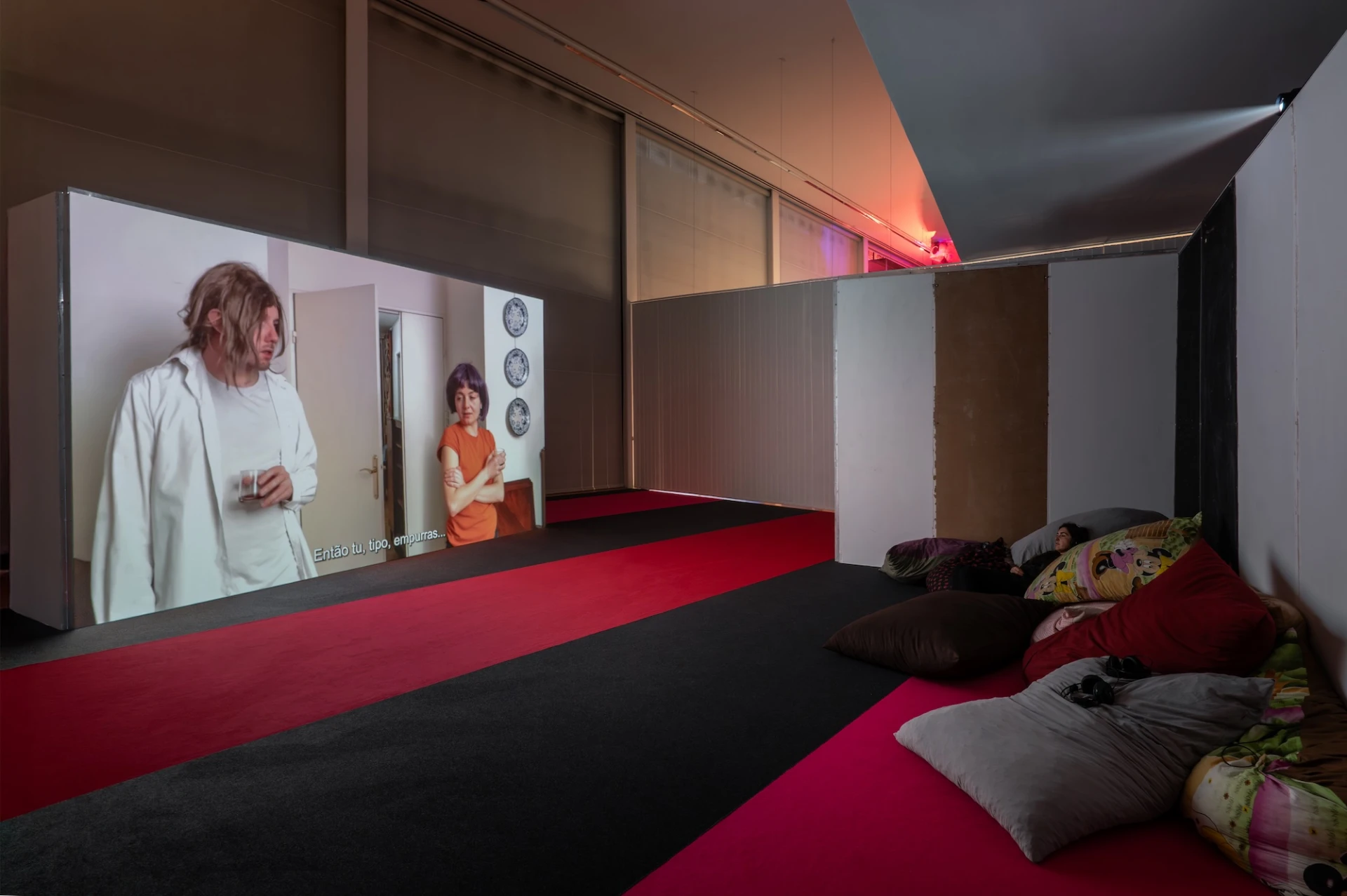
WR: I find it helpful to flip the ethnographic gaze onto the self, although in this case, perhaps it did not happen entirely: this museum has exclusively been collecting rural objects from a rural context—so the focus is still informed by class differences. At the same time, this tension suits Lumiar Cité, an art space housed in a specific part of town: a large social housing project devoid of other art institutions. Since the exhibition space is made entirely of glass, it becomes a machine that promotes voyeuristic gazes in two directions—from the inside out and from the outside in. And I don’t think it is truly that porous. The installation also tries to think through this: what does it mean to be in an enclosed space, and who is that space for? Who does it shelter, and from what? We also use the window filters in a particular way: in daylight, you can stand inside and look out, but you cannot look from the outside in. After the gallery’s closing time, at night when the room is dark, the situation reverses—people outside can see the projection, because the live streams continue 24/7. There are two possibilities of looking, depending on how accessible the space is and on the time of day.
TC: Studying your bouquet series, I remembered a phrase by Lady Macbeth. “Look like the innocent flower but be the serpent under it.” Flowers seem an innocent topic, but you excavate them. They can represent nature tamed, or even substituted, thus becoming a symbol of our current cultural state. Being dutch flowers, they could even acquire economic connotations, the tulip mania episode for example, perhaps the first capitalist crash in Western history. The same frailty is present in them, this tension between beauty and delicacy.
WR: The first flower works I made together with Jeroen de Rijke. We were young artists and didn't have much money. In the Netherlands, flowers are relatively cheap and readily available. We thought they could be containers of sorts, to try out different ways to construct meaning. Since we were raised at the Rietveld Academy by second—and third-generation conceptual hardliners, we were kind of drilled in conceptual ideology, but as a form of inherited trauma more than lived knowledge. What remained was largely dogma, with little real urgency in the mid-nineties. We wanted to poke fun at all the regulations imposed by our tutors, to have fun with meaning and approach these works as objects of cultural and political analysis, or as carriers of ethical or philosophical questions. Beauty is definitely a subject of these works in the sense that it is never unambiguous, always complex. I was, and still am, primarily interested in visual clichés, for instance—trying to make them look like other bouquets. The ideal outcome would be for you to see a work like that and feel you’ve already seen it a thousand times. What I've also always liked about working with flowers is that they have a duration. They have the capacity to be absent, and that's comforting to me.
TC: In a way, they are also patterns, the bouquets. The pattern is something you seem to be preoccupied with — how certain representations or motifs arise as cultural patterns. In your work Index, we can see people in the crowd gesticulating in familiar ways or assuming certain classical postures.
WR: I continue to wonder why certain forms rhyme and repeat, what is left of their initial meaning through this repetition, and what we can learn in the process. With my bouquets, the main questions are largely the same. So I’ll never make a bouquet where the objective is for you to be impressed by its newness.
TC: Still on the topic of patterns, I wanted to approach your tapestries and how you wanted to create a work about nothing, with them. I find this interesting because nothingness is the opposite of what you are usually invested in.
WR: And I didn't succeed, but I would still love to make a work about nothing. Yet each colour I chose to apply carried connotations. It's been a bit of a struggle to accept that and still continue to work against it. I ended up developing these works into a syntax of sorts, where they mainly refer to each other. I work with a small range of colours, made by the same producer. We use a synthetic sewing yarn, which is very durable and can withstand a lot of light. It’s affordable and always available. We create new yarns and colours out of this very generic, basic material. It's been a journey to see how much expansion there is within this field of limitations. This is where nothingness meets meaning.I have been working with the same producer from the start, Ulla Schünemann, who runs a handweaving workshop outside Berlin that was founded in the 1920s by Bauhaus student Henni Jaensch. Some of the looms are 300 years old. Because of the available looms, there's a limited number of sizes that we can produce. So while Ulla has been trying to arrive at this moment of nothing, it has so far rather become a project of self-referentiality. We have disappeared into a wormhole together.
TC: It's almost as if you are trying to reach the absolute limit of your way of thinking. Once you get there, and understanding that we are always inside certain interpretations, you seek a point of support through self-referentiality.
WR: These weavings are pictorial planes, so both objects and images. And objects are images for me too. It's as you say,, supposed to be an endpoint but the endpoint becomes electric again.
TC: In a way, their approach is almost minimalist, but I don't think you agree with Frank Stella when he says that what you see is what you see. There's always something else in there, for you.
WR: These works are formally indebted to minimalism, for sure, but the way of thinking belongs to another time. In the late ’90s, we saw many artists begin to produce large numbers of images. Everywhere I went, there were cameras. Cameras have always made me uncomfortable because I know what they are capable of, and at that time, I was especially disturbed, as I was going through great trouble to make almost nothing myself.We all took different cues from the early days of the internet. We could sense the onset of this explosion, and each of us responded differently. My response was to drastically reduce, to produce the context necessary for one to focus on the object. I have always been an enthusiastic addict of images, so I never objected to their proliferation. Rather, I am trying to develop methods to navigate it efficiently.
TC: A focused navigation. Your work embraces images, but it's also a quiet work. Your artistic approach is one of quietude.
WR: I don’t intend to copy the multitude; I’m trying to find moments of focus. I think it’s important that we develop critical ways of relating to the images around us. People always complain about the number of images surrounding them—today as much as 30 years ago. My response has always been: if you feel overwhelmed, then you have not seen enough. It is everyone’s personal responsibility to develop the mental and visual muscles needed to function in a contemporary visual environment. During my studies at the Rietveld Academy in the 1990s, before the internet, I would spend every evening after classes in the library, working through books. Now I am also scrolling, finding ways to see and to understand all these images. They are how we communicate. I am quite dyslexic and can only read very slowly, so images are important carriers of meaning for me. In a sense, I am reading images, trying to decipher them.
BIOGRAPHY
Tomas Camillis is an author and researcher based in Lisbon, working on fiction and on essays in the interplay between art, philosophy and literature. He has a master's degree in Art Theory by PUC-RJ. In recent years he has participated in researches, taught courses in cultural institutes, helped organize conferences and published in specialized magazines. He currently collaborates with the MAC/CCB Educational Service and Umbigo magazine.
ADVERTISING
Previous
article
06 May 2026
About the exhibitions at the Porto Municipal Gallery: Comissões #1, Colapso, and Pele do Mar
By Mariana Machado
Next
article
09 May 2026
Mesa-Paisagem (1973), by Ana Vieira, at Brotéria
By Carla Carbone
Related Posts
article
25 AUG 2026
Foreign Monuments: Grada Kilomba at Fundação Albuquerque
By Tomás Camillis
article
18 AUG 2026
The distant work: Ana Vieira at Galeria Vera Cortês
By Tomás Camillis
article
30 JUL 2026
Excess and Silence
By Tomás Camillis
article
08 JUL 2026
TOWARDS TERRA INCOGNITA: Interview with Giovanbattista Tusa
By Tomás Camillis