article
Língua Turva: The Aesthetic Unconscious
“Bringing together five artists, Língua Turva, curated by Margarida Mendes, presents within this blurry knowledge field signaled by aesthetics, a new wordless language that circulates through the space in a site-specific, circular movement. It speaks itself: impersonal, emerging without a clear speaker or subject, existing as a continuous flow of sensations, forms, and relations.”
On the morning I went to see Língua Turva, I passed a second-hand book stall on Rua Garrett. I opened a book at random and read a sentence about aestheticism. The title of this text is inspired by Jacques Rancière’s The Aesthetic Unconscious.
In this book, Rancière recalls that the use of the term aesthetics to designate artistic thought is recent. He returns to Baumgarten’s definition of aesthetics as “a field of knowledge perceived through the senses.” From this perspective, aesthetics designates a domain of knowledge that is subject to the operations of logic yet remains blurred.
Bringing together five artists, Língua Turva, curated by Margarida Mendes, presents within this blurry knowledge field signaled by aesthetics, a new wordless language that circulates through the space in a site-specific, circular movement. It speaks itself: impersonal, emerging without a clear speaker or subject, existing as a continuous flow of sensations, forms, and relations.
Língua Turva possesses a dust-like quality: a fleeting structure that seems to gather itself as we follow it with our eyes, only to disperse the moment our gaze shifts elsewhere.
Joana Escoval’s bronze and brass sculptures titled “it arises not from any cause but from the cooperation of many” are placed in the four corners of the space. These forms remain elusive. They seem to slip away the moment they are apprehended, resisting any stable or definitive reading.
Our relationship with nature and with the world is often mediated by the limits of our native language. In the joints of Escoval’s works, the categories and classifications through which we distinguish things in the material world begin to dissolve. They disperse into the air like particles of golden dust suspended in light. By this point, we have already entered the influence of another language, whose meanings cannot be translated into familiar terms.
The extent to which this system takes hold of us depends on how far we are willing to let ourselves go. Gradually, we begin to drift away from our linear conception of time, slipping into a more circular temporality. If time is no longer linear, then everything must be happening at once.
As Gaston Bachelard writes in A Intuição do Instante, “the silence of an event that has left us comes, but it continues to reverberate in the world around us. Through this schema, we grasp within what we call the present both the potential and the relative. For someone who continues to love, a past love is simultaneously present and past. For a heart that accepts both pain and memory at once, it is both suffering and consolation.”
The silence continues to reverberate in the world around it. In this sense, an image emerges at the level of sound.
Tuomas Laitinen’s sound work 600HZ (of protean behaviour) is composed at a frequency of 600 Hz - within the auditory range of octopuses - and unfolds as eight distinct sonic sequences. It constructs a space for thinking through sound: a site where frequencies seem to erupt and bubble up from the depths, reflecting on the potentials of language.
Originally commissioned for Radio Amnion, located two kilometers beneath the Pacific Ocean, 600 Hz draws inspiration from the tentacular coordination of octopuses and the formless continuities of their modes of life. These are processes that favour fluidity, adaptation, and distributed perception.
In Denis Villeneuve’s film Arrival, the heptapods communicate through a circular form of writing reminiscent of the ink-like fluidity of an octopus. The primary purpose of this language is to reconfigure human cognition, opening it to a non-linear experience of time, an operation that can only be achieved through language.
What I find particularly compelling is the way language shapes the structure of thought. In Arrival, the linguist character Louise gradually learns the heptapod language, and in doing so begins to think within its structure. As she internalizes this new linguistic system, her perception of time transforms: she acquires a form of vision that extends beyond linear temporality, where past and future coexist within the same perceptual field.
In the 1930s, the linguists Edward Sapir and Benjamin Lee Whorf formulated what came to be known as the Sapir–Whorf hypothesis, or linguistic relativity. It proposes that the language we speak shapes the way we think about reality. Different languages, in this view, reflect distinct interpretations of lived experience and can influence cognitive patterns on both individual and cultural levels.
In Vera Mota’s works, we are pulled into a flow where perception becomes kinetic. A vortex appears that follows bodily movement. This resonates with Novalis’s phrase “everything speaks". Each bears its own inscriptions in the form of scratches and folds, carrying the lines of its history and the signs of its fate.
Vera Mota operates with a kind of naturalist logic that recalls the reconstruction of animal communities from bones, or of entire forests from fossilised remnants. She moves through the labyrinths and subterranean layers of the social world, gathering fragments. From what appears insignificant or unreadable, she extracts something like the visual logic of hieroglyphs.
In doing so, within the topography of a place, the physiognomy of a face, the worn structure of a garment, or the chaos of objects, she uncovers elements of mythology, latent narratives embedded within material appearance.
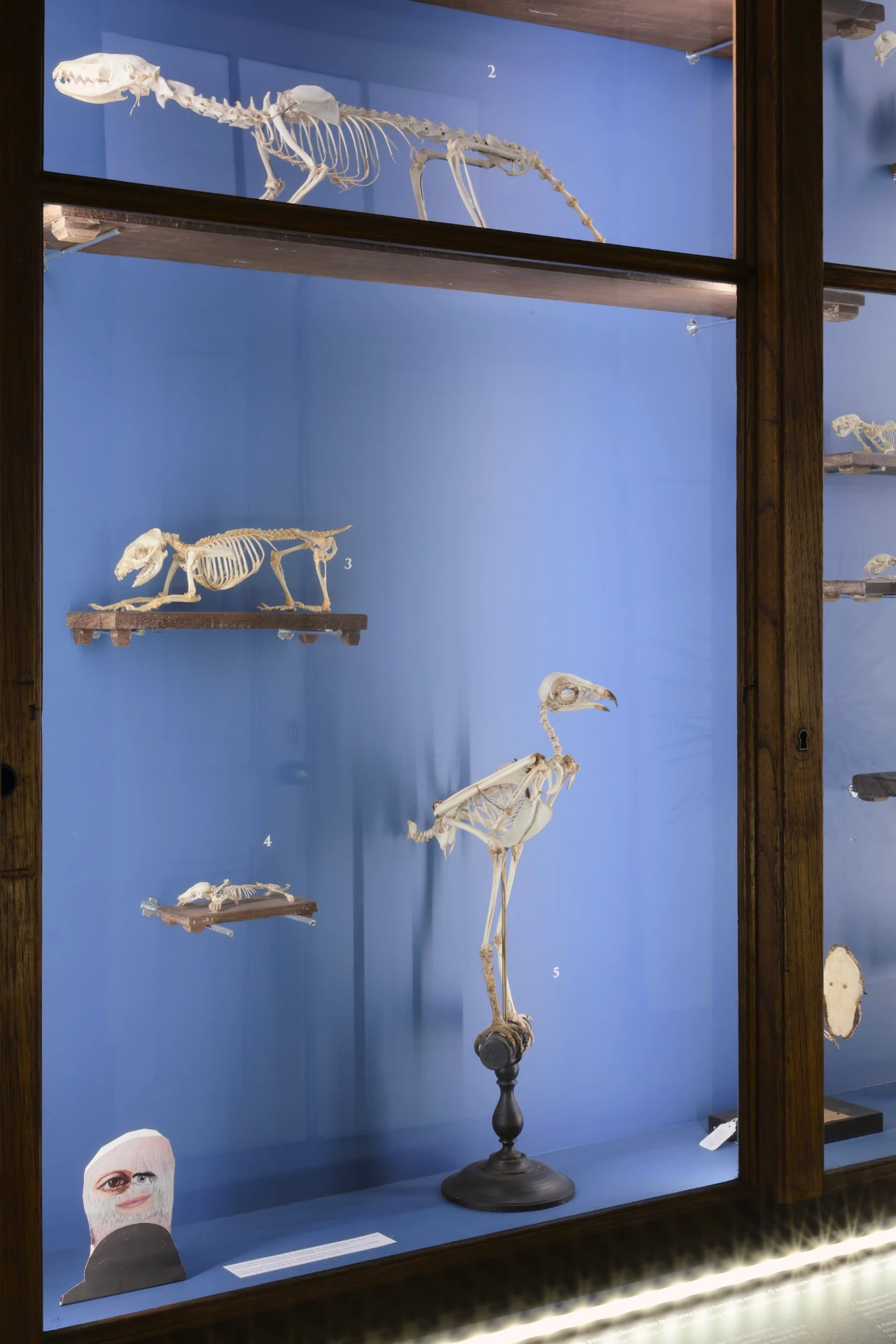
In Gonçalo Sena’s Ossos de Chuva (“Bones of Rain”), we encounter what Rancière calls the thought of the work: a form of thinking embedded in the artwork’s own material organization. Yet alongside this lies another force, a kind of “unthinking” that belongs to thought and gives it a quieter, more elusive power.
The wordless language of things reveals the truth of a civilization or an epoch by stripping away its monumental forms and laying bare what might be called the “bone of rain.”
This logic reminds me of Robinson Crusoe: alone on his island, he enters a narrow opening in a cave, a passage that functions as a return to the maternal body. The space is so constricted that, to pass through it, he must anoint himself with milk taken from animals he has domesticated. The author describes Robinson's state as follows: “He fitted himself so completely into the hollow of his nest that, as soon as he had taken up his position, he forgot the boundaries of his body.”
In Sena’s work, thought operates in a similar manner: as a form of full alignment with nature, where the limits of the self-dissolve and the boundaries of existence become secondary to a deeper continuity with the world.
David Horvitz’s single-breath glass sculptures function as a rupture in the space-time of the exhibition, much like the other works in Língua Turva. These glass pieces belong simultaneously to multiple temporal registers: they are the product of a craft tradition that has survived for centuries; they are made in the immediacy of a single breath, and they also carry within them a projected future trajectory, tied to their planned journey along the Tagus River basin. In this sense, the glass sculptures condense the philosophy of Língua Turva into a single breath: a fragile yet precise convergence where past and future are suspended within the present, folded into one another in their most delicate form.
In Arrival, Dr. Louise Banks articulates a similar temporal intuition toward the end of the film: “All I can do is embrace every moment I will live. Even if I know what will happen, however difficult it is for me, I must hold each moment tightly.”
In Língua Turva, there is no description that does not already carry within itself the force of the artwork it refers to. Everything is placed on an equal plane -equally significant, equally meaningful without hierarchy.
In this way, the exhibition produces a blurred language reminiscent of the “secondary dialogue” in Maurice Maeterlinck’s theatre: a form of speech that does not communicate directly, but rather resonates like an undercurrent, giving form to an aesthetic unconscious.
Língua Turva can be seen at Klein Space Lisboa until June 10.
BIOGRAPHY
Ayşenur Tanrıverdi is an Istanbul-based writer, living in Lisbon since September 2022. She studied at Istanbul University and is the author of two published works of literary fiction. A regular contributor to Cumhuriyet, a major Turkish newspaper, where she focuses on Portuguese culture. Her essays and critical texts on theatre, literature, and contemporary art have also been featured in various art magazines.
ADVERTISING
Previous
article
02 Jun 2026
On Wandering Among Beings: "Entre Seres" by Susanne Themlitz
By Ayşenur Tanrıverdi
Next
article
09 Jun 2026
Vivian Maier – Anthology at the Centro Português de Fotografia
By Ana Martins
Related Posts
article

09 OCT 2026
Geographies of Memory: A Stone in the Middle of the Road
By Ayşenur Tanrıverdi
article
18 JUN 2026
Olho de Vidro, by Pedro Barassi: The Gravity of the Gaze
By Ayşenur Tanrıverdi
article
15 JUN 2026
Notes on ARCO Lisboa 2026
By Ayşenur Tanrıverdi
article

08 JUN 2026
Língua Turva: The Aesthetic Unconscious
By Ayşenur Tanrıverdi