article
Notes on ARCOmadrid 2026
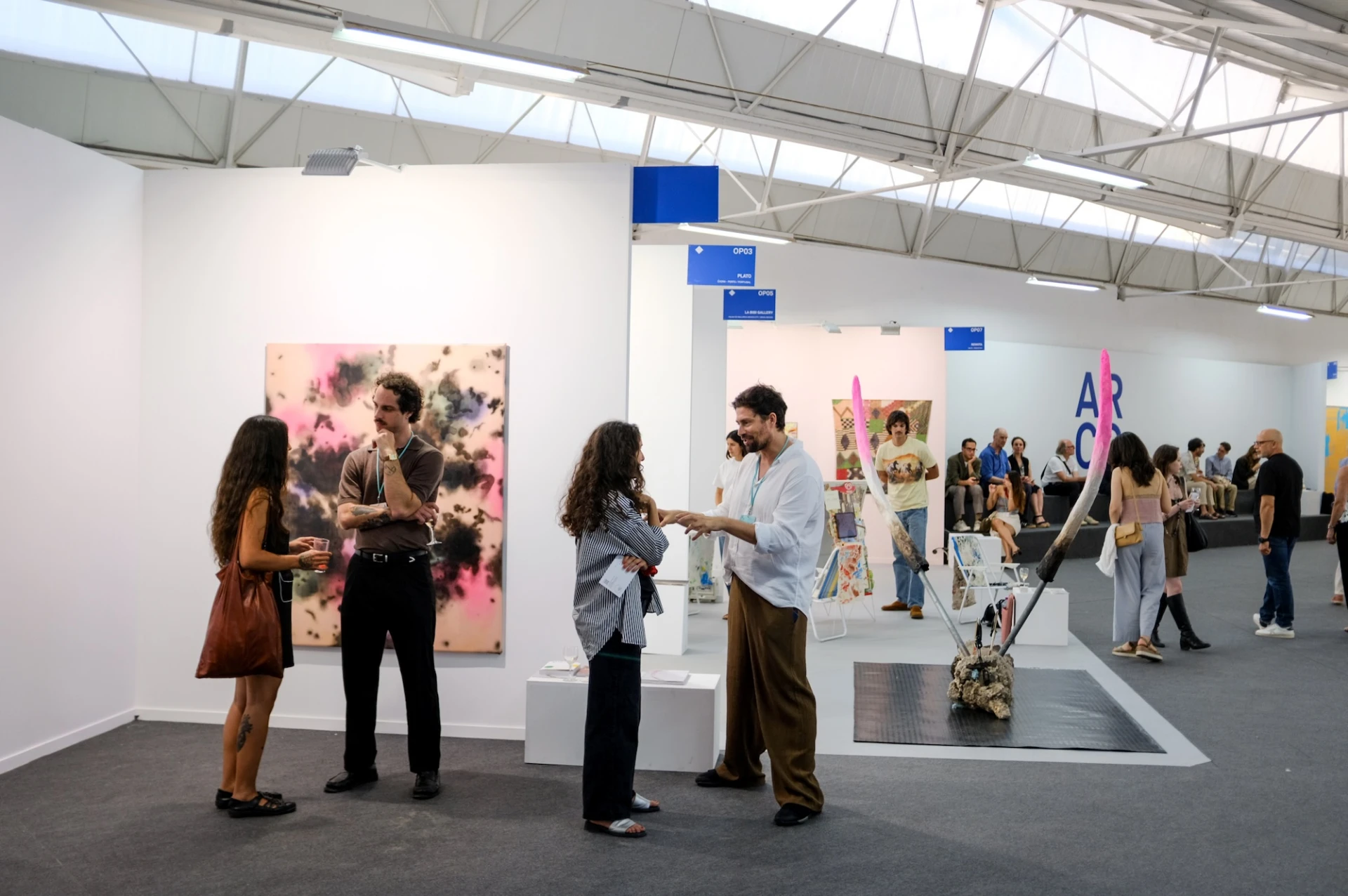
“And movement. It was perhaps the most vivid aspect I felt during my visit to ARCOmadrid: not only the artworks themselves, but also the interactions between people, events, the rhythm of the space, everything was in motion with a gentle, calming flow. Although the first two days, reserved for professionals, were calm, a subtle pulse ran beneath the surface.”
In the early 1960s, Umberto Eco introduced the idea of the “Open Work” (Opera Aperta). I like this concept because it gives a theoretical dimension to the uncertainty I encounter when entering a contemporary art fair. Rather than confining the viewer to a closed form or a single predetermined message, it invites the viewer to participate in the creation of meaning.
And movement. It was perhaps the most vivid aspect I felt during my visit to ARCOmadrid: not only the artworks themselves, but also the interactions between people, events, the rhythm of the space, everything was in motion with a gentle, calming flow. Although the first two days, reserved for professionals, were calm, a subtle pulse ran beneath the surface.
The spatial design of the 2026 edition was realized by architect Pedro Pitarch. He conceived the fair as a “temporary metropolis” using the materials of commercial fair architecture itself. This idea of a temporary city captures the nature of contemporary art fairs: a structure that exists only for a few days, generating a dense flow of galleries, collectors, artists, and visitors.
This was my second visit to ARCOmadrid. Experiencing the fair’s 45th edition allowed me to sense its historical continuity and approach it more consciously visitor. Each edition feels like a layer added on top of the previous ones. In this way, ARCOmadrid becomes an archive of the aesthetic climate of its time.
This year, 211 galleries from 30 countries came together at the fair. This is in addition to the already consolidated International Buyers’ Programme and the Special Guests’ Programme, which attract some 400 collectors and 200 professionals from around 40 countries to Madrid.
The works of approximately 1,300 artists were exhibited at the fair, and, notably, a report by MAV (Mujeres en las Artes Visuales) highlighted that the proportion of women artists rose to 40% this year.
This year, I felt more drawn to the numerical world that underlies the art world. As a devoted art lover and a passionate writer, I became curious about the prices of certain works, and, I must admit, perhaps I should have kept dreaming instead of knowing the prices…
Large-scale art fairs like ARCOmadrid go beyond mental and visual fatigue, and this year, I approached them with a different method to truly experience them. I first noted down the artists I knew and the works I particularly wanted to see, visiting the stands of these familiar pieces. Then I allowed myself to enter complete uncertainty, fully surrendering to the surprising impact of works I was encountering for the first time, which was most of them. This brings a sense of novelty that breaks the rigid structures of our minds. Watching the ideas we hold with certainty dissolve. Art is most fascinating when it disrupts the safe inner architecture we construct within ourselves.
The backbone of the program is the General Program, featuring 175 galleries, while ARCOmadrid accompanies the fair with three curated sections to uphold artistic diversity both in form and content.
One of these sections, ARCO2045: The future, for now, consists of 17 galleries and was curated by José Luis Blondet and Magalí Arriola.
ARCO2045: The future, for now was presented as one of the fair’s central themes, unfolding across two separate spaces within the venue. Here, we are invited to contemplate possible futures and the still-unsettled, experimental languages of art, imagining new horizons.
Among the galleries were Commonwealth and Council (with Patricia Fernández), David Nolan Gallery and Marc Selwyn Fine Arts (with Rodolfo Abularach), François Ghebaly (with Candice Lin), and Pace Gallery (with Paulina Olowska).
Patricia Fernández’s wandering drawings on the wood-textured floor, accompanied by the whispers of materials rooted in historical narratives, were both delicate and captivating.
Also participating were Capitain Petzel (with Barbara Bloom), Carlier | Gebauer (with Nicole Miller), CarrerasMugica (with June Crespo), Mor Charpentier (with Sylvie Selig), and Proyectos Ultravioleta (with Akira Ikezoe). These galleries were also part of the fair’s General Program.
In the Opening. New Galleries section for emerging galleries, curated by Rafael Barber Cortell and Anissa Touati, a large feminist installation created collaboratively by the Slovenian artists Nevena Aleksovski and Maja Babič Košir stood out. Composed of wallpapers, documents, and images, this work was presented by Ravnikar Projects gallery in Ljubljana.
In the same area, the delicate paintings and collages of Tamar Nadiradze also drew attention. In these works, young female figures appear as if lost within uneasy dreams. The artist is represented by the Tbilisi-based 4710 Gallery, and her pieces are priced in the low thousands of euros.
Finally, we move to the Profiles | Latin American Art section. Latin American Art holds significance as it highlights ARCOmadrid’s historical connection with the Latin American art scene. The fair continues to be one of the key meeting points for Latin American art in Europe. Curated by José Esparza Chong Cuy, the focus here is on presenting one artist per gallery, bringing together eleven artists in total. Among them were Gabriel Branco (with Galatea), Harold Mendez (with Patron and Commonwealth and Council), Paloma Contreras (with Pequod Co.), and Julia Gallo (with Yehudi-Hollander Pappi).
Harold Mendez’s works act like a sharp incision in the mind: they pause you, unsettle you, and leave you questioning your sense of certainty. They highlight the uncanny aspects of life, and I found them deeply affecting.
ArtsLibris was once again present at ARCOmadrid, bringing together over 90 publishers, bookshops, and cultural agents from 20 countries, with several book presentations taking place at the ArtsLibris Speaker’s Corner. I don’t even need to say how much I enjoyed this section. The intersection of publishing and contemporary art was so vivid. Umbigo Magazine launched its Borders edition, and we witnessed the intense interest it drew. Ralph Waldo Emerson’s words came to mind: “In art, the hand can never produce more than the heart can imagine.” In the eyes of the people gathered in front of the stand, I could truly see how they were presenting their work with honesty and as a reflection of a good heart.
Acquisitions
The Ministry of Culture and the Museo Nacional Centro de Arte Reina Sofía strengthened their collections by acquiring new works from ARCOmadrid 2026. For this edition, the Ministry invested €402,760 to purchase 17 works by 14 artists: Annette Messager, Claudia Andujar, La Ribot, Ester Chacón, Pere Noguera, Oriol Vilanova, Kapwani Kiwanga, Venuca Evanán, Ángel Bados, Amparo de la Sota, Joan Gelabert, Ana Laura Aláez, María Alcaide, and Roberto Jacoby.
Meanwhile, the Madrid Autonomous Region awarded the ARCO 2026 Prize to the artists Los Bravú, Federico Miró, and LUCE. The selected works are: En la grieta brilla el deseo (2025) from El Apartamento gallery; Sin título (2026), a painted intervention on a screen from F2 Galería; and Toldo Cruces Almería (2024) from 1Mira Madrid gallery.
All these works will become part of the collection at the Museo Centro de Arte Dos de Mayo in Móstoles.
The Madrid City Council acquired four works at the fair for over €71,100, which will join the collection of the Museo de Arte Contemporáneo (MAC) in Madrid. Among the purchased works are Ritmo del mundo (1984) by Madrid-born artist Patricia Gadea and the sculpture Hemos traído al mundo a todo el mundo. Other acquisitions include Elena Blasco’s Y jamás mejor dicho (2002), Catalan artist Oriol Vilanova’s installation Old Master (Cézanne) (2017), and Madrid-based Daniel Canogar’s installation Wayward (2022).
Awards
At this year’s ARCOmadrid, Proyectos Ultravioleta Gallery received the Lexus Award for Best Stand and Artistic Content.
The XXI NEWARTaward@ARCO, organized in collaboration with the Arts Connection Foundation, was awarded to Julia Scher for her work Avi Loeb, represented by Esther Schipper Gallery, and to Jonas Englert for Movement, presented by Anita Beckers Gallery.
Meanwhile, Valladolid-born artist Esther Gatón received the 10th Cervezas Alhambra de Arte Emerging Artist Award for her project Lazos y Calles.
June Crespo, from Ehrhardt Florez Gallery, was honored with the first edition of the Catapulta Acquisition Award, organized in collaboration with the National Gallery of Canada.
The Profiles | Latin American Art Award went to Commonwealth and Council + Patron galleries.
The 2nd Juana de Aizpuru Award was presented to Elvira González Gallery in recognition of its historic legacy and longstanding commitment to the fair.
Gallery directors Elvira and Isabel Mignoni commented: “We are deeply honored to receive this award on behalf of our gallery and the profession of gallery-keeping. ARCO feels like a home to us; it is the best platform we have both nationally and internationally. Receiving this award further strengthens our connection to this fair in our city.”
Continuing with notable works, Portuguese artist Dalila Gonçalves won the 9th Catalina d’Anglade Award with her piece Compasso, presented by Mais Silva Gallery. Gonçalves’ practice often revolves around measurement, balance, and spatial references. The title Compasso evokes both a geometric instrument and a rhythmic measure. In this sense, the work invites us to consider space not only as a physical realm but also as a conceptual coordinate system.
Seville-born artist Luis Gordillo, regarded as one of the most influential figures in Spanish painting over the past half-century, won the 3rd ENATE–ARCOmadrid 2026 Award with his work S/T (Untitled) (2010), presented by Prats Nogueras Blanchard Gallery.
The jury emphasized Gordillo’s status as one of the most important figures in Spanish painting over the past fifty years. His works construct a heterogeneous structure through variations, overlaps, and shifts in record, revealing nuances that might go unnoticed at first glance. The relationships between fragments, colors, and rhythms create a visual field open to exploration rather than a single, fixed image. According to the jury, approaching Gordillo’s paintings is like a wine tasting where the layers gradually reveal themselves: after the initial impression, the small decisions that hold the work together become visible.
Cristina Lucas received the Pilar Forcada ART Situacions Prize for her work D.A.N.C.E. (Dynamic Algorithm, Neural Creative Evolution) 3, presented through Albarrán Bourdais Gallery. Her work operates through algorithmic processes that remind us that image-making no longer belongs solely to the human hand. Here, the artist expands the boundaries of the creative process, exploring the relationship between artificial intelligence and visual production.
Additionally, the 2nd Young Talent Award was given to Julia Padilla, represented by Linse Gallery, and Venuca Evanán from Enhorabuena Espacio Gallery.
French collector Alexandra Alquier particularly praised the following artists: Nikita Kadan at Poggi Gallery (Ukraine); Diego Bianchi at Jocelyn Wolff; Marina de Caro’s 1998 textile and performance works at Ruth Benzacar Gallery; and Catalina Swinburn at Aninat Gallery, Santiago (Chile).
Supported by IFEMA MADRID, Fundación ARCO presented this year’s “A” Collection Awards, honoring four collections: Juan Antonio Pérez Simón – ‘A’ Helga de Alvear Award; Laurent Dumas – ‘A’ International Collection Award; Gabriel Calparsoro – ‘A’ National Private Collection Award; and MACBA Studio – ‘A’ Young Collector Award.
Among the most notable works were pieces by Jean-Michel Alberola, Erik Dietman, Fabrice Hyber, Annette Messager, and Jean-Pierre Pincemin, alongside artists who shaped the first decades of the new century in France such as Adel Abdessemed, Dove Allouche, Nina Childress, Hélène Delprat, Damien Deroubaix, Bruno Perramant, Georges Tony Stoll, and Claire Tabouret. The collection also includes international artists based in France, including Barthélémy Toguo, Ulla von Brandenburg, and Thomas Hirschhorn.
A few days before I arrived in Madrid, I rushed to see Thomas Hirschhorn’s POP-UP-MARILYN show at Lisbon’s Gare do Oriente (thanks to a dear friend who made sure I wouldn’t miss it). I truly think he is a genius! During this Madrid trip, I also had the chance to see his Art Center 6 work (Blow Down) at the Reina Sofía Museum. I am always struck by the heavy philosophical manifestos he writes for his installations, built on cardboard with such a delicate fragility that every moment seems ready to collapse or fall apart.
So, here we are, at the last day… ARCOmadrid closed its doors on the afternoon of March 8, drawing 95,000 visitors and generating an estimated €195 million for Madrid. Organized by IFEMA Madrid, the fair showed strong results both in attendance and commercial activity. Yet, what remains from the fair is more than numbers.
Since our mind is a kind of machine, a story too is a kind of machine; a strategy that must be constructed. Just as Umberto Eco’s fascination with machines reaches its peak in Foucault’s Pendulum -seeing them not as things that truly function, but as models of mental processes, almost like fairy-tale characters- I also perceive artworks as living beings. And I love swinging back and forth within the mechanisms of art fairs, like a pendulum.
BIOGRAPHY
Ayşenur Tanrıverdi is an Istanbul-based writer, living in Lisbon since September 2022. She studied at Istanbul University and is the author of two published works of literary fiction. A regular contributor to Cumhuriyet, a major Turkish newspaper, where she focuses on Portuguese culture. Her essays and critical texts on theatre, literature, and contemporary art have also been featured in various art magazines.
ADVERTISING
Previous
article

16 Mar 2026
Espaço Intermédio, by Cristina Ataíde
By Tomás Saraiva
Next
article
19 Mar 2026
A Oferta, by Jaime Welsh
By José Pardal Pina
Related Posts
article
18 JUN 2026
Olho de Vidro, by Pedro Barassi: The Gravity of the Gaze
By Ayşenur Tanrıverdi
article
15 JUN 2026
Notes on ARCO Lisboa 2026
By Ayşenur Tanrıverdi
article

08 JUN 2026
Língua Turva: The Aesthetic Unconscious
By Ayşenur Tanrıverdi
article
02 JUN 2026
On Wandering Among Beings: "Entre Seres" by Susanne Themlitz
By Ayşenur Tanrıverdi