article
Realismo Ilhéu: Marcelino Santos at the Museu do Neo-Realismo
“The work of Marcelino Santos, now on display in Realismo Ilhéu, an exhibition at the Museum of Neo-Realism, bears witness to a balance between these two worlds and modes of making. Santos’s work transcends the dichotomy and places craftsmanship on the highest plane of art. The question naturally arises: Is it art? Is it craftsmanship? It is art, in the noblest sense of what craftsmanship can be.”
In Plato’s Protagoras, the hero tells the story of Epimetheus, the mythological figure who, when creating human beings, forgot to provide them with natural defenses, as he had done for the animals. It is at this point that his brother, Prometheus, decides to steal from the workshop of Hephaestus (the god of craftsmen) and give humanity the secrets and skills of the mechanical arts, in an attempt to remedy Epimetheus’s mistake.
The mechanical arts, or the craftsman model, thus consisted of practical skills and technical knowledge that, through their specific functions, met the needs of society.
Craftsmanship (the mechanical arts), during this period, encompassed functional and practical knowledge. It operated within the sphere of specialization, grounded in skills mastered by a select few, in contrast to other forms of knowledge more concerned with virtue and values, which were debated within society, as evidenced by the dialogue between the sophist Protagoras and the philosopher Plato in Protagoras.
In the “knowledge of Prometheus,” or in craftsmanship, the craftsman employed techne with the aim of fulfilling or achieving a particular end. Plato rejected the artist because the artist could only reproduce the appearance of the object, creating a copy of a copy, and was incapable of producing the real object, the object in itself. For Plato, the craftsman was thus a useful agent in society, whereas the painter was an illusionist who, according to the philosopher, encouraged disorientation, lack of control, chaos, deceptive appearances, and the distancing of human beings from the truth.
Aristotle, in his work Poetics, introduced a more elevated role for art, assigning a “function” to painters. For this philosopher, painted images of nature provided opportunities, and time, to observe, analyze, and reflect on what we were seeing: its universal properties, its narratives, its truths, and its catharses.
The separation between craftsmanship and art reached its peak during the Renaissance, when artists began to claim their place within the realms of science and rational thought. The line separating art from craftsmanship finally began to blur somewhat in the twentieth and twenty-first centuries. The activist and artist William Morris, along with the masters of the multidisciplinary Bauhaus school, contributed to this erosion of the divide between popular culture and high culture.
Today, this distinction appears increasingly tenuous and imperceptible. More and more artists, attuned to postcolonial perspectives, emphasize the urgent need for artistic expression that contributes to dismantling social barriers, visible forms of intolerance, and ethno- and Eurocentric prejudices. Closer to living art and removed from the regulatory institutions of museums and the rigid conventions of Western art history, the beautiful art produced by African communities demonstrates how use can be skillfully harmonized with beauty and tradition. It is in this art, outside both time and the Western framework, that the division—the dichotomy—between art and craftsmanship becomes less apparent. Following Duchamp’s expansion of the definition of art1, and Gropius’s assertion that the utilitarian nature of objects made by craftspeople does not preclude their aesthetic value, such divisions no longer seem to make sense2.
The work of Marcelino Santos, now on display in Realismo Ilhéu, an exhibition at the Museum of Neo-Realism, bears witness to a balance between these two worlds and modes of making. Santos’s work transcends the dichotomy and places craftsmanship on the highest plane of art. The question naturally arises: Is it art? Is it craftsmanship? It is art, in the noblest sense of what craftsmanship can be.
Athena, goddess of crafts and the manual arts—dressed in soft, draped garments woven by her own hand—must be happy, high atop Mount Olympus, to see the art of weaving so highly esteemed here on Earth.
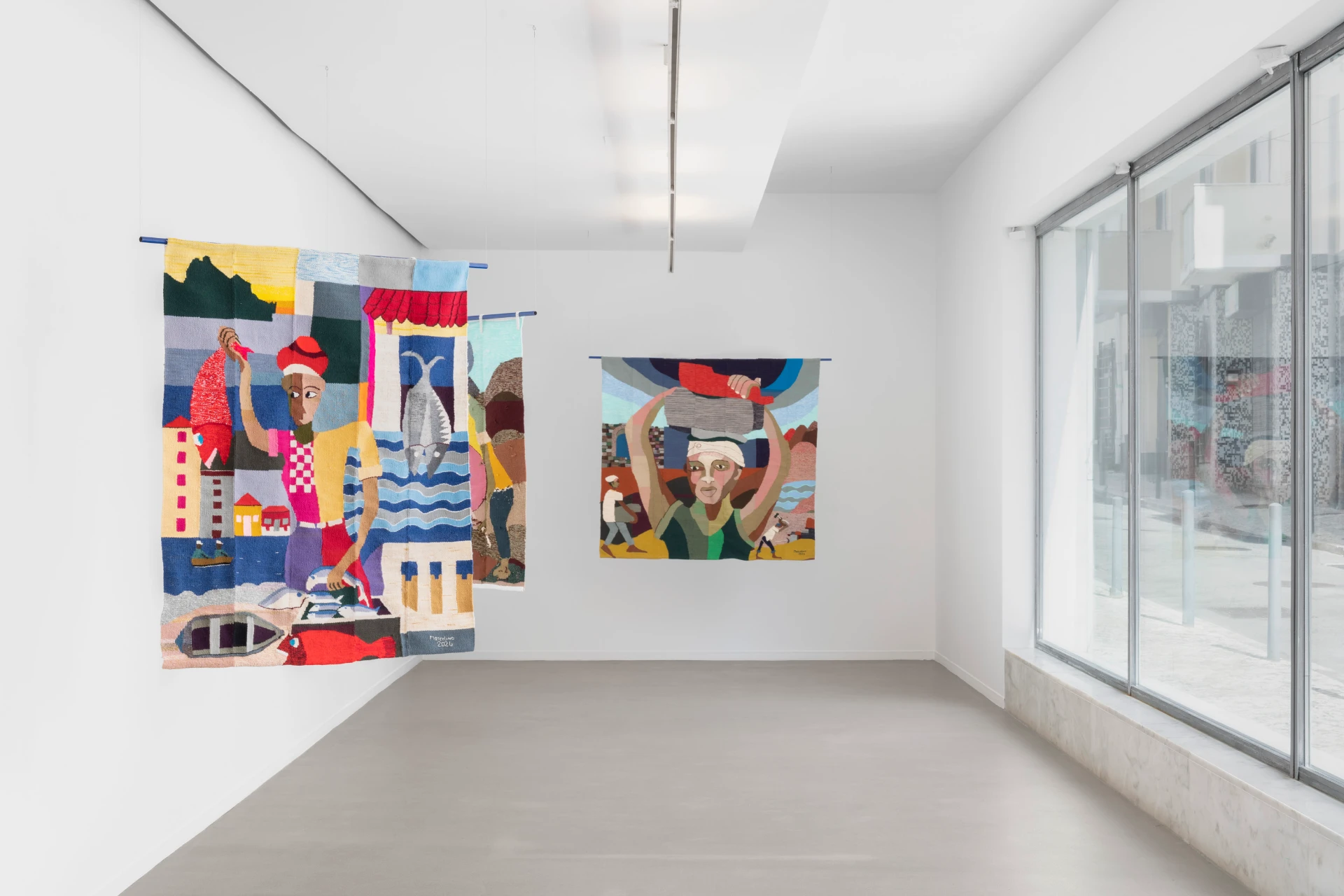
Marcelino Santos (1957), in an exhibition curated by Carlos Noronha Feio and Ricardo Barbosa Vicente, presents us, at the Neo-Realism Museum in Vila Franca de Xira, with an extraordinary collection of wool weaving works, mostly created by the artist in 2026 (with the exception of Homem do Atum, created in 2017, and Boa Vista, from 1982).
The work featured in the exhibition comprises tapestries, drawings, and paintings on cardboard, revealing the artist’s commitment to popular art, craftsmanship, and the traditional island culture of Cape Verde. Santos was an integral member of the legendary Cooperativa Resistência, founded in São Vicente in 1976, which was dedicated to defining a truly Cape Verdean cultural identity.
The tapestry works brought together in the exhibition reveal pure and vibrant colors, with tonalities that evoke Robert Delaunay, and suggest the thousands of gestures made by the artist as he intertwined the threads to create the compositions presented in the exhibition. They revolve around themes of men working the land, others fishing at sea, and women cleaning fish, accompanied by geometric patterns and fishing villages, street celebrations with drums, and carnival masks.
According to Carlos Noronha Feio and Ricardo Barbosa Vicente, Marcelino Santos’s images begin with direct observation of everyday life and take shape through drawing, thread, color, and composition, transforming scenes from daily life into representations imbued with memory and identity. For the same authors, Santos’s works embody precisely the dissolution of boundaries between art and craftsmanship, (…) without rigid hierarchies, (…) in which drawing, tapestry, and manual labor belong to a single artistic practice, a form of craftsmanship deeply rooted in Cape Verdean material culture.
Curated by Carlos Noronha Feio and Ricardo Barbosa Vicente, the exhibition is the result of a partnership between the Museum of Neo-Realism and CNAD, between Portugal and Cape Verde, and can be visited until October 11, 2026.
1 RODRIGUES, W. Arte ou artesanato? Artes sem preconceitos em um mundo globalizado. In: Cultura Visual, n. 18, dezembro/2012, Salvador: EDUFBA, p. 85-95
2 Ibidem
BIOGRAPHY
Carla Carbone was born in Lisbon, 1971. She studied Drawing in Ar.co and Design of Equipment at the Faculty of Fine Arts in Lisbon. Completed his Masters in Visual Arts Teaching. She writes about Design since 1999, first in the newspaper O Independente, then in editions like Anuário de Design, arq.a magazine, DIF, Parq. She also participates in editions such as FRAME, Diário Digital, Wrongwrong, and in the collection of Portuguese designers, edited by the newspaper Público. She collaborated with illustrations for Fanzine Flanzine and Gerador magazine.
ADVERTISING
Previous
agenda
22 Sep 2026
Cycle of conversations ‘FLAD Collection: The Dialogues’
By Umbigo
Related Posts
article
23 SEP 2026
Realismo Ilhéu: Marcelino Santos at the Museu do Neo-Realismo
By Carla Carbone
article
10 AUG 2026
Second Cycle of Exhibitions at the Arpad Szenes – Vieira da Silva Foundation
By Carla Carbone
article
06 AUG 2026
Autocolante. Iconografia da Liberdade, at MUDE
By Carla Carbone
article
09 MAY 2026
Mesa-Paisagem (1973), by Ana Vieira, at Brotéria
By Carla Carbone