article
Mixed media on paper #12: Masks unintended to mask
"There it was, hanging on a wall, the square blue-toned mask painting on virgin linen canvas. Accessible only to a few, revealed only to select individuals. But there it was, framed by walls lined with virgin silk, that very canvas of raw linen with its elegant colour splashes. Bright and luminous, its full presence is immediately apparent even with the glass separating us. This one never had to wear a mask. It is beautiful and harmonious, and that is all that is needed."
There is a painting residing at the Calouste Gulbenkian Foundation. It´s not on its own, let’s face it – it’s Gulbenkian we are talking about. But I was already fond of this particular one even before I knew where it was located. Upon finally seeing it in person, I discovered it had been placed not in public view, but in a separate area, on a more intimate wall. Finding paintings we like is a sort of pastime for artists. Making a special trip to a certain place to see something only known from publications, renewing our fascination with the masters we revere. Finding pieces of art beyond our wildest imagination or fresh names that become part of a mental lexicon. Experiencing everything first-hand with the boundless enthusiasm of someone who has discovered a new approach to something but has yet to figure out how to do it.
About two years ago, I went for it and gave myself a go at new artistic techniques with materials which I’d never used before. I was certain it was doable, despite my obvious respect for the unfamiliar. Having never painted on canvas before, I decided to become a student again. I reached out to my first-year Drawing lecturer at Lisbon's Faculty of Fine Arts and asked him if we could discuss a few queries I had about paints and surfaces for some new pieces I was planning to create. He told me to come along at the end of one of his lectures. It felt like a journey back in time. The room was now different, larger, brighter and more impressive. I took a seat at the very end of the lecturer’s desk and looked on as he gave feedback on the work of his real students. When he finished, he took the time to discuss matters with me, right there and then. The system had changed. Back when I was a student, the lecturer would start each class by bringing in a different art book to present a new technique that we had to try out during those sessions. Now, more efficiently, he had a computer and would open web pages to display different artists and techniques. I was reminded that time does indeed pass.
By the time my turn came, the students were already packing away their work. I opened a portfolio packed with experiments and said: “It should be this, but on canvas. And I don't even know if it’s possible.” I studied Sculpture; the Drawing subject was a cross-disciplinary element across my academic path. Throughout my entire time as a student, I always considered drawing to be the cornerstone of any artistic process I set out to undertake. The idea of engaging in a discipline that was not my own, namely Painting and its canvases, was only conceivable to me if there was someone to explain how to do it. And so it was. I must confess that my respect for painting had been renewed. So many ways to make it work...! Still, what I really wanted to do, I still have yet to achieve. But I found the nerve to paint on canvas after that guidance.
This brought me to the painting I spotted on a Gulbenkian wall. In order to explain the idea of using a blank canvas with spots of colour, the teacher cited the paintings of Jorge Martins as an example. He showed me on the computer the works he was referring to, from the 1980s. I had never seen them before. The fact that we are often unaware of artists we are supposed to know is quite telling. In Portugal, there is so much art that I did not even imagine existed.
One of the most interesting things was realising, from the teacher's explanation, the way Jorge Martins uses bold colours and well-defined shapes on a blank linen canvas. The colours almost seem to float across the whole surface. But how? The answer comes in the form of masking techniques. To put it more artistically, masking is a way of establishing the boundaries of the area to be worked on, in this case the chromatic perimeter. It seems quite simple: just put some adhesive tape over the area you want to paint, let it dry, remove the tape, and it's done. That would indeed be the case, were it not for the fact that canvas is a porous material, meaning that every intentionally applied spot of colour must first undergo the layer preparation process with acrylic plaster, which normally involves the entire canvas. I found this to be one of the most fascinating insights I have received in recent times. Just to think that the preparation of a canvas requires so much forethought. To know in advance exactly where we want to position the colour splashes. It renewed my admiration for painting and for the surgical precision of many of my fellow painters and friends. I have not had this training. I have not yet been able to throw myself into this mission of masks. The mask fell on me.
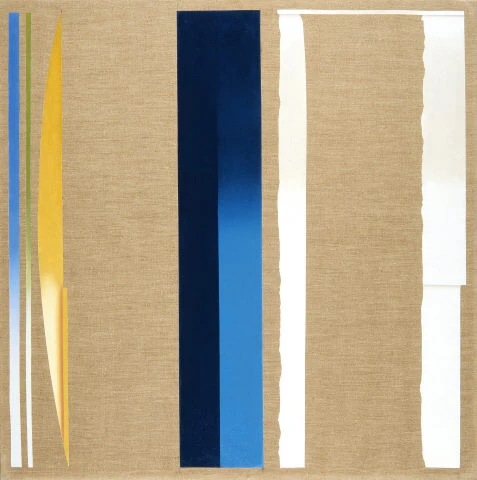
This painting by Jorge Martins was first shown to me on a computer screen and immediately captivated my imagination. It is titled Untitled and dates from 1983. Jorge Martins (1940–) is an artist with a long and diverse career. He began it in the 1960s and, over six decades of creative output, explored all the different pictorial languages, from abstract rigour to figurative painting. The 1970s, however, were pivotal in the emergence of raw canvas and the contrast with coloured surfaces in his work - a technique the artist describes as ‘the technique of isolated forms on virgin canvas’1.
This is the case with Untitled - a square-format work, 135 x 136 cm, made mostly of linen canvas, featuring that lovely texture in sand-coloured threads. It is an oil painting, slender and straightforward. Several elongated coloured forms rise from the textile background and, because they are vertically oriented, seem to counteract the square effect of the canvas as a whole. The colour is handled with much care. There is a blue gradient at the centre, offset by a similarly wide line of dark blue. On the right-hand side are some painted white bars reminiscent of torn typewriter paper, almost like applied cut-outs. The other side, providing an unexpected contrast, consists of a curved line in yellow tones, and two further very fine lines, also fading from green and blue towards white. The composition is so perfectly balanced, and so effective. These lines fill the entire neutral canvas. But they seem like pathways, detours and abstract reveries. They could be streaks of light.
After that return to the university, I went looking for more of Jorge Martins’ paintings, like the one I had first seen on a computer screen. These 1980s series are not widely available for public viewing. This serves as my public plea. I would also like to acknowledge publicly that I have recently seen two exhibitions of his paintings: one in Évora, at Fundação Eugénio de Almeida, and more recently at the Cordoaria Nacional in Lisbon. However, what I really wanted to look at were these colourful mask paintings.
One day, while on a study visit to the Calouste Gulbenkian Foundation’s headquarters, I stopped by the staff canteen on the top floor. As I was walking round the outside terrace, I stumbled upon the dining room designated for the Foundation’s President and his guests. Given that visitors cannot enter, I peered through the outer glass pane. And I could hardly believe my eyes. There it was, hanging on a wall, the square blue-toned mask painting on virgin linen canvas. Accessible only to a few, revealed only to select individuals. But there it was, framed by walls lined with virgin silk, that very canvas of raw linen with its elegant colour splashes. Bright and luminous, its full presence is immediately apparent even with the glass separating us. This one never had to wear a mask. It is beautiful and harmonious, and that is all that is needed.
1 Excerpt from a notebook by the artist Jorge Martins: “When I started using the isolated forms technique on a blank canvas in the 1970s and 1980s, could I have been unconsciously bringing discontinuity and quantifiability into space? And non-locality.” The notebook is displayed in Jorge Martins’ solo exhibition, entitled Timescape, on show at the Torreão Nascente of the Cordoaria Nacional until August 30, 2026.
BIOGRAPHY
Luísa Salvador (Lisbon, 1988) is a visual artist and researcher. She has a PhD in Contemporary Art History from NOVA FCSH, having been awarded a scholarship from FCT - Foundation for Science and Technology (2015-2019). She has an MA in Contemporary Art History from NOVA FCSH (2012) and a degree in Sculpture from FBAUL (2009). In parallel with this activity, she develops her artistic practice. She has been exhibiting regularly since 2012. She won the Young Creators Award 2018 in the Visual Arts category. Alongside her artistic practice, she also writes, including theoretical texts and chronicles. In 2018 she founded the quarterly publication "Almanaque - Reportório de Arte e Esoterismo", of which she is the editor. She lives and works in Lisbon.
ADVERTISING
Previous
article
25 Aug 2026
Foreign Monuments: Grada Kilomba at Fundação Albuquerque
By Tomás Camillis
Next
article
26 Aug 2026
Museu das Expectativas, by Pedro Gomes: What is a museum?
By Ana Isabel Soares
Related Posts
article
25 AUG 2026
Mixed media on paper #12: Masks unintended to mask
By Luísa Salvador
article

01 JUL 2026
Mixed media on paper #11: The summer of crossword puzzles
By Luísa Salvador
column
07 JUL 2025
Mixed media on paper #10 - The strawberries of the saison
By Luísa Salvador
article
15 APR 2025
Mixed media on paper #9: The silence of the bee and Morandi
By Luísa Salvador