article
TERRACRONIA - Masterclass with Federico Campagna in Montemor-o-Novo
"In the Terracronia context – an event whose very name evokes a movement that is, in fact, deeply aligned with what we are experiencing today – namely, the geological and cosmic shifts, collective and individual, physical and virtual – the Italian philosopher’s presentations form a sort of score for this - Vagar - that Évora, as the Capital of Culture, offers the country and the continent: a slower pace, listening to the rhythms of the earth, in contact with the community, weaving this sophisticated tapestry between the past and the future, between the contemporary and the traditional, between philosophy and the material construction of the world."
Cronia, from the Greek Kronos, is the suffix that conveys the idea of time. Synchrony: at the same time; diachrony: evolution over time. It is also the suffix in Terracronia, or “the time of the earth,” a project carried out by the Associação Oficinas do Convento, curated by João Rolaça, for Montemor-o-Novo. The city is part of the Évora district, the European Capital of Culture for 2027. Terra Cronia takes place under a larger event - VAGAR - which names the programming that will take place in Alentejo from 2026 to 2027.
It was around the concept of VAGAR that Évora’s cultural program structured its project in the Alentejo region. Grounded in three thematic strands – Time, Space, and Matter – the program bridges art and science, the local and the global, sowing seeds for the region’s future. In this sense, it engages with the unique character of the Alentejo region, its cities, and communities, while also reflecting and evoking the project’s cosmopolitan nature.
Throughout May, June, and July 2026, Terracronia has been hosting a series of events and activities that aim to integrate material and metaphysical practices into the city’s landscape. The project features guest artists and lectures centered on the themes of the Montado Forest – a hallmark of the region – the Earth and its Production and Poetry processes; the Encounter of Generations and Traditional Knowledge in relation to contemporary art; and the Imaginaries necessary to build a world.
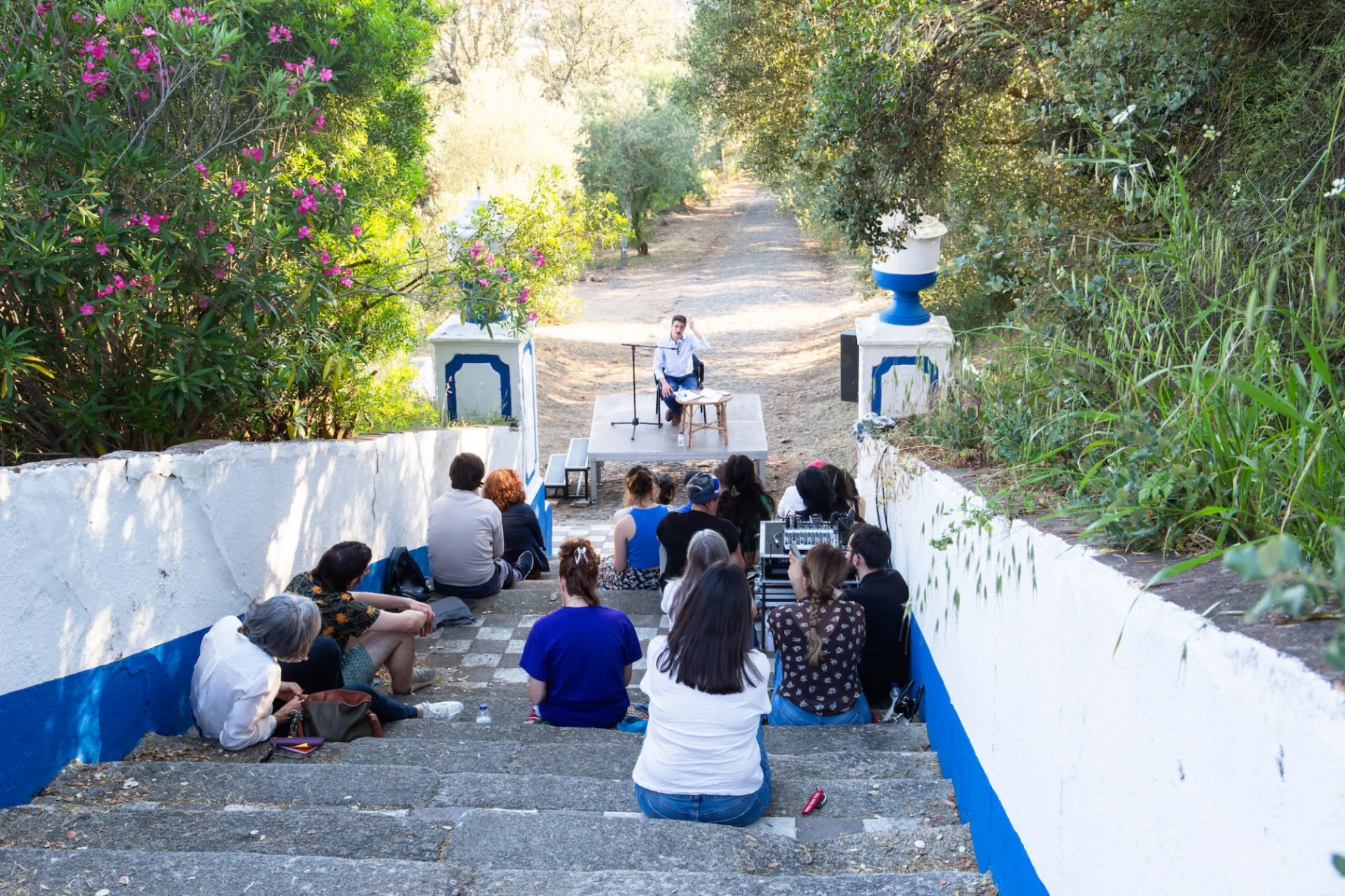
Regarding the latter topic, from May 20 to 23, three meetings were held with Italian philosopher Federico Campagna to discuss his upcoming book How to Build a World. At various locations throughout the city of Montemor-o-Novo – the Convent of São Francisco, the Municipal Library, and the Chapel of Nossa Senhora da Visitação – the philosopher presented the main ideas of his new book, which conceives of the world not as a static symbolic reality, but as something that can be built and rebuilt.
**
Federico Campagna is an Italian philosopher living in London, author of Otherworlds: Mediterranean Lessons on Escaping History (Bloomsbury, 2025), Prophetic Culture: Recreation for Adolescents (Bloomsbury, 2021), Technic and Magic: The Reconstruction of Reality (Bloomsbury, 2018), and The Last Night (Zero Books, 2013). Federico Campagna straddles the worlds of philosophy and art; he can be described as a philosopher who reflects on the conditions of possibility, the impacts, and the consequences of “creating worlds” based on history, the lessons of metaphysics, and his engagement with the art world.
In Mediterranean Lessons On Escaping History, the philosopher brings together a significant collection of stories from the imaginaries of the Mediterranean region – from Greek mythology to the legends of Alexander the Great – in order to highlight the “creative” character that marks major historical narratives, as well as the relationship between creative metaphysics and the materiality of the great events and transformative cycles in the region’s history. The philosopher begins with the embryonic idea that every great change and every great loss imply the need to rethink our reality.
From there, Federico Campagna presented the main metaphysical principles for establishing the foundations of the Real through the metaphor of the architectural construction of a house. From the infinite and oceanic expanse of infinite perceptions, the philosopher delineated, according to his theory, how the Real of the Real takes shape: what constitutes the foundations of what we believe and how they are formed; how its pillars are forged; how its floors are built; whether or not we should open doors and windows; and what is the best roof to bring fresh air into our own reality.
**
Aldous Huxley, in The Doors of Perception, takes up an ancient insight by William Blake, found in The Marriage of Heaven and Hell: “If the doors of perception were opened, everything would appear to man as it is: infinite. Human beings have shut themselves off within themselves, to the point that they now see all things through the narrow slits of their cave.”
It is precisely from this dizzying infinity, which characterizes the Real, that Federico Campagna begins his exploration: faced with the vertigo of seeing and experiencing the world in accordance with the eternity that marks every object and every life – we create worlds.
When looking at a simple object like a barrel, the philosopher argues, we are faced with much more than a barrel: we are faced with a metaphysical object. The tree from which it is made, and that before being a tree was something else entirely; the labor that produced it, and the history of those hands; the earth in which the tree grew; the history of that earth. Everything that exists, in metaphysics, is a fragment of eternity. Federico draws on this eternity to argue that world-building is both a collective and an individual necessity. To cope with this dizzying eternity, we slice it up and carve it out.
Creating worlds is, therefore, fundamental to existence. The philosopher moves from anthropology to philosophy to demonstrate the vast capacity of different societies to create symbols, myths, monsters, gods, fantasies, truths, sacred and profane objects, and ways of categorizing, imagining, and justifying the events of the world.
This plurality of the real is fundamental to the philosopher, who emphasizes the need to maintain a certain elegance in relation to the whole truth: we know it is true, but we also cannot be swallowed up by the truth. We must leave a crack open for the Real beyond the Real: knowing that our reality is a reality, and not all of reality, is one of the fundamental aspects of the construction of reality. Allowing the roof to breathe, allowing ourselves to have doubts, encountering other worlds – this is a fundamental part of the world.
In this primary need to hold fast to a Real, we observe, with humility, that there is a plurality of worlds. That rather than a single Real, we are faced with a plurality of Realities, forged collectively and individually through culture as ways of binding subjects and communities to themselves, of anchoring their feet to the ground so they do not fly off into the infinite abyss of existence.
**
Methodologically, the philosopher uses the metaphor of the house to guide the construction of a world. He aims to guide the audience on a philosophical journey, which is the symbolic construction of the world. The philosopher will open the door to ontology, metaphysics, and the construction of concepts, weaving them into his idea that philosophy can be a way to build a house that protects us from the vertigo of reality – much like someone playing a video game in an excessively lush landscape.
The essential foundations that precede a world's construction are: the space where we will build this world and the function of this world. A world that has no function may be a world that does not need to be created at all. Because, for the philosopher, when creating a world, the most important thing is to take into account the consequences of that world. A world must be judged by its consequences, not by its truth, says the philosopher. In this sense, the inner-outer space in which the construction of the world takes place – the threshold space of the imagination – must be accompanied by a question that is both practical and ethical: what is the purpose of a world?
A world can be modern European ideology, greek mythology. A world can refer to the foundations of Islam, as well as to Yanomami mythology. More than that, it can also refer to our own individual world: that which guides our daily actions, our choices, our fundamental beliefs.
The point is that a world always has a reason for being. As the philosopher himself points out in his book Mediterranean Lessons, the experience of immigration is, for example, an emblematic moment of losing one’s world. It is an entry into a liminal space, a space between worlds. Migration is an experience that confronts us with a kind of nihilism, since what we believed to be fundamental to our individuality and our collective identity can become trivial in another context.
And the particular grief of this experience is a symbolic loss, but also a potential gain. Many current issues involve this loss and, consequently, the possibility of new encounters: the encounter between cultures, the clash between worlds, coexistence with difference, the change in physical and mental landscapes – all of this points to our capacity and need, over time and throughout history, to recreate our foundational mythologies.
A world, in this sense, provides us with shelter, but it also grants us stability in the world. Its function must encompass a certain degree of flexibility, coexistence, and abstraction. But more than that, the first thing – and this is the lesson we can draw from nihilism – is to recognize that worlds are fictions.
This knowledge will allow us to properly gauge the consequences of our world, so that we are not swallowed up by the very truth we embody. There is a measure of fundamental autonomy in relation to the world, a certain elegance that stems from a sense of distance.
However, Federico also highlights two fundamental aspects in the construction of this world which – to borrow a bit of neoliberal jargon – shed light on important practical questions: who is the client? In other words, who pays for the construction of the world? Who has the power to “world”? When we are faced with a desire or a dream, we must always be certain that it is not someone else’s dream. Or, from a more materialistic perspective: we must always be certain that we are not constructing the world of the one who is paying for its construction.
In this sense, it is important to accurately assess the power and capacity to create worlds: is it a large corporation, the power of the community, or the state? Everything must be properly evaluated so that we can create worlds and identify who the “stakeholders” are. For Federico, “stakeholders” are those “affected” by our world – or, in short, those who are involved in it. When properly considered, they are part of the assessment of the consequences of our world. Given neoliberal jargon, I wonder if the book might not help shape futuristic public policies.
**
The book, which is also still a work in progress, wanders between pragmatism and a “new creative normativity,” drawing on the intersection of nihilism and metaphysics. Given Federico’s artistic context and his relationship with world-building in video games, this approach ultimately opens up an interesting avenue into philosophy as a creative field, as well as into the contemporary need to rethink our fundamental mythologies.
In the Terracronia context – an event whose very name evokes a movement that is, in fact, deeply aligned with what we are experiencing today – namely, the geological and cosmic shifts, collective and individual, physical and virtual – the Italian philosopher’s presentations form a sort of score for this - Vagar - that Évora, as the Capital of Culture, offers the country and the continent: a slower pace, listening to the rhythms of the earth, in contact with the community, weaving this sophisticated tapestry between the past and the future, between the contemporary and the traditional, between philosophy and the material construction of the world.
Terracronia is an event organized by Oficinas do Convento – Cultural Association for Art and Communication, with artistic direction and curation by João Rolaça. It takes place from June 20 to July 8 at various venues in Monte-mor-o-novo. Upcoming events are on July 6 at 6:00 p.m., featuring Teresa Pinto Correia and Ana Fonseca, and on July 8 at 6:30 p.m., featuring Teresa Pinto Correia and Céu Salgueiro; both events focus on the Montado Forest.
BIOGRAPHY
Mariana Varela (b. 1991) is a poet and sociologist. She has published "Enigmas de Jaguar e Jasmim" (2019) and "Rotativa" (2022), both edited by Urutau. She edited the mini literary magazine "Frente!" and currently edits the literary magazine "Letra Lenta". A graduate of the University of São Paulo, with a master's degree in sociology from Universidade Nova de Lisboa, she is currently pursuing a PhD in philosophy at the same institution. She writes articles on the intersection of aesthetics and philosophy.
ADVERTISING
Previous
article
23 Jun 2026
Intervalos – WhiteBox #1, at Museu do Caramulo
By Inês Ferreira-Norman
Next
agenda
24 Jun 2026
Applications open for the EDP Foundation New Artists Award 2026/27 until July 15
By Umbigo
Related Posts
article
03 AUG 2026
Rosa Barba. Drawing Vocabularies, at CAM - Gulbenkian
By Mariana Varela
article
23 JUN 2026
TERRACRONIA - Masterclass with Federico Campagna in Montemor-o-Novo
By Mariana Varela
article
25 FEB 2026
Color and gesture - a primordial noise of the world: Fernando Mello Brum at 3+1 Arte Contemporânea
By Mariana Varela