article
The Broken Lyre - Ascensão: Vers la Lumière, no Museu Arpad Szenes - Vieira da Silva
"Seeking to position itself between a classical poet and (above all) a modern painter, in a constantly evolving exhibition in five acts that begins with O Tecido do Mundo and now concludes with Ascensão: Vers la Lumiére, I believe I find in the exhibition 331 Amoreiras em Metamorfose a desire to understand the current artistic landscape in relation to the historical cycles of our culture, especially in the general events that resonate with the lives of the couple Vieira da Silva and Arpad Szenes, the main artists of the museum that promotes the exhibition."
When Orpheus' music resounded through Tartarus, the hero not only convinced Hades and Persephone to allow him to rescue Eurydice, his wife—Ovid writes that also "Tantalus did not seek to grasp the elusive water, Ixion's wheel stopped in astonishment, the birds ceased pecking at the liver, the Belides did not tend to the vessels, and even you, Sisyphus, sat upon the boulder." If eternal torment is reserved for those who attempt to overcome the harmony of the cosmos, only Orpheus' impeccable lyre can restore these lost souls to the order that binds all things together. But what would be the true nature of this union? An objective fraternity, imposed on each thing by the very structure of the cosmos, or rather a silent alliance between all beings and experienced by each one, never quantified or even understood? When Orpheus plays his lyre, does he access the external melody that harmonizes everything, or does he touch a latent impulse of belonging in the intimate fiber of each thing? Perhaps we are like Alpheus and Arethusa, water in the water of the world, so mixed that we are incapable of witnessing anything objective—and Orpheus would be unique because he would extract, from both waters, the common substance.
Orpheus was also the messiah of the religious mysteries that took root in the rural areas of ancient Greece, contrasting the structured clarity of classical mythology with an enigmatic drama that influenced the philosophy of Plato, whose transcendental doctrine was key to the development of Christianity. Our sense of reality oscillates between the Greco-Roman cosmic clarity and the incarnate Christian mystery, between the impeccable structure of the Greek temple and the elusive splendor of Byzantine mosaics, between natural objectivity and subjective experience. The Greeks did not believe in transcendence: their gods are immanent to the phenomena of nature. But the Christian falls in love with this spectral plane that slips past the flesh but does not belong to it, in the glorious solitude of an invisible god. Like Christ, Orpheus is reborn, but instead of transcending to the beyond, he descends to the underworld, without therefore leaving immanence.
Therefore, it seems inconceivable to me to think of a tradition of abstract Greek art. For modern abstraction to have emerged, it was necessary for secular modernity to abandon religious doctrines, but for our spiritual attitude to still retain this impulse towards a beyond that transcends the forms of nature (even the classic Mondrian is abstract only because he manages to contemplate a rupture between psyche and world, in this existential solitude so foreign to the Greeks). Disbelieving in the Bible but inclined towards spirituality, the Romantics isolated themselves from modern society to seek in nature the absolute previously found in the church, concretizing in semi-abstract works the lost unity between humanity and the universe. In his Monk by the Sea, Caspar Friedrich David exposes the epiphany of a devotee who abandons the monastery to find the divine on the horizon. Even later, Turner disrupts forms and obliterates details, Kandinsky expresses himself in gestures and colors, and even Malevich replaced the Orthodox icon with the black square. Through art they sought a modern transcendence not entirely different from that which Vieira da Silva also dreamed of at the end of his life.
Seeking to position itself between a classical poet and (above all) a modern painter, in a constantly evolving exhibition in five acts that begins with O Tecido do Mundo and now concludes with Ascensão: Vers la Lumiére, I believe I find in the exhibition 331 Amoreiras em Metamorfose a desire to understand the current artistic landscape in relation to the historical cycles of our culture, especially in the general events that resonate with the lives of the couple Vieira da Silva and Arpad Szenes, the main artists of the museum that promotes the exhibition. Its penultimate act, Notas Sobre as Melodias das Coisas, explored not only the hidden harmony shared between all things but also the condition of the artist who aims to articulate schemes of understanding but stumbles upon the fragmentary speed of their own experience. In this sense, the turbulent spirituality that Vieira da Silva felt after Arpad's death—a period highlighted by this final act of the exhibition—is also the anguish of the modern subject immersed in a world deaf to the melody of Orpheus (which opens the exhibition with a passage from Ovid), divorced from the structures of mystical or religious meaning that used to mediate our relationship with the universe. How can this individual, who intuits the other shore but finds only broken bridges, express himself?
From the outset, an ascending vector is signaled—the first work, Atelier, Lisbonne by Sara & André, is the metamorphosis of a painting by Vieira da Silva into an installation that liberates its vectors from the pictorial environment to inhabit empty space. And wouldn't overcoming circumstances be precisely one of the meanings of transcendence? Climbing the stairs, we find an equally ascending triad of paintings by Vieira da Silva: first, the trajectory of Orpheus in an anguished vertex fleeing the underworld; then, the stars as symbols of a still interpretable transcendence; and finally, the pure surpassing of all silhouette or symbolism—the beyond itself. This Platonic staircase is explored throughout the exhibition. We ascend and descend through works that develop their own relationships with abstract form and, often, with the content of transcendence. Like certain symbolic figurations of astral elements and signs of the zodiac that not only occupy the canvas in a logic of vertices and geometries similar to abstract graphic art, but which in their symbolism also transcend the particular through the simple graphic design of a universal image. One can even relate them to the Painéis para a Sacristia da Capela do Palácio de Santos, a sacred series where Vieira da Silva develops liturgical iconographies in an abstract vocabulary—in some of them, he paints knots of space, or beams of light crystallized in penetrating needles, in a war between the ethereal and the material that expands like a cry to target the world. This struggle against the divine to force its revelation, finally experiencing the beyond, is the despair of the modern who still peers through the dimensional rift, as when Jacob grasped Gabriel in the endless night painted by so many artists, including Vieira da Silva. It is interesting to relate its tortuous rays to Van Eyck's solar lines, who geometrized such luminous astrality with a mathematical precision perhaps closer to the circular radiance present in the works Epsilon Indi Bb, by Rui Toscano, Essência, by Carolina Vieira, or Manteiga, by Fernando Marques Penteado. To work with light is to construct theologies—one can understand the divine as the gentle repose of the golden beam or as the torment of fire, which swallows the world to levitate it in smoke.
In Evaporação IV, Ilda David's circular gestures reminded me of Dilúvio, a drawing where Da Vinci studied both the anatomy of the elements and the fall of curly hair, in a search for the underlying structure of appearances, also undertaken by Vieira da Silva, whose link between meticulous architectures and lyrical outbursts articulates the human experience in exploring the patterns that compose reality. After Arpad's death, her fragments and conjunctions become more ethereal and luminous, without, however, reaching the serene clarity of a whispered epiphany—perhaps Arpad, who even when painting abstractly was like an ode to nature, encouraged her towards concreteness, in life and in art. Having gone, his absence became the anguished thirst for transcendence that marks Vieira da Silva's late work, bringing her closer to the belief in an incomprehensible beyond—like an Orpheus with a broken lyre. His vortices, rippled by grids and exploded geometries, and brittle patterns and incomplete emergences, are reinforced here by the names of the exhibition rooms: L’interrogation, L’infini turbu-lent, Le Départ — titles of his works.
Would the absolute always be paradoxical? Hegel dreamed of a constantly expanding human spirit, a metamorphosis of assimilations that accepted temporary monstrosity to later achieve perfection. His dialectic situates our becoming in history, seeing in Romanticism the ultimate act of art, since its form could no longer accommodate our spirit, then supported by more elastic disciplines, such as philosophy. Mondrian used abstraction to reconcile modern plasticity with classical status, restoring to art this perfect balance between spirit and artistic form that Hegel saw in the Greeks. More Ovidian, Vieira da Silva rejects such an Orphic balance, finding the core of our experience precisely in a prismatic vertigo that embraces everything, without reducing anything, shining like an irreconcilable monster, because it is better to structure the complexity of the world than to simplify its exuberance. Encountering the world is also about feeling the existential anguish of the human being who, even if they don't find their core, doesn't cease their search either.
Reflective Addendum.
In a prominent passage in the exhibition space, Françoise Frontisi-Ducroux writes that weaving is the main means of transmitting Greek cultural heritage. Indeed, the rhythm inaugurated by the act of weaving establishes a rigorous harmony suitable for narrating myths, which are presented to us in the tapestry that stitches together the entire cosmos. For it is not enough to simply educate; it is necessary to do so in the correct cadence—the metrical structure of the verse aligns itself with both the rhythm of the lyre and the compass of the loom, inserting history into the natural impulse and seducing the student into cosmic communion. Modern art has a different conception of rhythm. Its poetry allows the abandonment of meter in favor of free verse. Instead of closed melodies and dominant keys, Schoenberg's atonal music approaches dissonance. The literature of the last century lists the subjective experiences of the character without dedicating itself so much to the cohesion of the overall structure, as Aristotle advised. But versatility is not chaos—being categorical in freedom is the core of modern artistic practice. There is no such thing as free verse, declared T.S. Eliot, who also did not worship metrics, but questioned their rigidity with refined fluency. The lack of formulas is not a permission, but the responsibility of learning to articulate the still undefined, making the superfluous vital. In this sense, there is modernity in Ovid's magnum opus, the book that is itself the principal metamorphosis, as if the world were unveiling to us its stream of consciousness that creates and recreates all things, from the beginning to the present, in these dizzying changes of characters, times, and places. As Apollo pursued Daphne, we too try to capture the mental silhouette of this narrative which, like the maiden turned tree in the instant of touch, insists on escaping us. This vortex of stories is perhaps one of the most enduring examples of the fleeting nature of our experience.
Ascensão: Vers la Lumière is the fifth and final chapter of the exhibition 331 Amoreiras in Metamorphosis, curated by Nuno Faria and on display at the Arpad Szenes - Vieira da Silva Museum until January 18.
BIOGRAPHY
Tomas Camillis is an author and researcher based in Lisbon, working on fiction and on essays in the interplay between art, philosophy and literature. He has a master's degree in Art Theory by PUC-RJ. In recent years he has participated in researches, taught courses in cultural institutes, helped organize conferences and published in specialized magazines. He currently collaborates with the MAC/CCB Educational Service and Umbigo magazine.
ADVERTISING
Previous
article
07 Jan 2026
A Morte Escreve a Floresta, by Nuno Henrique
By Débora Valeixo Rana
Next
article

08 Jan 2026
Ar.Co – Bolseiros & Finalistas’24, at Torreão Nascente da Cordoaria Nacional
By Maria Inês Augusto
Related Posts
article
25 AUG 2026
Foreign Monuments: Grada Kilomba at Fundação Albuquerque
By Tomás Camillis
article
18 AUG 2026
The distant work: Ana Vieira at Galeria Vera Cortês
By Tomás Camillis
article
30 JUL 2026
Excess and Silence
By Tomás Camillis
article
08 JUL 2026
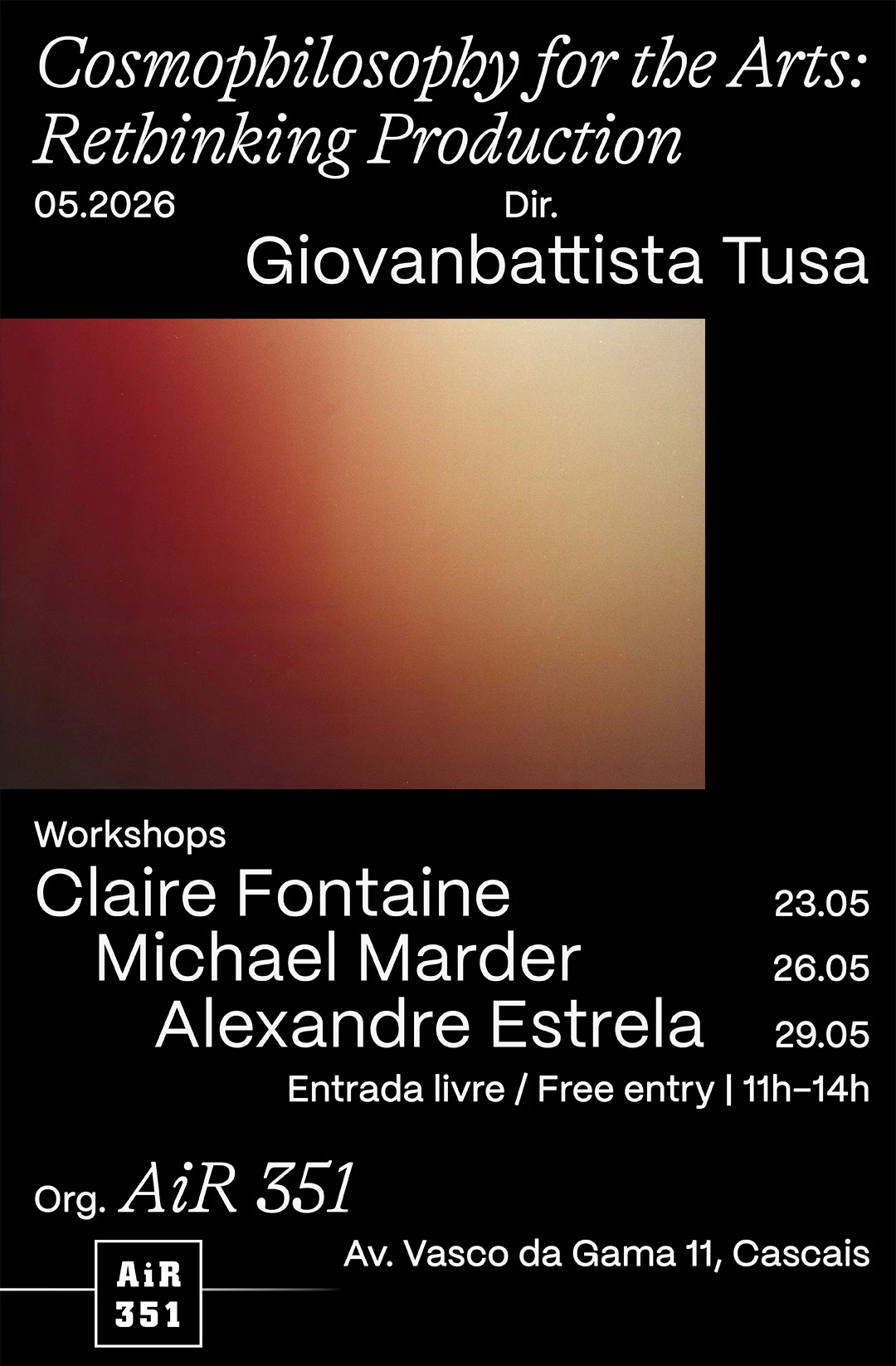
TOWARDS TERRA INCOGNITA: Interview with Giovanbattista Tusa
By Tomás Camillis