article
A Morte Escreve a Floresta, by Nuno Henrique
“If in Carneiro the forest is experienced as presence and continuity, here it appears as a fragmentary archive of a wounded world, where nature can no longer be inhabited immediately, only touched and rewritten. A Morte Escreve a Floresta exposes what death makes visible: friction surfaces, textures torn from the trunk, tiny shells that survive as fossils of a fragile ecosystem.”
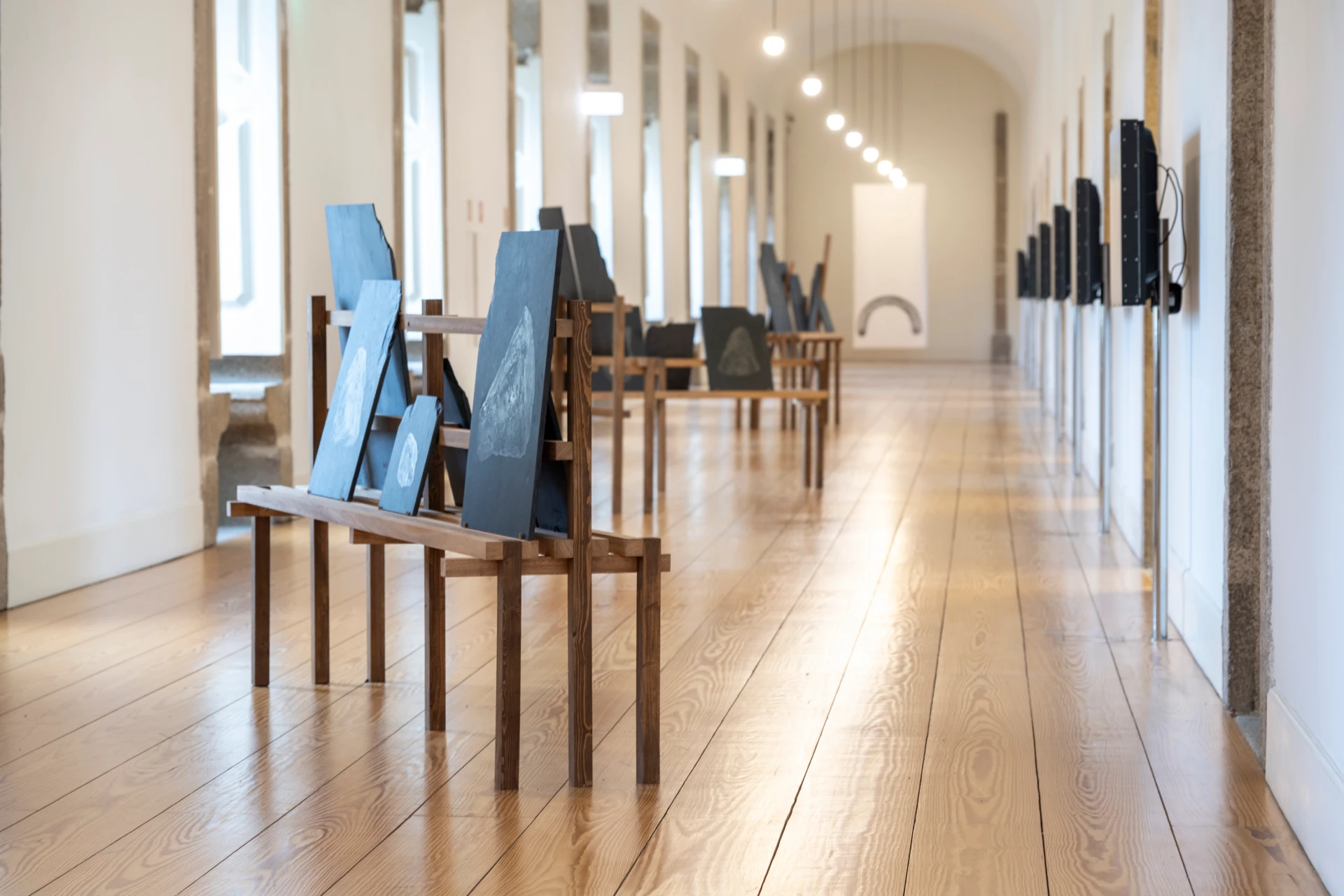
Alberto Carneiro's work taught us to think of the tree as a body and the forest as a process of passage where the subject inscribes itself through communion, a place where the landscape ceases to be distant and becomes a sensitive and situated experience, constructed from direct contact with natural matter. In the silkscreen Harmonia na Floresta (2011), this relationship manifests itself through a duplication of the point of view: in one image, the forest is presented according to a recognisable orientation, organised by the verticality of the trunks; in another, the same image appears inverted, as if the gaze had been shifted into the plant structure itself and absorbed by it. This inversion is not merely formal. It introduces instability into the observer's position, suggesting that seeing the forest implies accepting being seen by it too, and that neither party offers itself as a stable whole.
It is from this legacy that Nuno Henrique builds his proposal. But instead of extending the poetic identification with the life cycle of nature, he enters through a side door, still nearby: he works on the interruption of this cycle. If in Carneiro the forest is experienced as presence and continuity, here it appears as a fragmentary archive of a wounded world, where nature can no longer be inhabited immediately, only touched and rewritten. A Morte Escreve a Floresta exposes what death makes visible: friction surfaces, textures torn from the trunk, tiny shells that survive as fossils of a fragile ecosystem. Nuno Henrique's gesture becomes clear: there is no pretence of restoring a lost harmony, but rather an attempt to critically re-inscribe it, showing what remains when continuity is broken.
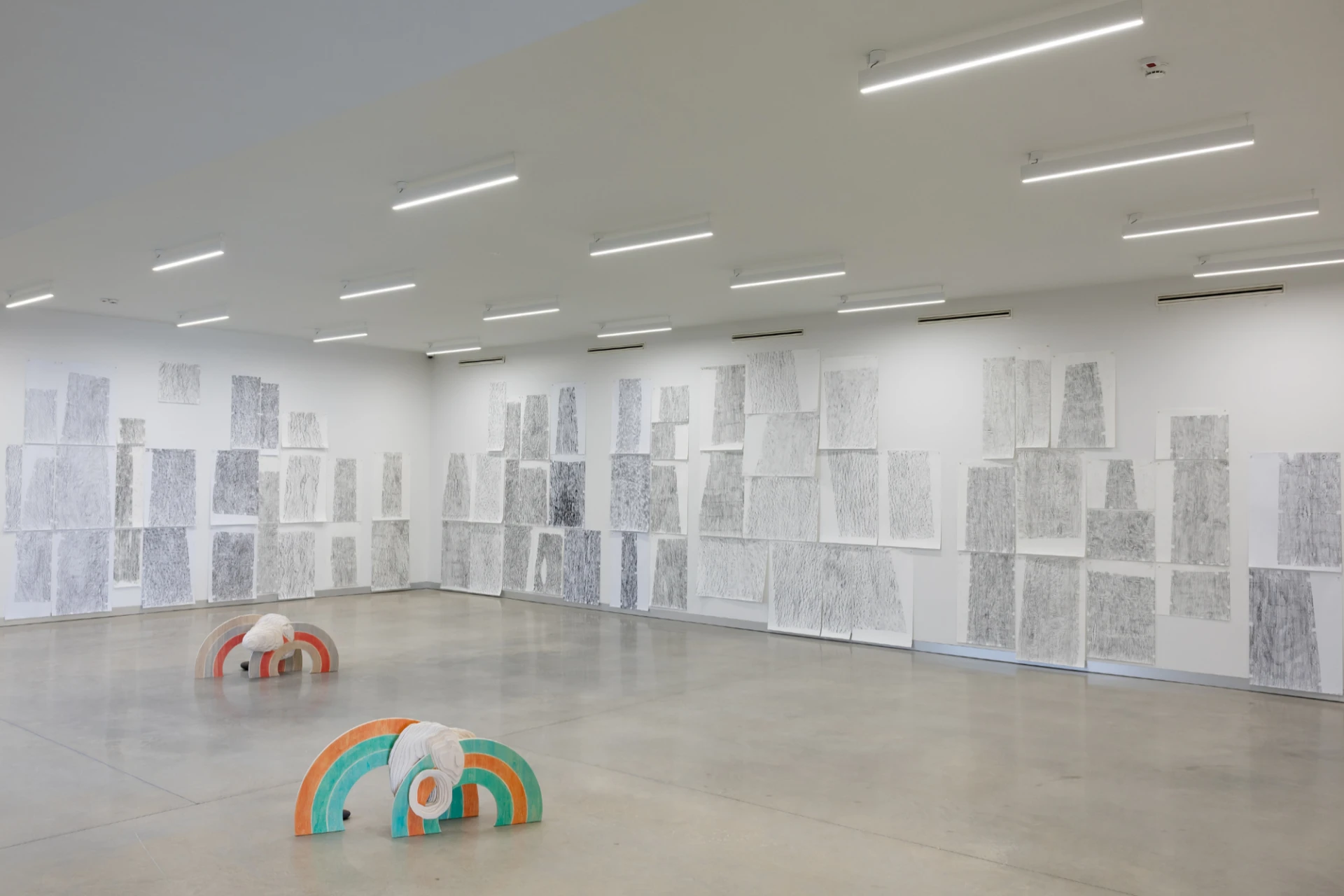
The central installation of the exhibition, composed of 85 frottages made from tree trunks, graphite and oil pastel on paper, is organised as a visual field without hierarchies. Each element functions as an autonomous unit and, simultaneously, as part of a broader system of relationships. There is no attempt to represent the tree, but rather to record its surface, what remains when the tree is no longer present. The trace we see is neither expressive nor illustrative; it is proof of physical contact between body and matter. By moving away from expressive logic and approaching an almost indexical regime, Nuno Henrique presents us with a forest that survives as an archive of marks. The forest is drawn by the accumulation of traces, in a slow and non-linear time, where different layers of a fragile ecology coexist. The shells that affix the frottages, integrated into the exhibition, materialise this logic: the inscription of a temporality that resists.
The sculpture Nuvem, double-rainbow, ilha, presented in two pieces, deepens these questions. Constructed from plywood, screws, dowels, wax, pigments and beach pebbles, the work combines industrial processes with collected natural elements. Its shape refers to the shell of the Wollastonia turricula snail, a species endemic to the Porto Santo archipelago. The shell is translated into repeated sections, cut and stacked, exposing the internal logic of its construction. The chromatic arcs that cross the sculptures cease to operate as an optical phenomenon and become a solid structure, a constructive element that fixes in matter what is, by definition, ephemeral. Placed directly on the floor and away from the walls, the two sculptures occupy the centre of the exhibition space without imposing themselves as monumental objects, establishing instead a relationship of physical proximity. The small pebble placed nearby acts as a counterpoint: an unaltered natural fragment that, by contrast, emphasises the degree of intervention exercised on the other materials.
In the light of Heidegger, this set of works can be read as a reflection on finitude. The rubbed tree and the worn materials make visible the condition of a being traversed by its own possibility of end. But the exhibition does not dwell on the observation of loss. On the contrary, it is precisely under the horizon of death that the creative gesture asserts itself. Here Arendt resonates: creating is a constitutive condition of being human, the way in which we establish some durability in a transitory world. It is in this gesture that Nuno Henrique reinscribes an ethic of ecological art inherited from Alberto Caeiro: he takes the tree and transforms it into a work that persists in the erosion of time.
A Morte Escreve a Floresta, by Nuno Henrique, is on display at the Alberto Carneiro Art Centre in Santo Tirso until 25 January.
BIOGRAPHY
Débora Valeixo Rana (b. 1990, Lisbon, Portugal) is a philosophy teacher living in Porto. She graduated in Philosophy from the Faculty of Letters of the University of Porto (2011) and has a Master's degree in Teaching Philosophy in Secondary Education (2019). Her academic and professional career reflects a deep interest in the intersection between Art and Philosophy, a dialogue that led her, in 2022, to take up a master's degree in Artistic Studies and Art Criticism at the Faculty of Fine Arts of the University of Porto.
ADVERTISING
Previous
article
06 Jan 2026
Selva Oscura, by Tito Mouraz, at 3+1 Arte Contemporânea
By Maria Brás Ferreira
Next
article
07 Jan 2026
The Broken Lyre - Ascensão: Vers la Lumière, no Museu Arpad Szenes - Vieira da Silva
By Tomás Camillis
Related Posts
article
17 SEP 2026
It´s a pink area, by Marc Kokopeli and Sydneys Schrader
By Débora Valeixo Rana
article
01 APR 2026
Meteorizações, by Filipa César
By Débora Valeixo Rana
article
06 FEB 2026
Traslados, by Marcelo Moscheta
By Débora Valeixo Rana
article
07 JAN 2026
A Morte Escreve a Floresta, by Nuno Henrique
By Débora Valeixo Rana