article
The landscape in Rodamoinho: Marina Rheingantz at the ICA in Milan
Rodamoinho (Vortex), Marina Rheingantz’s exhibition at the ICA – Institute of Contemporary Art in Milan, is a device for looking beyond painting, intertwining various memories and geographies.
Inside the brutalist ICA building, on the outskirts of Milan, remnants of stories that seem to blend can be found; they came from the interior of Brazil to the gray of Europe's vastest and most polluted plain, uniting landscapes: this is Rodamoinho by Marina Rheingantz (Araraquara, São Paulo, 1983 - represented by the Fortes d'Aloia e Gabriel gallery), her first solo exhibition in Italy.
Landscape research was the first trigger in the artist's career: “I started painting in 2005, when I was still studying art. My favorite painter was Iberê Camargo, and, at the time, I started saving rolls of paper to make compositions and paint later. From these, landscapes began to appear. I drew on my memories of Araraquara, where I grew up, where there are sugarcane plantations and a vast perspective,” Marina explains, adding that over time her own painting has undergone many small changes.
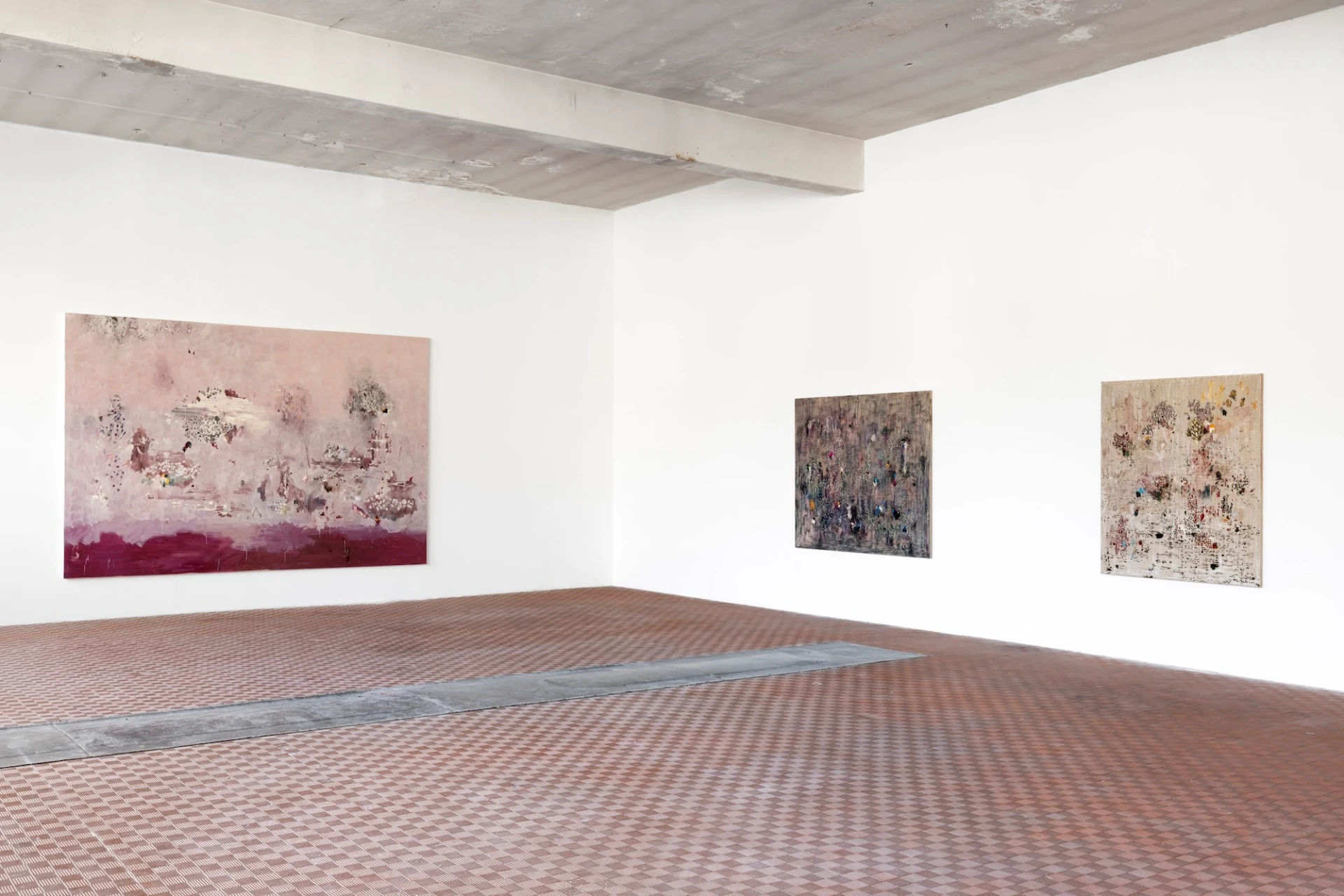
In fact, in the ICA's ground floor gallery, something changes in our perception as we approach the screens - not everything is oil, in fact, not everything that is color is a painting: anticipating what is to come soon after, in the following rooms, here is a tapestry whose stains are embroidered with needle strokes, areas of nuance coming from the paintings.
It was in 2015, during a residency in London, that Marina discovered Moroccan tapestry and began to use it as a reference: “At the time, I really liked the idea of symbolic landscapes, reduced, graphic landscapes with symbols: that's why I started using tapestry texture in painting. At first, they were two separate things: vertical paintings related to this, and more landscape in the horizontal ones. However, over time, they came together, and from that point on, many things unfolded, to this day. But I never stopped painting landscapes; things come and go, they mix. I like the relationship between the paintings and the textile work.”
Leaving the exhibition's first area, we notice that the color of the floor tiles, which have survived time and Milanese gentrification—an old industrial shade between brown and red—is reflected in the tones of Marina's paintings. As we climb the main staircase of the ICA, the surprise, more than on the corner, awaits us on the walls of four small rooms: the tapestries, this time, take on an environmental format, occupying the entire spaces, ideally exchanging their own identity with the paintings, which, in turn, maintain a more intimate dimension, although the entire production seems to live in dialogue with the architecture.
“I didn't visit the ICA before the exhibition, so I didn't know these details. But it was a nice surprise, because even the jacquards looked like a continuation of the staircase wall, and so did the floor of the smaller rooms. While installing the fabrics, I thought just that: this floor could become a pattern for a jacquard, or even a painting,” says the artist, who goes on to tell us how the stitching came from an idea by her mother, who wanted to make an embroidery based on a painting. “It’s a very slow process. But embroidery always comes from a painting, or some detail of a painting. I think the biggest challenge is understanding the meaning to give to it. And understanding how it comes back to painting: it's a path I'm still understanding, it's recent research.”
Marina Rheingantz's painting—whether on fabric, thread, or paint—always retains a broad, vibrant, and simultaneously diluted dimension: patches of earth and sky, revealing her passion for the works of Richard Diebenkorn (1922-1993), especially the 1972 series Ocean Park. Dilutions that also refer to the watercolor technique, which Marina says helps her a lot in the process, although each painting has a very individual path, different starting points that become backgrounds, disappear, become traces and ghosts.
“I find it hard to describe my painting process; it's a mixture of many things, but in the end, I always think it has to do with the excitement of paint. I used to play in the mud a lot when I was a child, and I often feel that painting is a way of returning to that messiness and freedom of childhood, where you don't control anything,” reveals the artist, whose works always have titles that refer to an image of nature, a material, a condition: Maritaca, Sugito, Honey... or Rodamoinho itself. A process that comes from notes, lists of words, places, poems, or suggestions from friends who help her choose. Always when the work is finished: “I really like this process because it comes from an outside perspective, which sees the painting differently, opening up other meanings.”
Curated by Alberto Salvadori, the exhibition is open until March 7.
ADVERTISING
Previous
article
04 Feb 2026
Visions of Transit and Apocalypse in Klaipėda - Klaipeda Biennale of Contemporary Art
By Alexander Burenkov
Next
agenda

04 Feb 2026
Applications open for “O Banquete” until March 1
By Umbigo
Related Posts
article
18 MAY 2026
God and the Devil in the Land of the Biennial
By Matteo Bergamini
article
-6qspq.jpg)
07 APR 2026
RedSkyFalls, Portugal at the Venice Biennale: An Interview with Alexandre Estrela
By Matteo Bergamini
article
12 FEB 2026
Stories of shadows and worlds: Francisco Tropa in Bologna
By Matteo Bergamini
article
04 FEB 2026
The landscape in Rodamoinho: Marina Rheingantz at the ICA in Milan
By Matteo Bergamini