article
Stories of shadows and worlds: Francisco Tropa in Bologna
As Part of the Art City program, a side event of the Italian city's art fair, Miss America marks Tropa's first solo exhibition in Italy, following Portugal's representation at the 2011 Venice Biennale
An exhibition in black and white: perhaps this chromatic example could faithfully define Miss America by Francisco Tropa (Lisbon, 1974), the site-specific project for the Palazzo de' Toschi in Bologna (Italy), opened contemporaneously with the Arte Fiera week.
Two major works - Miss America and Lantern with clock mechanism, both from 2025 – live under an enigmatic title, while light plays its leading role in the composition of this landscape of time, whose ancestors are found both in the history of art and in the streets of Italy and Portugal.
Miss America is, in fact, a very loaded title: a riddle about the word Miss, which can also be interpreted as Missing. So, there are these two sides; the idea of a beauty pageant interested me because aesthetics always influences art. On the other hand, 'Missing America' speaks to what is happening today: the lack we feel of a glorious, even democratic, idea, questioning what brings us nostalgia," explains the artist, regarding the discrepancy between this "modern" title and the "old" soul of the works.
The two emerge as opposites and complementary: Lantern with clock mechanism lives in total darkness while Miss Americainhabits pure light.
"I let myself be inspired by this complicated space, uniting a reflection on temporality and encompassing the idea of sculpture and landscape," Tropa tells us, illuminating, within this cycle of time, also the oldest legend of art: that of the birth of painting through shadow.
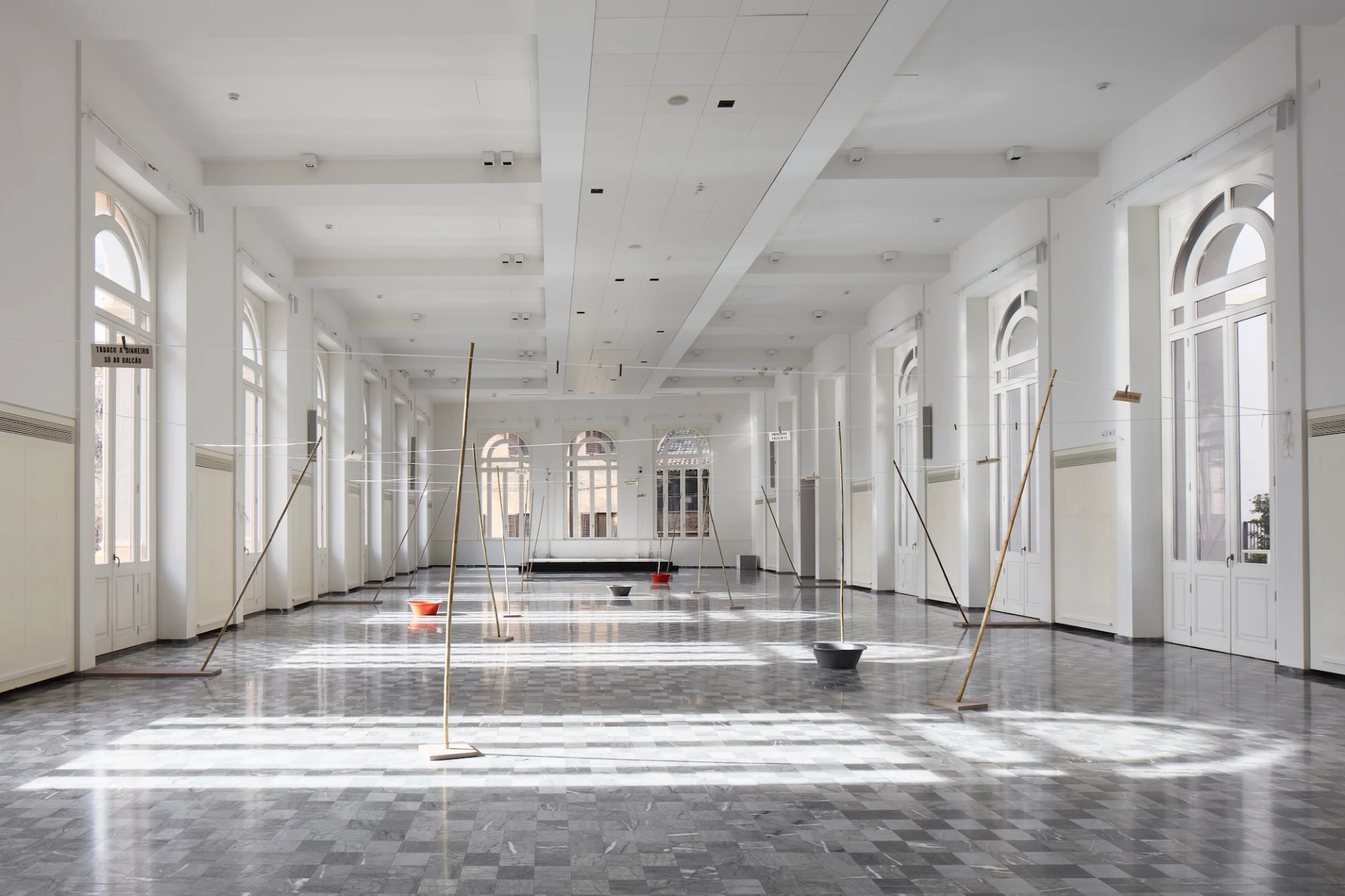
In Miss America, time is investigated in its most dynamic form; through decelerated acts, what would be the "normal" tasks of gestures are transformed: this happens through the entrance onto the scene (twice a day) of some actors, whose slow steps and hands convert the habit of stretching and removing the sheets into a possibility of varying the landscape, in which one also finds the trace of a simple domestic action, indeed, a sculptural one. "They go up and down the ropes, taking out and storing the white handkerchiefs: it’s a very simple movement. I consider it a very social piece, which could be installed in numerous spaces, creating a very good design, and could change it cyclically," Tropa continues.
Instead, the movement that guides the clock case of the Lantern is continuously repeated – a reference to the Earth's movement – projecting a large shadow onto a screen that could be that of a cinema or the wall of a cave.
"It goes back to the origin of the creation of images, which is why I call it a magic lantern: it is truly the basis of phantasmagoria. What fascinates me greatly is that the figure we are observing projected does not have the normal identity to which we are accustomed: it is an unmediated image. It is not a photograph, it does not have a backlit screen; it refers to the history of representation. And as soon as we get used to the real object present here – the clock case – it disappears from our attention as our gaze is drawn to this very elementary camera obscura," explains the artist, emphasizing the desire to recover the possibility of seeing images in a way that is completely forgotten today.
Miss America, in its entirety, reveals to us what is still the miracle of perception; a shadow that transforms into a sliver of time, throughout an era full of disembodied images - that is: a mystical contemplation of darkness and brilliance.
The installation is completed by a series of small signs hanging from clotheslines, reminiscent of old inscriptions, notices from shops and bars, whose originals were collected at flea markets by the artist himself; "Especialidade da casa" (House specialty), "Cerveja em copo" (Beer by the glass), "Tabaco em dinheiro só ao balcão" (Tobacco in cash only at the counter): here, one enters time through semantics, almost referring to the Surrealism of Magritte's inscriptions, letting the "purified" environment of conceptual art return to the alleys of Venice, Alfama or Bologna itself, in a time trapped in the hourglass of memory.
However, as curator Simone Menegoi writes, Francisco Tropa's practice is composed of hypotheses and numerous layers of interpretation. Miss America, therefore, becomes an invitation that goes far beyond a simple theory: once again, it is art that challenges us to look from other perspectives, to rediscover the fascination with the world.
ADVERTISING
Previous
article
11 Feb 2026
Notre Feu, by Isabelle Ferreira
By Margarida Alves
Next
agenda
16 Feb 2026
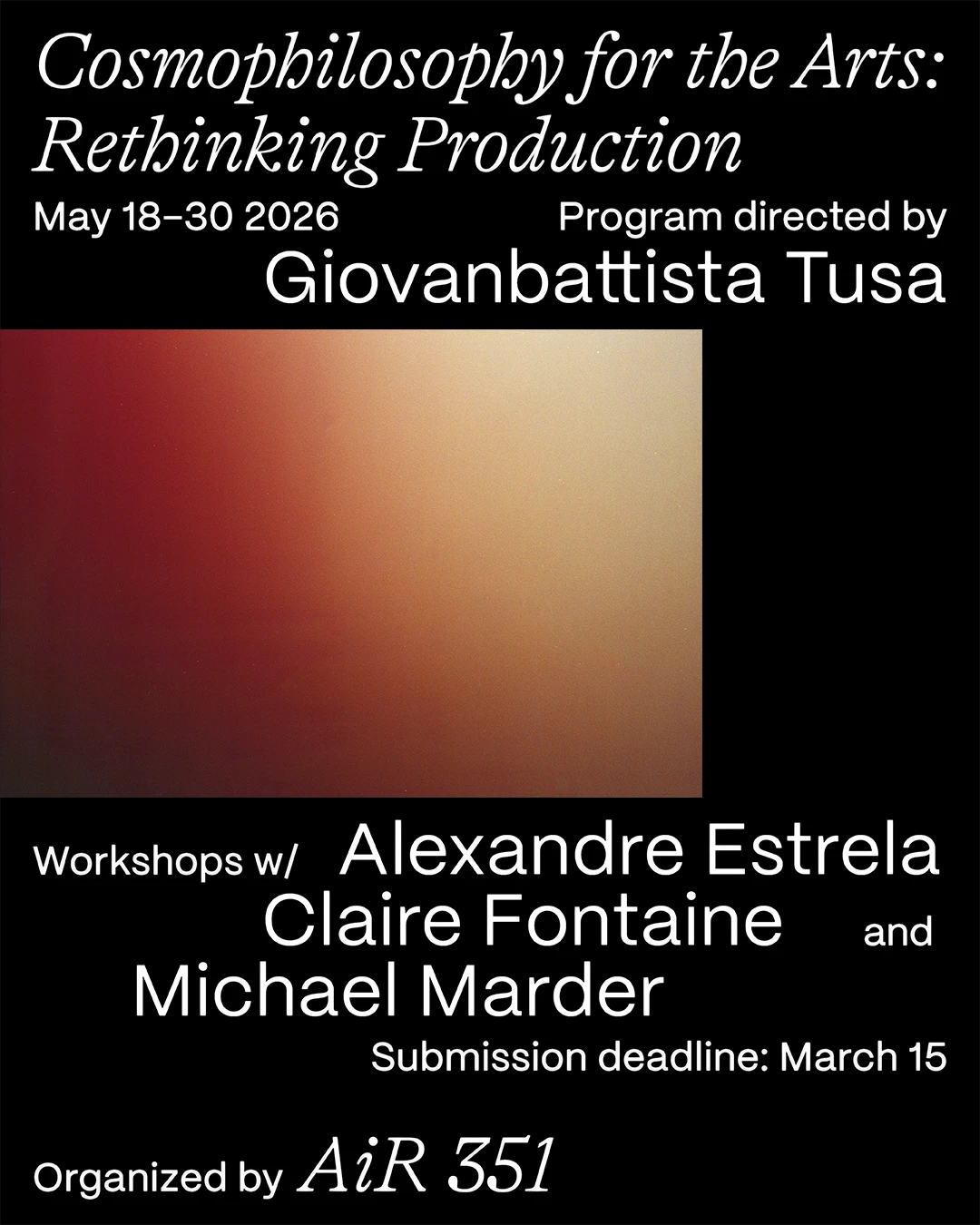
Call for Applications until March 15 - Cosmophilosophy for the Arts: Rethinking production
By Umbigo
Related Posts
article
18 MAY 2026
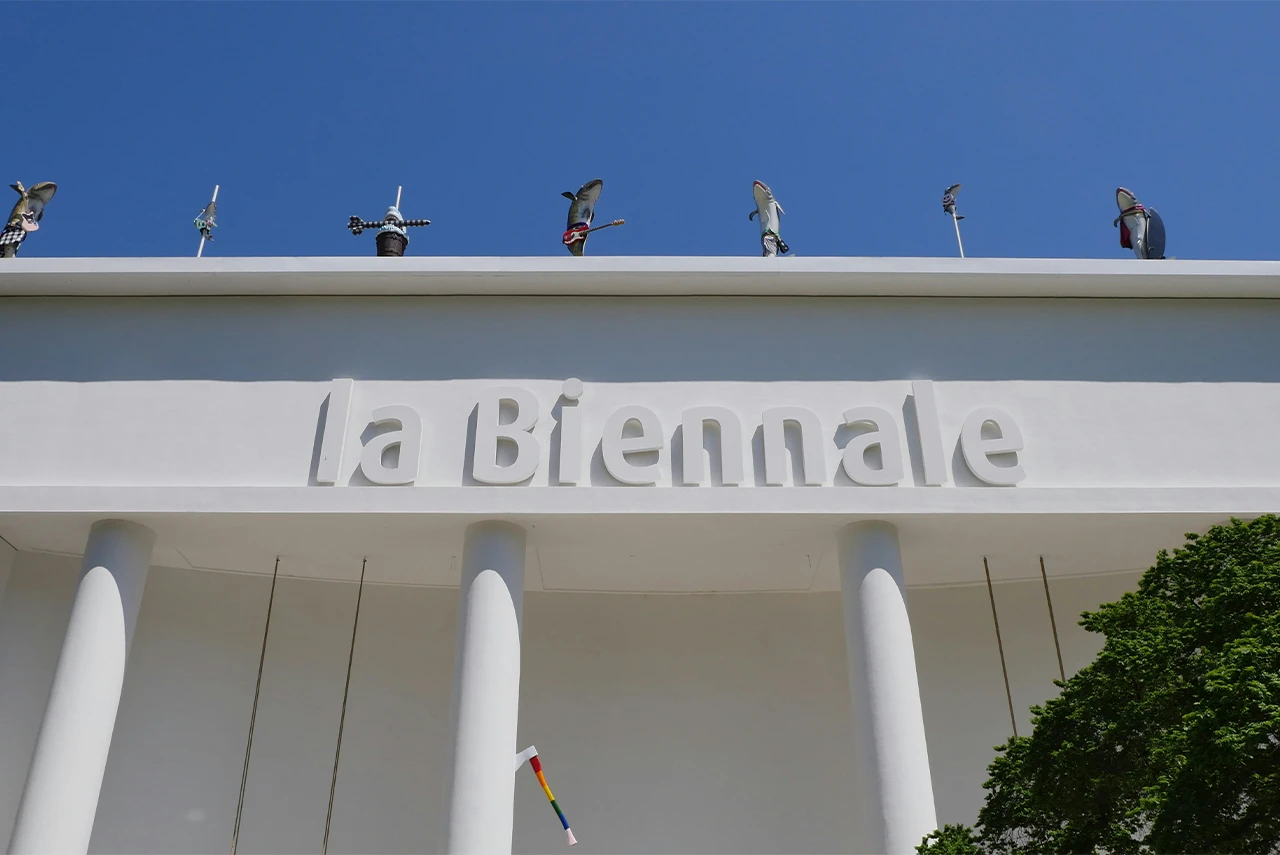
God and the Devil in the Land of the Biennial
By Matteo Bergamini
article
-6qspq.jpg)
07 APR 2026
RedSkyFalls, Portugal at the Venice Biennale: An Interview with Alexandre Estrela
By Matteo Bergamini
article
12 FEB 2026
Stories of shadows and worlds: Francisco Tropa in Bologna
By Matteo Bergamini
article
04 FEB 2026
The landscape in Rodamoinho: Marina Rheingantz at the ICA in Milan
By Matteo Bergamini