article
Space and time: lugar-depois, at Museu Zer0
"What to do with this history and tradition in the context of a digital art museum? Perhaps the answer to this question is what explains the first major exhibition of the Zer0 Museum as a locatable and self-contained space. There have been other moments along the still brief path to this point (most recently, in October 2025), but this lugar – depois, in fact – inaugurates its own vision, strategy, design, and vision. This occasion was envisioned by Fátima Marques Pereira, who took office last March as President of the new Board, and the current exhibition, on display until December, represents the full commitment of the new team.
In one of the most thought-provoking essays on the Library of Alexandria, and on how the present day has inherited institutions and ways of thought from Antiquity, Daniel Heller-Roazen1 recalls the difficulty of distinguishing between "Museum" and "Library" as repositories of knowledge. If today they are understood as separate entities, this stems primarily from the distinct spaces they usually occupy (even if large museums have libraries of great importance). It is first as a "museum" that the great "library" is generated; it is in this space that it originates. Heller-Roazen begins by describing cartographic features of Alexandria, goes on to refer to the city's great palaces and, within them, quoting Strabo, locates the museum. The place is, therefore, the genesis and form of knowledge – it is needed, so to speak, to give consistency to knowledge. A museum must be, above all, a place (the place where the muses sit).
What to do with this history and tradition in the context of a digital art museum? Perhaps the answer to this question is what explains the first major exhibition of the Zer0 Museum as a locatable and self-contained space. There have been other moments along the still brief path to this point (most recently, in October 2025), but this lugar – depois, in fact – inaugurates its own vision, strategy, design, and vision. This occasion was envisioned by Fátima Marques Pereira, who took office last March as President of the new Board, and the current exhibition, on display until December, represents the full commitment of the new team.
Starting the visit at the very top of the silos (I recall the charm of the building itself, both in its original architecture and in the restoration/reconfiguration by the Pedra Silva Arquitetos studio) invites one to understand Luísa Cunha's piece, É Aqui (It's Here) (Figueiredo Ribeiro collection), as a symbol of power. The presentation sheet states: É Aqui is "a political act" that carries with it the reclaiming of the place where it is installed. It is, in fact, through the way the sound takes on a superior and manifests itself, when the female voice asserts its presence in the place. The old silos of Santa Catarina da Fonte do Bispo are further marked as a museum. When I first encountered this piece, everything was elevated: it is located on the top floor, emitting from a superior, superhuman plane, and the temperature of that space, only with great difficulty achieved through air conditioning, demanded the weight of presence, intensifying the corporeality of the experience. The voice, a digital reproduction, materializes the enduring nature of the work, embodying the existence of the being who created it – Luísa Cunha passed away about a month after the opening of this exhibition.
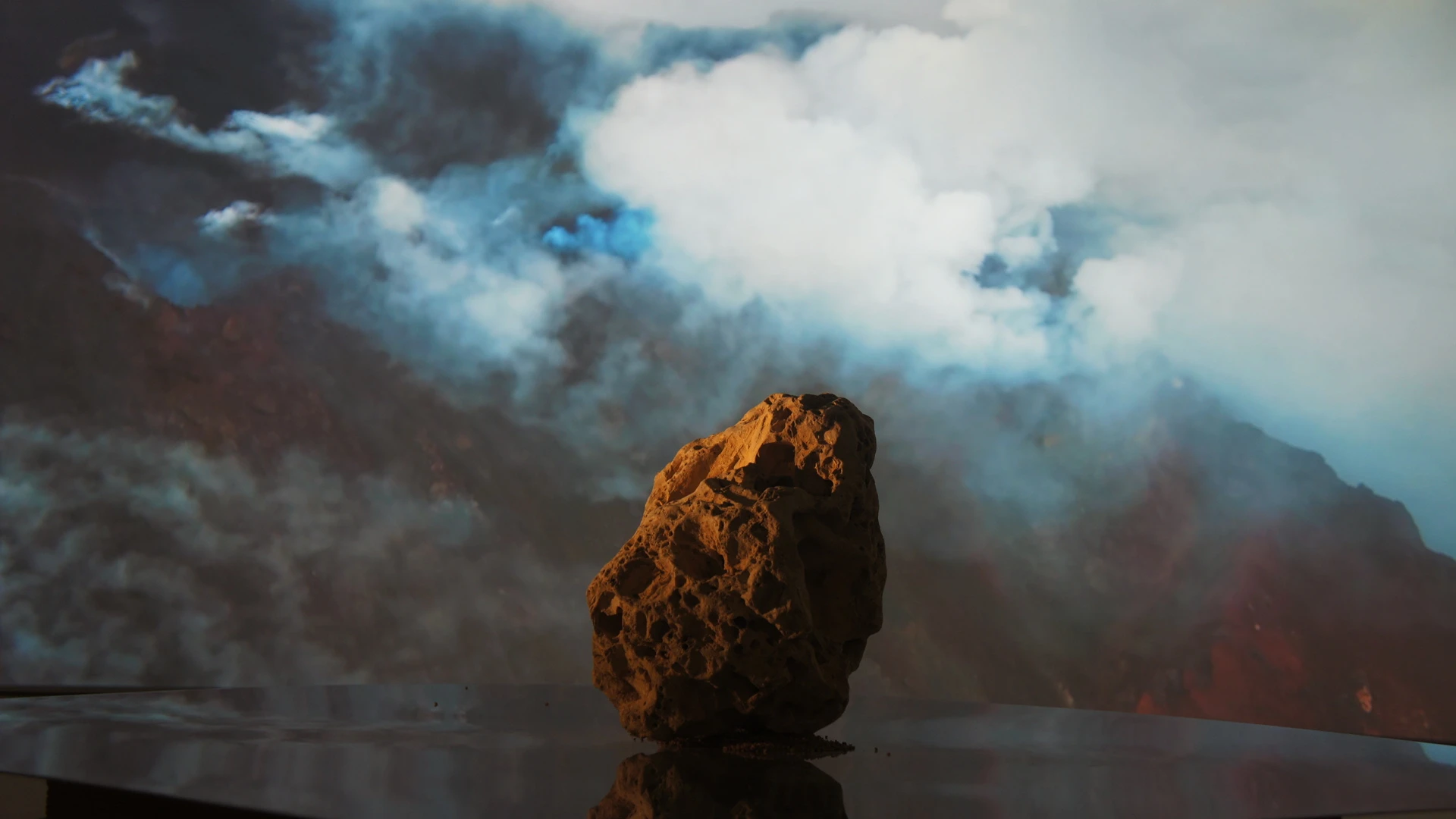
The location, or the signs of a spatiality recognizable as an ecosystem (a key word in understanding the Zer0 Museum today), also appears in two magnificent works by Gil Delindro: Lava Lavra, a sound and video installation based on collections from the Etna and Stromboli volcanoes; and Burned Cork [shown in 2024, along with other pieces by the artist, in the Dar a Ouvir initiative in Coimbra], which emphasizes the verticality of the trunk of a partially charred cork oak, making audible the sounds it produces through two microphones that brush against the surface of the rotating trunk and amplify the noise. The result of both installations, distinct and autonomous by their presence in different rooms (even if contiguous and with transparent partitions), resembles phantasmagoria resulting from the appeal of fire, whether visible in the records of volcanic eruptions or latent in the title and in the burnt trunk of the lamenting cork oak. (How much does this tree bark remind us of the relationship between museum and library, if you remember, as Didi-Huberman reminded us, that the word invented by the Latins for the point where the bark of trees adheres to the trunk is liber.2)
A poetics of the earth in pain emerges from Miguel Teodoro's video and words, Chemical Affinities, as well as from the arrangement he chooses to show it in the "organ room" of the Zer0 Museum. A rectangular lake, upon which rest three small sculptures, suggests a dialogue with the mirror that, in Lava Lavra, supports a magmatic rock and reflects the images that loop: just as these are seen duplicated, inverted, so too are the chemicals discussed simultaneously useful in the production of scientific and artistic artifacts (revealing photographic images, for example) and destroying the earth's balance. A similar ethnographic impulse underlies the rich intricacy of TAR, which Francisca Rocha Gonçalves and Anna van der Velde composed for spaces that accentuate specific characteristics of the Museum. By combining video, sound, and installation with various materials, and by using the surfaces of the rooms and the connections between spaces within the building, they create "a dystopian underwater world" in an environment that the visitor enters and where, attentively, they will even perceive the voices of shellfish gatherers from the Ria Formosa. It is from the wind blowing over the terrace of the Zer0 Museum – that is, from the local environment – that Inês Mendes Leal gathers the energy that stimulates the sculpture Window (a play on the word that, in English, designates a window and contains the word that names the wind). The place is the driving force behind the promotion of an "active listening to the territory," an expression used in the press release from the new Board of Directors last April.
In the museum's largest room, three audiovisual pieces confront each other in a set created by António Rafael, Luís Fernandes, Miguel Pedro, and Miguel C. Tavares. They present images and sounds of post-industrial territories in Ricochete, arranged obliquely in reflection of one another. They are evidence of the effects of industrialization on the landscape; the experience of the environment they constitute, in their confrontation with one another, prompts reflection: Where do we stand? What kind of land is ours if machines dominate it like monsters? Perhaps, more than pointing to the "place," the first term in the exhibition's title, these pieces indicate the "after" (the second term). They speak of a later time, a time that complements the places of the present.
The temporality of what comes after, as much as a reflection on spatial location, permeates José Jesus's installation, Subterranean Homesick Alien. The alien of the title is not extraterrestrial, but subterranean (the corner of the room metaphorically represents the underground). It is a strange being, made of phosphorescence, but it inhabits this world and feels homesick (is its home of this world?). If it is "science fiction," as stated in the exhibition leaflet, it is equally a partner in the inhabitation of a common time and space (as is the common ground that Miguel Teodoro speaks of). David Bastos's piece literally divides the space of the room in which Jesus's resides: a laser beam crosses it diagonally, reinforcing the luminescence. In the center, crossed by the laser, a combustion transforms organic matter (ground eggshell, beeswax) and releases the smoke that animates the sculpture. What remains, after?
The installation that concludes the visit, in the lobby space, may go unnoticed, but it refers to the piece with which the exhibition began (É Aqui): both are made present through a loudspeaker. However, while Luísa Cunha’s piece affirms and reclaims the space, A Casa do Mar (The House of the Sea) by Francisca Aires Mateus, questions the existence of meaning beyond verbal language. An Estonian actress (Keele Kaljuvee-O’Brock) reads the eponymous short story by Sophia de Mello Breyner, and her diction suggests that she is unfamiliar with the language she is reading. If language delimits nationalities, if it is a territorial form, what does it mean to inhabit it without mastering it? A language can, after all, be like the magma that flows from Etna: inhospitable, yet captivating; dramatic, sculptural, inviting.
The proposals by lugar – depois are not exhausted by these impressions. The extension of this exhibition over time encourages revisits to the Zer0 Museum, a stimulating home for contemporary muses.
The exhibition also includes events that took place at the opening (created by the Openfield and Boris Chimp 504 collectives), as well as an animation film cycle, projected in collaboration with the Animated Image course at the School of Education and Communication of the University of Algarve, and special programming on the last Fridays of each month. lugar – depois can be visited until December 7, 2026..
1 Daniel Heller-Roazen (2002). "Tradition’s Destruction: On the Library of Alexandria", October, Vol. 100 (Spring 2002), The MIT Press, pp. 133-153.
2 Georges Didi-Huberman (2017). Cascas. Translated by André Telles. São Paulo: Ed. 34, p. 73.
BIOGRAPHY
Ana Isabel Soares (b. 1970) has a PhD in Literary Theory (Lisbon, 2003), and has been teaching in the Algarve University (Faro, Portugal) since 1996. She was one of the founders of AIM – Portuguese Association of Moving Image Researchers. Her interests are in literature, visual arts, and cinema. She writes, translates, and publishes in Portuguese and international publications. She is a full member of CIAC – Research Centre for Arts and Communication.
ADVERTISING
Previous
agenda
14 Sep 2026
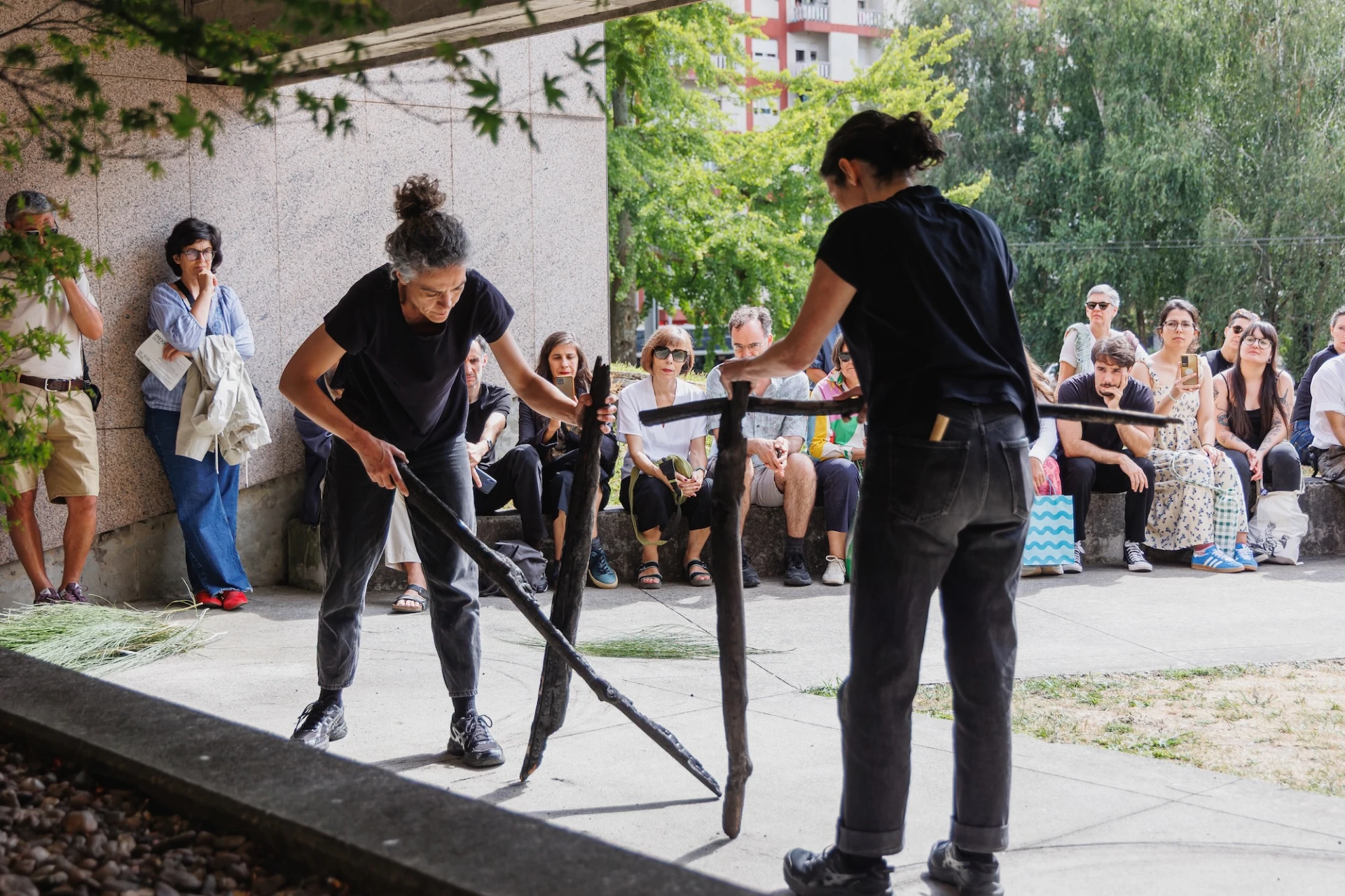
The duo Carla Cruz & Cláudia Lopes was selected for the UmbigoLAB artistic residency at Fundação da Casa de Mateus 2026
By Umbigo
Related Posts
article
14 SEP 2026
Space and time: lugar-depois, at Museu Zer0
By Ana Isabel Soares
article

09 SEP 2026
The Elusiveness of Time: on the exhibition ‘Uma Árvore’ by Daniel Moreira and Rita Castro Neves at the Palácio da Galeria in Tavira
By Ana Isabel Soares
article
26 AUG 2026
Museu das Expectativas, by Pedro Gomes: What is a museum?
By Ana Isabel Soares
article
19 JUN 2026
Passenger Side: Drift, movement
By Ana Isabel Soares