article
Scrolls, at Buraco: The Two Sides of the Same Coin
“The exhibition's title evokes scrolls but also scrolling, a gesture of consumption: sliding, advancing. The image reduced to its most disposable condition. Yet, the artists seem to propose the exact opposite, without ever transforming it into a kind of moral declaration. This forces us to return, to get lost in a detail, to try to understand the system. There are things to read there—it demands time. Time to perceive what disappears and what persists in Sofia's paintings. Time to follow Roger's compressed images. Time to read this proposal to seek the origins of the language of representation, the false automatism in a gesture that is, after all, intentional—despite there being no need for study, for great preparation for what is conceived and presented."
I arranged with João Bragança Gil to go to Buraco to visit Scrolls. I arrived in a hurry—I didn't want to miss what there was to see—and without much urgency to seek connections between the artists. Or rather, I went in convinced that, considering this particular exhibition, this exercise in comparison didn't make sense. Roger Paulino and Sofia Mascate come from places too different to fit into a unified interpretation, I thought. And that seemed, at first, clear enough to me.
But some exhibitions simply don't stay where we put them.
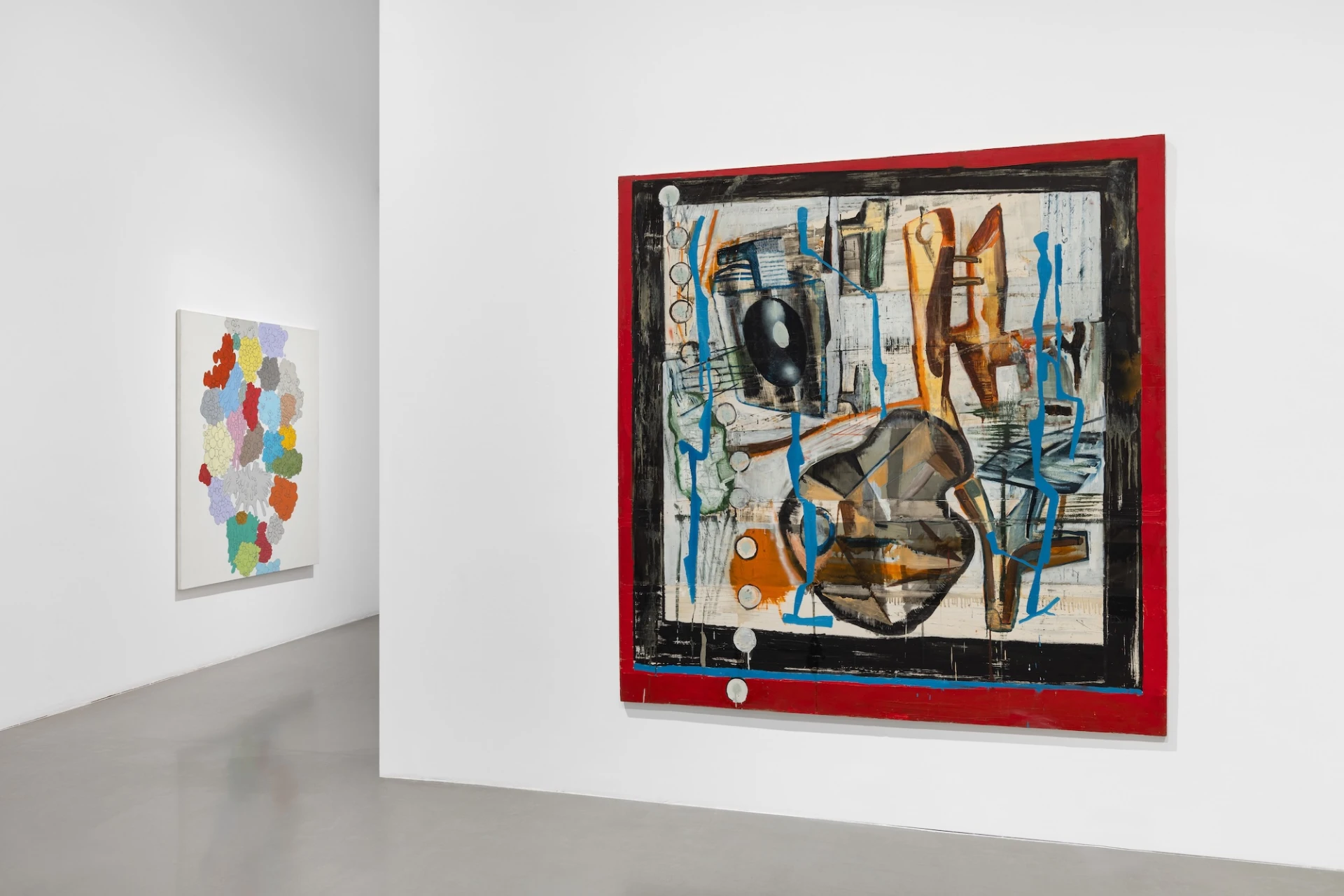
Roger often starts from printmaking as a practice and method: matrix, proof, error, repetition. A system in which the image is constructed by the insistence of the gesture, by chromatic variations upon other variations, by structural inscriptions, by objects and forms that come and go. As if each work were a test of resistance to the very idea of image.
Sofia comes from a painting background, although that says little about the exploration she develops in her work. In it, one recognizes a desire for composition that also functions as a form of historical thought. Still lifes, visual devices with their own universes, gravitational centers laden with references that accumulate time and memory. Without any desire for restoration, however. What one finds is rather an exercise in reinvention, an exploration that advances through detours, subtractions, and discoveries.
Put that way, in theory, everything seems to push them apart. In practice, I realized that something insisted on bringing them closer—but we'll get to that later.
Scrolls begins almost like a prologue. Right at the entrance, two works anticipate what we will explore: Lungs (2022), by Roger, and Regress (2026), by Sofia. A linocut by one, a pen drawing on cardboard by the other—the latter cut at an angle that functions simultaneously as support and frame.
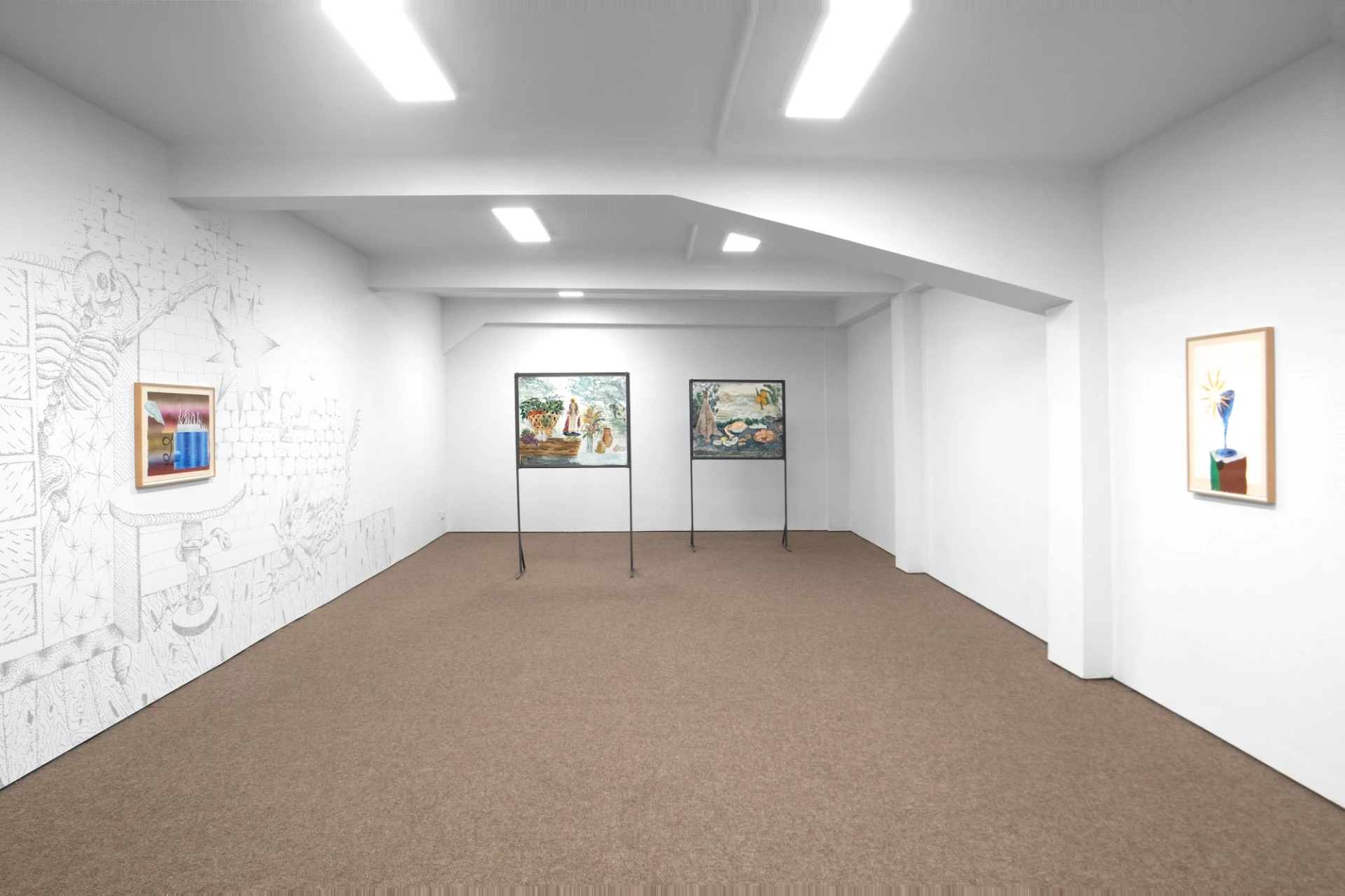
Upstairs are Tamagotchi (2024), by Roger, and a series of drawings by Sofia with figures, cornucopias, bows, vases, shells and fruits. There is something immediate about these compositions, but not naive. One imagines a quick, almost compulsive line, as if the signs needed to be released before organizing themselves. And yet this speed does not involve speed reading. On the contrary.
In the oil paintings on glass presented here, this logic becomes even more evident — Summer, Winter, Spring, Autumn (2025). There is an approximation to tradition that the artist simultaneously summons and dismantles. In the center of the room, a device depicting two confronting dogs, framed by a frame topped with a ribbon and flanked by flower vases, evokes echoes of classical painting in a broad sense. The composition is carefully centered, and the visual narrative is, in my view, laden with meaning. Something similar happens in Roger's work, although through other means: through a technical specificity that he has been refining and a persistent attention to the construction of the image.
It was downstairs, while talking to João Bragança Gil that I realized I was establishing unauthorized connections, a detour where the two meet. A stain that seemed to respond to another, a fragment that repeated a form on another wall. Continuities emerged that were not inscribed anywhere, but which seemed to bring together the attempts of both artists to interpret the world: the history of art, fragments of life, symbols and signs. The way they traverse past and present without any shame, making ancient and contemporary references coexist in the search for something yet to be formulated.
Sofia also works through erasure, through subtraction of matter, through transparencies and superimpositions. Some of the oil-on-glass works function as front and back—other compositions emerge as we move around them—while others do not depend on this inversion. There are paintings in which the two faces coexist without hierarchy, as if one surface extended the other and the work refused to fix a point of termination. In her work, she explores a reinvention of a living Baroque, fueled by polychrome iconography.
Roger, on the other hand, produces instability through proliferation, repetition, and a refusal to close. He presses the image against the cotton paper, insisting on its physical transfer to the surface. The result, when viewed together, is an active density where each element seems to carry more than it shows. Two distinct strategies to confront the same problem: how to prevent the image from resolving itself too quickly.
And then there's the mural intervention, which is really where it all begins. Three days of immersion, techno, and continuous gesture transform the wall into a surface saturated with signs. By working at the intersection of painting and printmaking, seeking a language that simultaneously belongs to both territories, the mural, with its limited lifespan, becomes a natural extension of this research.
The exhibition's title evokes scrolls but also scrolling, a gesture of consumption: sliding, advancing. The image reduced to its most disposable condition. Yet, the artists seem to propose the exact opposite, without ever transforming it into a kind of moral declaration. This forces us to return, to get lost in a detail, to try to understand the system. There are things to read there—it demands time. Time to perceive what disappears and what persists in Sofia's paintings. Time to follow Roger's compressed images. Time to read this proposal to seek the origins of the language of representation, the false automatism in a gesture that is, after all, intentional—despite there being no need for study, for great preparation for what is conceived and presented. The two artists are not similar in language. They are similar in resistance—each in their own way, with their materials, their rhythms, and their obsessions. Two sides of the same coin that do not resolve themselves in each other, but that exist precisely because they do not coincide. In the end, the exhibition is not about similarity. It's about unfolding: this way of keeping what is represented in suspension, contaminating. And, as Mariana Tilly writes in the class handout, what pleasure there is when unfolding occurs.
The exhibition can be visited until July 4, 2026.
BIOGRAPHY
Maria Inês Augusto, 34, has a degree in Art History. She worked at the Museum of Contemporary Art (MNAC) in the Educational Services department as a trainee and for 9 years at the Palácio do Correio Velho as an appraiser and cataloguer of works of art and collecting. She took part in the Postgraduate Programme in Art Markets at the Faculty of Social Sciences and Humanities of Universidade Nova de Lisboa as a guest lecturer for several editions and collaborated with BoCA - Bienal de Artes Contemporâneas in 2023. She is currently working on an Art Advisory and curatorial project, collaborating with Teatro do Vestido in production assistance and has been producing different types of text.
ADVERTISING
Previous
article
24 Jun 2026
DAWN, de João Pedro Vale + Nuno Alexandre Ferreira
By Ana Grebler
Next
article

29 Jun 2026
Housing (Non) Humans at Galeria Filomena Soares
By João Pedro Soares
Related Posts
article
25 JUN 2026
Scrolls, at Buraco: The Two Sides of the Same Coin
By Maria Inês Augusto
article
12 JUN 2026
Tabique, by Rita Gaspar Vieira
By Maria Inês Augusto
article
12 MAY 2026
Phantom Tales, by Pedro Zhang
By Maria Inês Augusto
article
10 MAR 2026
Deviation as structure: four decades of painting by Pedro Casqueiro
By Maria Inês Augusto