article
Eu que já fui eu, by Maria José Oliveira
“In Maria José Oliveira’s work, materials engage in dialogue, and entropic wear dissolves the image, transforming it into a body in the process of becoming. However, I feel that there is a certain imprecision in the language used here. All bodies are in a state of becoming. That is the nature of the world. Therefore, the artist, in a demiurgic gesture, selects and highlights the action, transforming the artwork into a succession of times, emerging materialities, and living and inanimate materials.”
Time, time's thickness in the body, in gestures, the hands.
How is time inscribed in matter? How are symbolic objects redefined to the very limits of form?
In Maria José Oliveira’s work, materials engage in dialogue, and entropic wear dissolves the image, transforming it into a body in the process of becoming. However, I feel that there is a certain imprecision in the language used here. All bodies are in a state of becoming. That is the nature of the world. Therefore, the artist, in a demiurgic gesture, selects and highlights the action, transforming the artwork into a succession of times, emerging materialities, and living and inanimate materials.
Water, held in the cupped hand, returns to the primordial body; it does not remain in a container. Beside it, salt emerges—a remnant of evaporation.
Fire consumes paper. Fire's action is not visible; only its traces remain.
Books are consumed by bookworms, whose minuscule scale prevents us from fixing our gaze on the action. The latent presence of a body in transformation emerges.
In other cases, the container hints at a pre-existing state. Shells of the human body inhabit the exhibition. There is, however, a presence-absence that persists in these negative spaces, leaving them in limbo.
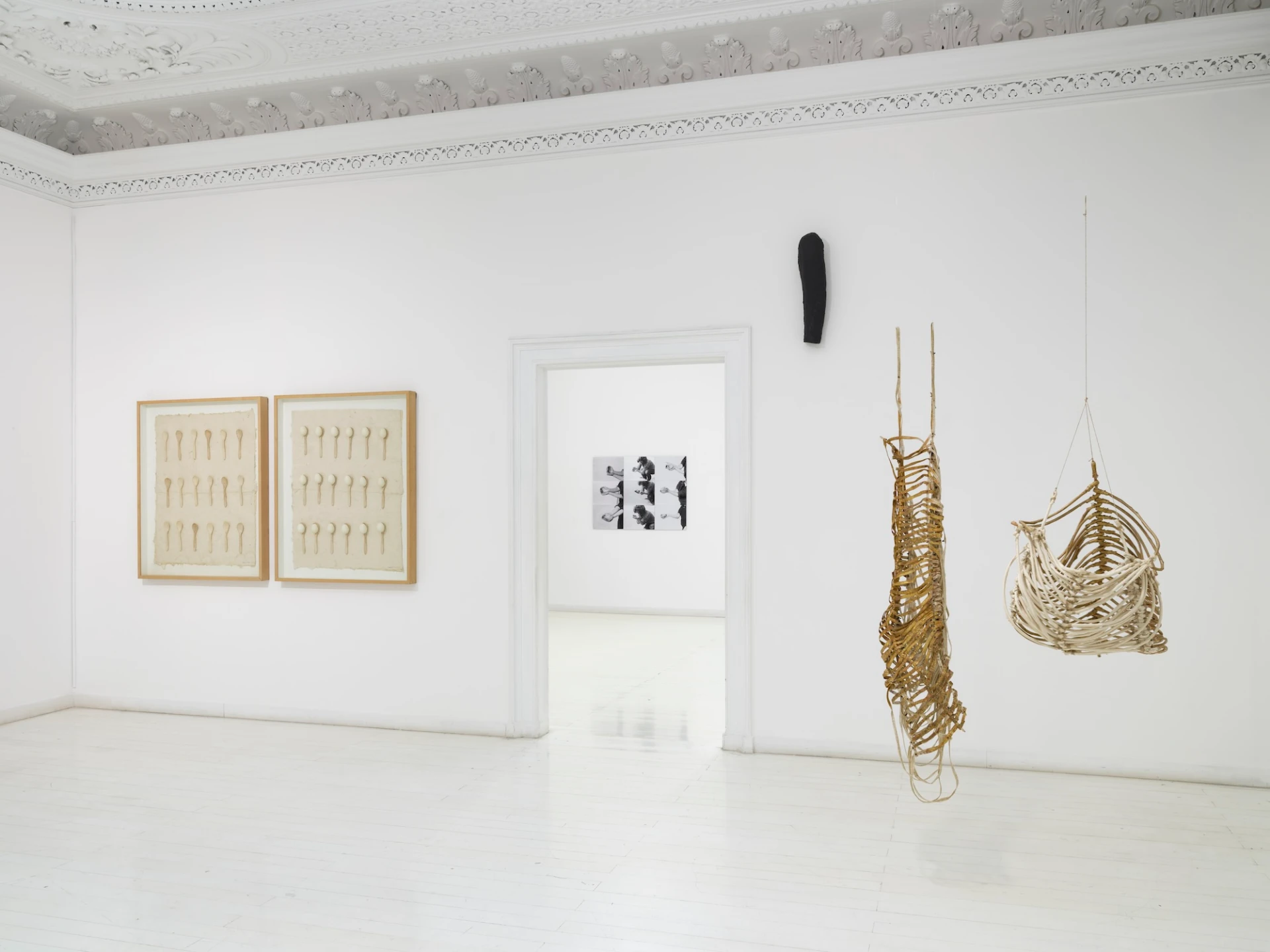
Spoons moulded from paper and eggshells—anthropomorphic memories of use—remain recognisable but are approaching the point at which they can no longer fulfil their function.
Between the container and its contents, one can make out what remains of a torso, inside a body whose skeletal structure still stands. Its entrails float like a specter.
The artistic process transforms common and fragile materials, intentionally refusing to confer upon the object the apparent permanence of a noble material. For we are all stardust. And perhaps, in the universe, the rarest substance is not gold or silver, but water—the condition of life. Organic matter. Material poiesis.
All bodies transform, from astronomical structures down to the tiniest particles that delve deep. Faced with the mystery of creation, water blends with clay. The body is both container and clay-like content. The artist’s hands become the hands of God. The first Being is born into the light of this ambiguity.
Curated by Paula Parente Pinto, the exhibition Eu que já fui eu is open at MNAC, in Lisbon, until October 4, 2026.
1 LUCRECIUS, On the Nature of Things, Book I, lines 262–264, translated by Luís Cerqueira, Editora Relógio de Água, 2015. Original title: De rerum natura (1st century B.C.).
BIOGRAPHY
Margarida Alves (Lisbon, 1983). Artist, PhD student in Fine Arts (FBAUL). Researcher by the University of Lisbon. Degree in Sculpture (FBAUL, 2012), Master in Art and Glass Science (FCTUNL & FBAUL, 2015), Degree in Civil Engineering (FCTUNL, 2005). She is a resident artist in the collective Atelier Concorde. Collaborates with national and foreign artists. Her work has an interdisciplinary character and focuses on themes associated with origin, otherness, and historical, scientific and philosophical constructions of reality.
ADVERTISING
Previous
interview
25 Sep 2026
Interview with Isadora Alves, author of the Umbigo.space cover
By João Pedro Soares
Next
article
29 Sep 2026
Multiple Eyes, to unlearn how to see
By Maria Inês Augusto
Related Posts
article
28 SEP 2026
Eu que já fui eu, by Maria José Oliveira
By Margarida Alves
article
11 FEB 2026
Notre Feu, by Isabelle Ferreira
By Margarida Alves
article
-054-xns5g.jpg)
03 DEC 2025
Earth Gods / Velar Sculpture, at the Museu do Oriente
By Margarida Alves
article
03 NOV 2025
Caos com Carinho, by Mariana Malheiro
By Margarida Alves