article
Serapinas and Ourahmane at the Porto Municipal Gallery
The Portuguese debuts of Lithuanian artist Augustas Serapinas (1990) and Algerian artist Lydia Ourahmane (1992) marked the opening of the second exhibition cycle of 2026 at the Porto Municipal Gallery (GMP). Whilst these are distinct exhibitions, there are, nevertheless, parallels between them that prompt reflection and questioning regarding the body, its senses and its limits. Furthermore, the installations by both artists have a performative dimension and integrate ongoing projects, adapted by their creators to the Portuguese context through collaborative work with local institutions and cultural agents.
Blending humor and irony, and exploring themes such as education and teaching methodologies while examining intersections between art history and the history of the body’s representation, Augustas Serapinas’s exhibition Cultura do Corpo: Edição Porto, curated by João Laia, draws on the legacy of Ancient Greece—particularly the Classical Academy and the ideal of human perfection known as kalokagathia, promoted by philosophers such as Aristotle and Plato and achieved through a balance between intellectual and moral development and physical well-being. Reworking the expression mens sana in corpore sano and drawing a parallel between physical training and artistic learning, Serapinas’s ongoing project Body Culture takes the idea that art institutions and gyms can be understood as complementary spaces: the former cultivating critical thinking and emotional intelligence, the latter physical strength and endurance. I’m very interested in the way the body is trained, disciplined, and repeated, whether in art or in sport.1
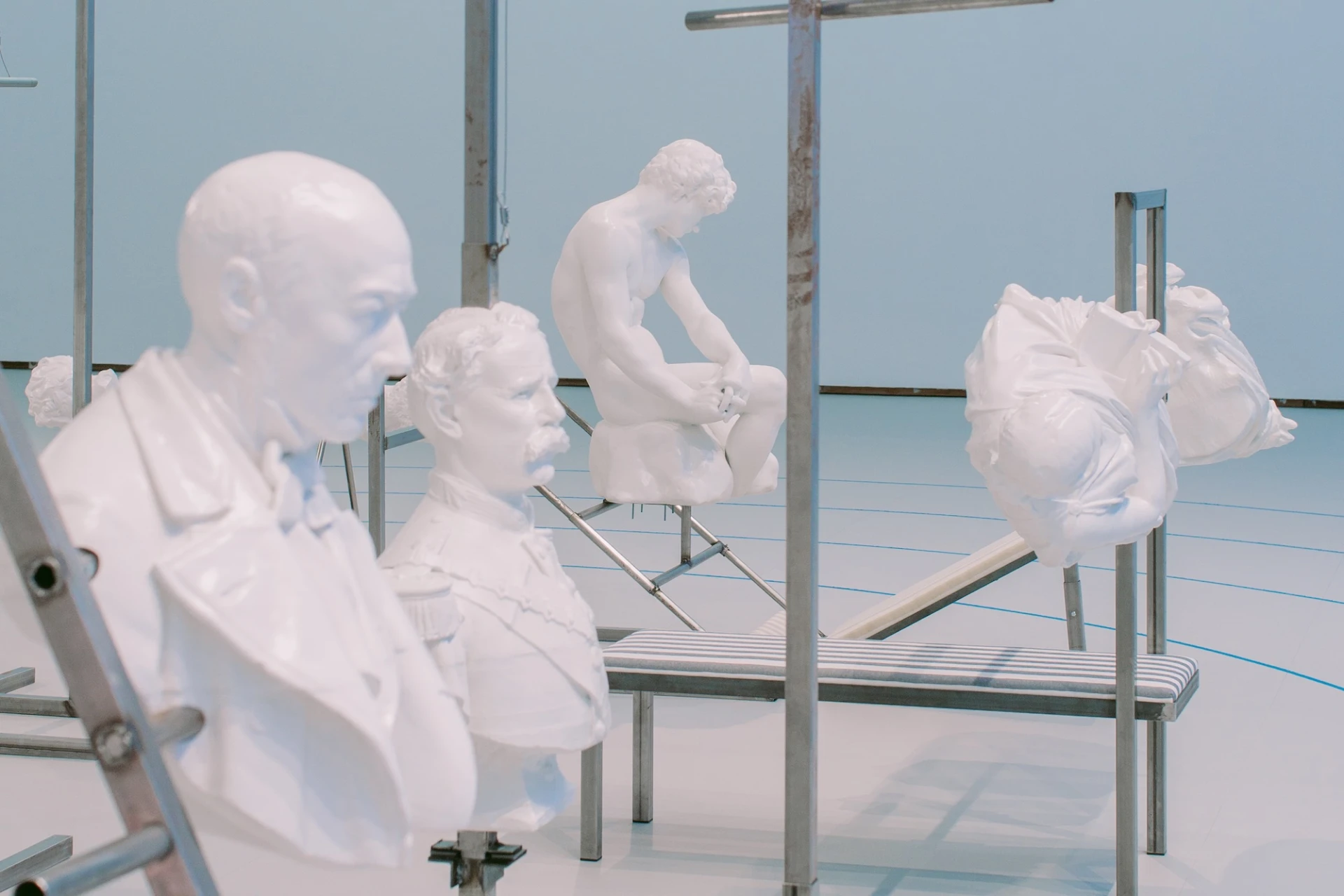
Transforming the ground floor of the Porto Municipal Gallery into a hybrid space somewhere between a gym and a drawing studio, the large-scale installation is striking for its functional running tracks and weightlifting equipment, whose weights replicate sculptures from the collection of the Soares dos Reis National Museum. Drawing easels are also positioned throughout the space. Designed to involve the public, the exhibition functions as a performative statement, activated both by visitors practicing academic drawing—traditionally focused on copying classical sculptures—and by groups of athletes who engage with the installation as a gym. Through the duality of physical exercise and drawing, Serapinas reveals how both disciplines rely on effort and the repetition of gestures as methods of improvement and learning: (...) there is a very strong connection between learning to draw and training at a gym; in both cases, the body is pushed to persist, repeat, and improve through practice.2
Positioning itself as a performative platform for critical reflection, the artist’s sculptural gym allows audiences to examine, on the one hand, the history of Western art and, on the other, to rethink educational concepts and structures that emphasize repetitive practice and hard, diligent work.3 It is worth noting that the first presentation of Body Culture, in 2012, grew out of the artist’s own experience as a student at the Vilnius Academy of Arts. Its classical drawing curriculum—based on observing sculptures, plaster casts, anatomical fragments, and the human body—led him to reflect on and question the methods of art education. Since then, the project has taken on various configurations, with the Porto edition, developed in dialogue with the city, being the first to focus exclusively on the local context in which it is presented. It incorporates more than sixty replicas of sculptures from the collection of the Soares dos Reis National Museum (MNSR). Replacing the dumbbells and weights on the exercise machines, fragments of historic sculptures associated with Porto—including O Desterrado (1877), and Firmino (1867) by Soares dos Reis; Busto de Camões (1880) by Francisco José Resende; Cabeça de Senhora (1923) by Francisco Franco among others—become the raw material and active elements of the participatory installation. Removed from their museum context and placed at the center of an environment devoted to physical exercise, the sculptures cease to be untouchable objects and become part of a physical routine4. This shift enables new readings of the representation of the body, repetition as a mode of learning, the role of copying in the transmission of artistic knowledge, and the persistence of classical art in the contemporary imagination. At the same time, the sculptures play a central role in the exhibition experience, creating connections between different disciplines, practices, and audiences.
Drawing on the tradition of ancient gymnasia, Body Culture: Porto Edition reminds us that culture and physical exercise are not opposites, but rather reflections of the enduring human desire for self-improvement and the pursuit of perfection—a pursuit that has persisted from Antiquity into the contemporary era.
On the upper floor of the GMP, far removed from the pop sounds of the previous exhibition, conceptual artist Lydia Ourahmane’s Para Voz draws us into a sensory and intimate experience. Surrounded by darkness and emptiness within the gallery’s triangular space, the work is almost invisible yet perceptible to the touch, taking the form of a Braille score inscribed directly onto the gallery walls.
Conceived in collaboration with her sister, composer and musician Sarah Ourahmane, and developed in response to the architecture and acoustics of the exhibition space, For Voice—whose first version, Per Voce (2025)5 was presented at Castello di Rivoli in Turin—grew out of the artist’s personal experience. While living in an old apartment building in Barcelona with no ceiling lights, she found herself having to feel her way along the walls to locate the light switches, which inspired her to create a work that would map the architecture of the space.6 Bringing together sound7 and performance, Lydia Ourahmane’s work asks: how else can we perceive space through sound, without relying on one of our primary senses—sight?
The performative piece, which is in fact a two-part work, consists of a score to be performed by two visually impaired vocalists. Transcribed into Braille and incorporated into the walls, the score is activated as each singer physically follows it, moving through the space as the composition unfolds. One of the intriguing aspects Lydia emphasizes in the piece is the way Braille music notation works: the six-dot cell conveys the pitch and rhythm of a sound, as well as the key and octave in which the composition was written. According to the artist, there is an enormous amount of information between each cell; and the way the singer interprets the work seems almost miraculous, given his ability to carry out so many simultaneous translations.8
On the opening day, the audience had the opportunity to experience the transcendent atmosphere created by the performances of the two Portuguese singers, Cristina Afonso and Joana Rita Santos. With the aim of keeping the work alive in the absence of the performers, Lydia developed a kinetic sound system. Mounted on a track running along the ceiling, two illuminated loudspeakers move at the same speed as the singers would read the score, playing back the two recorded voices that echo through the darkness of the gallery, allowing the viewer to experience the work as closely as possible to the actual performance.
Amid the sung words of heartbreak, separation, and the inevitable realization that two people once shared a rhythm, the exhibition’s curator emphasizes the collaborative encounter at the heart of the work’s creative and artistic process. The project’s collaboration with blind Portuguese singers also brings another fundamental aspect of the work into focus: the relationship between humans and machines, a theme that likewise emerges in Serapinas’s installation.
The exhibition Cultura do Corpo: Porto Edition, curated by João Laila, can be visited at the Porto Municipal Gallery until 18 October. Para Voz, curated by Krist Gruijthuijsen, is on display at the same venue until 25 October 2026.
1 Quoted from the artist’s presentation during the guided tour of the exhibition on 12 July 2026.
2 Idem, Ibidem.
3 LAIA, João – Augustas Serapinas. Cultura do Corpo: Edição Porto. [Exhibition text].
4 Quoted from the artist’s presentation during the guided tour of the exhibition on 12 July 2026.
5 For each version of the piece performed, Lydia and her sister created different scores; the one performed in the Italian city was played by a trio, whilst the one in Porto was performed by a duo.
6 Quoted from the artist’s presentation during the guided tour of the exhibition on 12 July 2026.
7 Sound plays a major role in Lydia Ourahmane’s artistic practice. She began studying the piano at a very young age and, having lived amongst diverse cultures and multiple languages, considers music to be her most constant language.
8 Quoted from the artist’s presentation during the guided tour of the exhibition on 12 July 2026.
BIOGRAPHY
Mafalda Teixeira, Master’s Degree in History of Art, Heritage and Visual Culture from the Faculty of Letters of the University of Porto. She has an internship and worked in the Temporary Exhibitions department of the Museu d’Art Contemporani de Barcelona. During the master’s degree, she did a curricular internship in production at the Municipal Gallery of Oporto. Currently, she is devoted to research in the History of Modern and Contemporary Art, and publishes scientific articles.
ADVERTISING
Previous
article
01 Sep 2026
THIS IS (NOT) A CHURCH: Can a church be a place for encounter?
By Maria Inês Mendes
Next
article
03 Sep 2026
Radical Gestures, by Tatiana Macedo, at Rialto6
By Tomás Saraiva
Related Posts
article
02 SEP 2026
Serapinas and Ourahmane at the Porto Municipal Gallery
By Mafalda Teixeira
article
07 JUL 2026
Interview with Silvestre Pestana, author of the Umbigo.space cover
By Mafalda Teixeira
article
15 JUN 2026
ANOZERO’26 – Bienal de Arte Contemporânea de Coimbra: Segurar, Dar, Receber (To hold, to give, and to receive)
By Mafalda Teixeira
article
02 JUN 2026
Submundo, de Paulo Wirz, at Teodoro W.
By Mafalda Teixeira