article
The Theatre of Care at Galleria Federico Vavassori
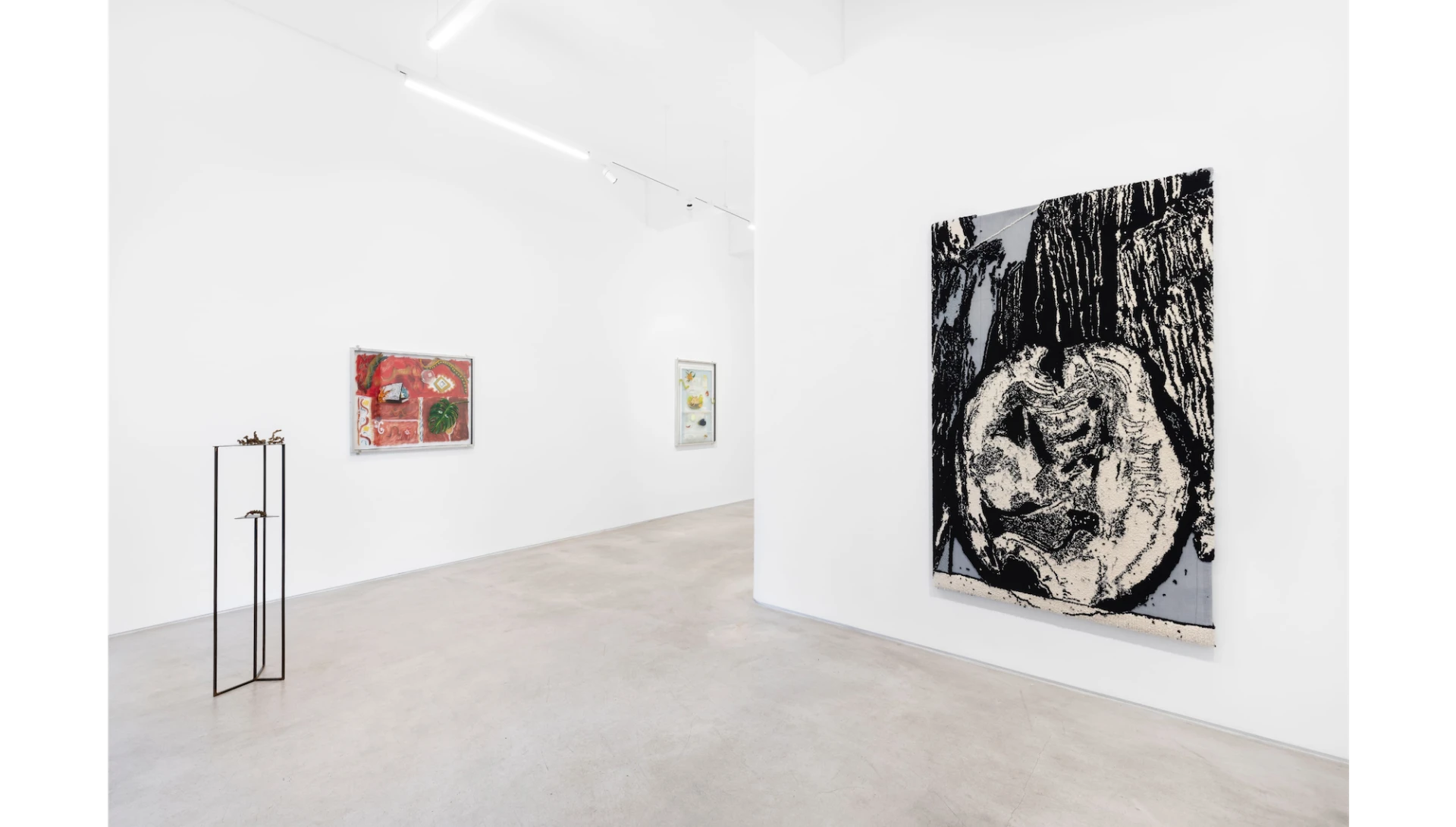
The exhibition at Galleria Federico Vavassori brings together forty artists in support of programmes at Nisida, the juvenile detention centre located on the small volcanic island of the same name in the Gulf of Naples. Long associated with questions of justice, education, and social reintegration, Nisida occupies a singular place within the Italian imagination: a site of confinement, yet also a place where alternative futures may still be imagined and cultivated. The island's geographical separation from the city has often functioned as a metaphor for social exclusion itself. Yet the initiatives supported there today suggest another possibility: that spaces of marginalisation can also become sites of encounter, creativity, and transformation.
The proceeds from the exhibition, administered through Fondazione Severino, support educational and cultural programmes within the institution, including a theatre initiative inspired by the legacy of Eduardo De Filippo. One of the most influential figures in twentieth-century Italian culture, De Filippo understood theatre not merely as a form of entertainment but as a civic practice. Throughout his work, he remained attentive to the lives of those excluded from dominant narratives, insisting that culture could restore dignity, cultivate empathy, and create forms of collective reflection. His theatre was grounded in the conviction that representation carried ethical responsibilities, and that artistic practice could participate meaningfully in the life of the polis.
The presence of a theatre programme within a juvenile detention centre therefore carries a significance that extends far beyond pedagogy. It invites reflection on the relationship between artistic practice, subject formation, and social participation. What does it mean to introduce performance into a space organised around surveillance, discipline, and regulation? What forms of agency become possible when individuals are invited not merely to be observed but to speak, act, imagine, and represent? Such questions place the project within a longer intellectual tradition concerned with the relationship between aesthetics and civic life.
The significance of this initiative extends beyond philanthropy in its conventional sense. It belongs to a distinctly Italian lineage in which culture is understood not as an autonomous sphere detached from social reality but as a form of public engagement. If De Filippo understood theatre as a vehicle for dignity and participation, Pier Paolo Pasolini understood artistic production as a form of social critique—a means through which society might confront its own contradictions, exclusions, and moral failures.
Pasolini's theory of cinema remains particularly relevant in this regard. For him, the image was never neutral. Cinema constituted a language capable of revealing structuresof power embedded within everyday life and exposing realities that dominant political, economic, and cultural narratives sought to obscure. Throughout his work, Pasolini resisted the reduction of culture to commodity, insisting instead upon its ethical and political function within the public sphere. The artist, in this sense, was not called upon merely to represent reality but to interrogate it.
Viewed through this lens, the exhibition at Galleria Federico Vavassori may be understood as a counterpoint to certain tendencies within the contemporary art world. In an era increasingly shaped by visibility, market positioning, institutional branding, and speculative value, artistic discourse is often subordinated to the imperatives of circulation and exchange. The social life of art risks becoming inseparable from its financial life. Questions of resale value, marketability, and cultural capital frequently eclipse broader considerations of public responsibility.
Such observations are not intended as a moral condemnation of the market. The contemporary art world operates within complex economic realities, and artists, galleries, collectors, and institutions inevitably participate in them. Yet it is precisely within this context that projects such as the Nisida exhibition acquire significance. Rather than denying the existence of the market, they invite reflection on what responsibilities cultural institutions might assume from within it.
By contrast, this project recalls an alternative understanding of cultural production: one in which the gallery functions not merely as a site of display and transaction but as a civic platform capable of mobilising artistic labour in the service of broader social concerns. In collaboration with Fondazione Severino, the exhibition transforms artistic generosity into a concrete social intervention, inviting reflection on whether cultural institutions bear responsibilities beyond the market and whether art might still operate as a space in which questions of care, justice, solidarity, and collective responsibility can be publicly negotiated.
In this respect, the exhibition also recalls an older tradition of cultural patronage: the private salon as a space in which artistic production, intellectual exchange, and civic responsibility converged. Historically, salons were not merely venues for social distinction. At their best, they functioned as places where patrons, artists, writers, and thinkers gathered around shared questions concerning the public good. Their hosts understood cultural stewardship as inseparable from a responsibility toward community.
While the contemporary gallery necessarily operates within a different economic and institutional framework, initiatives such as this suggest that traces of that ethos remain possible. By mobilising its networks, resources, and symbolic capital in support of young people at Nisida, Galleria Federico Vavassori reactivates a model of cultural patronage in which care, solidarity, and civic engagement are not peripheral to artistic activity but constitute part of its very purpose.
This understanding also resonates with the work of Antonio Negri, whose reflections on art and the multitude challenge the notion that culture merely reflects existing social relations. For Negri, artistic practice possesses a constitutive dimension: it does not simply represent the world but participates in the production of new forms of collective subjectivity and social imagination. Art becomes a space in which alternative modes of association, cooperation, and common life can be rehearsed and brought into visibility.
Seen from this perspective, the significance of the exhibition lies not only in its philanthropic outcome but also in its capacity to assemble what Negri would describe as a multitude: a temporary constellation of artists, institutions, patrons, collectors, educators, and young people connected through a shared commitment to the common good. The value of such an initiative therefore exceeds the funds it generates. It resides equally in the social relations it creates, the solidarities it makes possible, and the public conversation it opens regarding who has access to culture, visibility, and participation.
Yet perhaps the most significant outcome of the exhibition is not financial but relational. What emerges through this initiative is a temporary community: a network of artists, educators, philanthropists, institutions, collectors, and members of the public brought together by a shared commitment to the lives and futures of young people they may never meet. In a cultural landscape often characterised by competition, individualism, and market-driven forms of value, the exhibition proposes an alternative model grounded in reciprocity and mutual responsibility.
This understanding recalls Negri's conception of the common as something produced collectively rather than inherited. Community, in this sense, is not a pre-existing condition but an ongoing practice. The exhibition therefore does more than support Nisida; it temporarily constitutes a public around it. Through artistic participation, philanthropic engagement, and civic attention, it creates a shared space of concern that challenges the isolation upon which both incarceration and social exclusion so often depend.
Seen through the combined lenses of De Filippo, Pasolini, and Negri, the exhibition is not merely a charitable initiative. It is an experiment in cultural citizenship. It proposes that culture remains one of the few spaces in which care, solidarity, and social imagination can be enacted rather than simply discussed.
At a moment when many European societies face growing social fragmentation, economic precarity, and diminishing public investment in cultural and educational programmes, such a gesture acquires particular significance. It recalls an older understanding of cultural institutions as participants in civic life and asks a question that extends far beyond Nisida itself: what responsibilities do artists, galleries, collectors, philanthropists, and civil society bear toward those whose lives unfold within structures of exclusion, and what forms of justice might art still help us imagine?
If the broader significance of the exhibition lies in its capacity to mobilise a community around questions of justice, care, and cultural participation, the reflections offered by participating artists reveal a striking convergence regarding the specific role art might play within such a framework. What emerges from their responses is not a belief in art as a substitute for legal reform, education, or social policy. Nor do they advance the familiar rhetoric of art's transformative power in any simplistic sense. Instead, they repeatedly return to a more subtle proposition: that artistic practice creates spaces in which identities become less fixed, categories become unstable, and alternative forms of subjectivity become imaginable.
This distinction is crucial. Contemporary discussions surrounding socially engaged art frequently evaluate artistic projects according to their measurable social outcomes. Exhibitions are increasingly expected to demonstrate their utility, to justify themselves through quantifiable forms of impact, or to function as extensions of educational, therapeutic, or rehabilitative programmes. Yet the artists participating in the Nisida exhibition repeatedly resist this instrumental logic. Their responses suggest that the value of art may reside precisely in its refusal to be reduced to a corrective technology.
This position emerges with particular clarity in the reflections of Costanza Candeloro. Rather than focusing upon rehabilitation, she is interested in what artistic practice makes possible within institutional environments structured by classification and regulation. "What interests me in this context," she writes, "is art's capacity to interrupt the identities that institutions assign to individuals.”
Her observation recalls a long tradition of critical thought concerned with the relationship between power and subjectivity. Institutions do not merely administer bodies; they also produce categories through which individuals become legible to themselves and others. The detainee, the defendant, the patient, the student—such identities are never merely descriptive. They organise experience, delimit possibilities, and structure expectations.
Art, according to Candeloro, introduces a different logic. "If detention functions through processes of classification, correction, and regulation," she writes, "artistic practice can open a space in which other forms of subjectivity become imaginable." Rather than reinforcing existing narratives about those subjected to institutional power,artistic practice creates the conditions for invention. Alternative stories, voices, and modes of self-understanding emerge. The significance of art lies precisely in its capacity "to exceed the categories through which institutions define and manage human lives.”
What is particularly striking about this formulation is its refusal of redemption narratives. Candeloro does not imagine art as a mechanism through which individuals are repaired, improved, or normalised. Instead, art functions as a space in which institutional definitions lose some of their authority. The subject is encountered not as an object of intervention but as a site of possibility.
A similar concern appears in the reflections of Davide Stucchi, although his point of departure is somewhat different. Stucchi remains wary of attempts to justify art through claims of social usefulness. "Art cannot replace justice, education, or care," he observes, "because art is not even able to replace the experience it produces.” The statement is important precisely because it refuses a common temptation within contemporary cultural discourse. Artistic practice often acquires legitimacy by borrowing the language of other disciplines. Art is praised because it educates, heals, rehabilitates, or solves social problems. Yet for Stucchi, such arguments misunderstand the specificity of artistic experience.
Rather than providing solutions, art creates situations in which established roles and definitions become less fixed. Stucchi frequently returns to the relationship between objects, spaces, and perception. A room, a stage, a doorway, or a simple object can temporarily alter the way individuals occupy space and understand themselves within it. In this sense, what interests him about the Nisida project is not redemption but possibility.
"The presence of theatre at Nisida feels particularly significant," he writes, "because theatre is itself a space of transformation. For a moment, identities can be rehearsed, displaced, and imagined differently.”
This emphasis upon rehearsal is especially revealing. Theatre does not produce definitive transformations. It does not permanently alter social reality. Rather, it creates provisional situations in which alternative identities can be tested, inhabited, and explored. Such experiences may be temporary, but their significance lies precisely in their ability to demonstrate that existing arrangements are neither natural nor inevitable.
For Stucchi, "art does not provide solutions, but it can create conditions in which other possibilities become imaginable." The political force of art therefore resides not in its capacity to determine outcomes but in its ability to expand the horizon of what appears possible.
The responses of Wilhelmina Merante and Leyla Riggio deepen these concerns considerably. Their reflections repeatedly return to the relationship between language,representation, and the construction of subjectivity. If institutions organise experience through fixed categories, art introduces alternative forms of language through which different forms of selfhood may emerge.
For Merante and Riggio, artistic practice should not be understood as a process of reprogramming or reconfiguration. Such terms remain too close to the corrective logic of institutional power. Instead, they propose what might be described as a projective understanding of transformation. Art enables individuals to imagine themselves in relation to possibilities not yet realised.
This distinction is crucial. Whereas systems of correction frequently seek to return the subject to a predetermined social norm, artistic practice opens a space in which the future remains fundamentally undetermined. It is less concerned with adjustment than with imagination.
Equally significant is their insistence that artistic autonomy and social commitment need not exist in opposition. Contemporary debates often frame politically engaged art as a threat to aesthetic autonomy. Yet Merante and Riggio reject this binary. The works brought together within the exhibition emerge from what they describe as "free and heterogeneous paths of research." Their autonomy remains intact. Yet it is precisely this autonomy that allows them to participate meaningfully within a collective social project. "The viewer finds themselves inside the social cause," they write, "utilising the artwork as a doorway rather than a report.”
This distinction deserves careful attention. Reports communicate information. Doorways facilitate passage. The artwork does not simply describe a social reality from a distance; it creates conditions through which that reality may be encountered differently. The spectator becomes implicated rather than merely informed.
Their reflections on theatricality are particularly resonant in the context of Nisida. Theatre, they argue, possesses an "absolute transformative and projective power." Through performance, subjectivity becomes capable of displacement. The performer enters a role while simultaneously remaining themselves. Identity becomes mobile. New forms of relation become possible.
"The mise en scène inevitably configures itself as a way to transpose subjectivity outside the context in which it is enacted.”
This observation acquires particular force within a carceral environment. Confinement is organised through the restriction of movement, possibility, and social identity. Theatre, by contrast, operates through transformation, projection, and imagination. The stage becomes a temporary site in which institutional realities can be suspended, even if only momentarily. Merante and Riggio describe this capacity as "edifying, vital, and more necessary than ever." Their emphasis is not on escape but on expansion. Theatre does not abolish the conditions of confinement. Rather, it demonstrates that those conditions do not exhaust the possibilities of human experience.
Perhaps most importantly, their reflections challenge the corrective assumptions that frequently underpin discussions of rehabilitation. Legal, pedagogical, and therapeutic frameworks often position individuals according to predetermined roles. The subject becomes a defendant, a case, a pupil, or an object of intervention. Such systems may be necessary, yet they also risk reducing individuals to the functions they perform within institutional structures.
Art introduces another possibility. Merante and Riggio describe artistic practice as "a tool for reflection rather than correction." The distinction is profound. Correction presupposes a norm toward which the subject must be directed. Reflection opens a space of inquiry. It does not dictate what an individual should become; it creates conditions under which they may encounter themselves differently.
In this sense, art returns the subject to a condition of singularity. The individual ceases to appear merely as an object of evaluation and instead re-emerges as a thinking, expressive, and political being. Art renders the subject, as Merante and Riggio put it, "beyond judgment and inscrutable.”
Taken together, the reflections of Candeloro, Stucchi, Merante, and Riggio reveal a remarkable consensus. None advocate for art as a substitute for justice, education, or social policy. Nor do they imagine artistic practice as a simple mechanism of rehabilitation. Instead, they describe art as a space of interruption: a place where established identities become unstable, where alternative futures can be rehearsed, and where individuals may encounter themselves beyond the categories assigned to them.
If the theatre programme at Nisida carries a political significance, it lies here. Not in its ability to correct individuals, but in its capacity to preserve the possibility of becoming otherwise. Theatre becomes valuable because it rehearses freedom—not as an abstract ideal, but as the ongoing possibility of imagining oneself differently from the identities imposed by circumstance.
In this sense, the programme inspired by Eduardo De Filippo appears less as an educational initiative than as an affirmation of imagination itself as a condition of civic life. The stage becomes a place where other futures may be glimpsed, however briefly,and where the subject remains irreducible to the categories through which institutions seek to define them.
If the artists participating in the exhibition repeatedly return to questions of subjectivity, imagination, and freedom, the broader framework of the project raises a different set of concerns: those of community, care, and civic responsibility. For while the exhibition undoubtedly provides material support for programmes at Nisida, its significance cannot be reduced to philanthropy in the narrow sense of charitable giving. The project invites a more ambitious question: what forms of social relation become possible when artistic, institutional, and philanthropic resources are mobilised around a shared commitment to those who exist at the margins of public visibility?
The distinction is important. Philanthropy is frequently understood as a response to immediate need, while social justice concerns itself with the structural conditions that produce inequality in the first place. Yet the most compelling aspect of the Nisida project lies precisely in its refusal to separate these dimensions. Through its collaboration with Fondazione Severino, the exhibition addresses concrete needs while simultaneously opening a broader conversation about dignity, participation, and access to culture.
This orientation is particularly significant within contemporary Italy. Economic precarity, social fragmentation, and declining public investment in cultural and educational infrastructures have increasingly transformed access to culture into a privilege rather than a common resource. Against this backdrop, the work of Fondazione Severino suggests a different understanding of cultural participation: not as a luxury to be enjoyed once other social concerns have been addressed, but as an essential component of civic life itself.
The theatre programme at Nisida exemplifies this position. Inspired by the legacy of Eduardo De Filippo, it proceeds from the conviction that culture possesses a unique capacity to cultivate empathy, reflection, and participation. Such an approach challenges the tendency to view artistic activity as supplementary to legal, educational, or social interventions. Instead, culture emerges as a fundamental dimension of human development—a means through which individuals participate in the symbolic and imaginative life of the community.
This understanding aligns closely with traditions of restorative justice. Unlike punitive models organised around retribution and correction, restorative approaches emphasise relation, responsibility, and transformation. Yet the role of culture within such processes remains underexplored. Art cannot repair social harms in any direct or measurable sense. What it can do, however, is create spaces in which new forms of relation become imaginable.The significance of the Nisida project therefore lies not only in what it provides but also in what it proposes. It suggests that care is not simply an administrative function but a cultural practice. It emerges through attention, participation, and the recognition of shared vulnerability. Such an understanding moves beyond conventional distinctions between benefactor and beneficiary, replacing them with a more reciprocal model of social engagement.
Indeed, one of the most remarkable aspects of the exhibition is the community it assembles. Artists, collectors, educators, cultural workers, philanthropists, institutions, and members of the public become participants in a shared project whose significance exceeds any individual contribution. What emerges is not merely a network but a temporary public—a collective formed through attention to a common concern.
This dynamic recalls Antonio Negri's conception of the common as something actively produced rather than passively inherited. Community, in this sense, is not a stable identity but an ongoing process of relation. The exhibition does not simply support Nisida; it constitutes a public around Nisida. Through artistic participation, philanthropic engagement, and civic attention, it transforms a site frequently associated with exclusion into a point of collective concern.
Such observations inevitably return us to the role of cultural institutions themselves. Contemporary debates often position the art market and social responsibility as mutually exclusive domains. Commercial galleries are frequently understood as sites of exchange, while ethical or political concerns are imagined as external to their operations. The Nisida exhibition complicates this opposition.
There is, finally, a remarkable political and social acuity in Federico Vavassori's decision to initiate this project in collaboration with Fondazione Severino. Its significance does not reside merely in the gallery's willingness to host a charitable exhibition, nor in the temporary adoption of philanthropic values external to its ordinary activities. Rather, the project demonstrates how a commercial gallery might extend its own field of operation without abandoning the complexities of the contemporary art market that sustains it.
In this sense, the exhibition should not be understood as a displacement of Fondazione Severino's mission into the art world, but as the convergence of two distinct yet complementary forms of civic engagement. Fondazione Severino contributes a long-term commitment to social transformation through culture and education. Galleria Federico Vavassori contributes the networks, visibility, symbolic capital, and intellectual infrastructure of the contemporary art world. Together, they create a framework in whichcultural production and social responsibility become mutually reinforcing rather than mutually exclusive.
What emerges is a model in which ethical inquiry is not positioned outside the structures of cultural production and exchange but pursued from within them. At a moment when the relationship between artistic value and market value is frequently framed as antagonistic, Vavassori proposes another possibility: that the mechanisms, networks, and visibility generated by the art market can themselves be mobilised in the service of broader social concerns.
The exhibition neither denies nor escapes the conditions of contemporary art; rather, it asks what forms of responsibility become possible when those conditions are treated not as limits to ethical action but as opportunities for its expansion.
Indeed, this initiative appears less as an exception to Vavassori's practice than as an extension of it. Throughout his work as a gallerist, he has demonstrated a sustained interest in the historical, social, and intellectual dimensions of artistic production. The exhibition therefore emerges not as a philanthropic interruption of the gallery's programme but as a continuation of an ongoing inquiry into the responsibilities of cultural institutions within contemporary society.
This distinction is crucial. Too often, socially engaged projects are interpreted as departures from ordinary institutional activity, temporary suspensions of market logic in favour of moral purpose. The Nisida exhibition suggests another possibility. Ethical responsibility need not appear only at the margins of cultural production. It can be pursued from within the very structures through which contemporary art circulates.
The result is neither a moralisation of the market nor a commodification of care. Rather, it is a rare attempt to imagine how the infrastructures of contemporary art might contribute to the cultivation of a more inclusive public sphere. In doing so, the project recalls the civic ambitions of earlier traditions of cultural patronage while remaining fully conscious of the conditions of the present.
If De Filippo understood culture as a vehicle for dignity and participation, Pasolini insisted upon art's obligation to confront the contradictions of society, and Negri imagined artistic practice as a site for the production of the common, the Nisida exhibition brings these traditions into productive dialogue. It proposes that artistic practice remains capable of generating forms of social imagination that exceed both institutional correction and market exchange.
Seen through this lens, the exhibition at Galleria Federico Vavassori, together with the work of Fondazione Severino, is not merely a charitable initiative. It is a theatre of care. By mobilising artists, collectors, institutions, philanthropists, educators, and the public around the lives of young people at Nisida, the project creates more than financial support. It creates a community. In doing so, it reminds us that culture's most enduring value may not reside in the objects it produces but in the social bonds it makes possible.
The lasting achievement of the exhibition may therefore lie not only in the resources it generates for Nisida but in the public it momentarily assembles around it. In bringing together artists, cultural workers, collectors, philanthropists, and citizens through a shared commitment to the lives of young people often rendered socially invisible, the project transforms spectatorship into participation and attention into responsibility.
What emerges is not simply a charitable gesture but a civic proposition: that culture remains one of the few spaces in contemporary society capable of holding together ethical reflection, political imagination, and collective care.
In an age increasingly defined by fragmentation, isolation, and the economisation of cultural life, this initiative reminds us that art's most radical gesture may still be its ability to bring individuals together around the possibility of an alternative future: one of the enactment of principles as opposed to the performance of personalities.
Participating artists: Paola Bay, Renata Boero, Benni Bosetto, Sylvano Bussotti, Costanza Candeloro, Alessandro Carano, Doriana Chiarini, Ciccio, Lorenzo Coletta, Marcello Concari, Concorde, Alessandro Di Pietro, Anna Franceschini, Giorgia Garzilli, Dario Guccio, Alessandro Guerriero, Marcello Jori, Lorenza Longhi, Beatrice Marchi, Emanuele Marcuccio, Franco Mazzucchelli, Wilhelmina Merante + Leyla Riggio, Jimmy Milani, Daniele Milvio, Effe Minelli, Davide Monaldi, Pietro Moretti, Marco Pio Mucci, Jim C. Neda, Valerio Nicolai, Brigitte Niedermair, Gianni Piacentino, Aronne Pleuteri, Gianni Politi, Lisa Ponti, Giangiacomo Rossetti, Cinzia Ruggeri, SAGG Napoli, Giulio Scalisi, Giacomo Serpani, Turi Simeti, Davide Stucchi, Priscilla Tea, Federico Tosi.
BIOGRAPHY
Josseline Black is a contemporary curator, writer, and researcher. She holds an M.A. in time-based media from the Kunst Universität Linz and a B.A. in Anthropology (specialization Cotsen Institute of Archaeology) from the University of California Los Angeles. She operated for five years as in-house curator of the international artistic residency program at the Atelierhaus Salzamt (Austria) wherein she had the privilege of working closely with a number of brilliant artists. Included in her duties within the institution she allocated and directed the Salzamt hosting of the E.U. CreArt mobility for artists program. As a writer, she has reviewed exhibitions and co-edited texts for Museu Nacional de Arte Contemporânea do Chiado, Portugal, Madre Museum Naples, the Museums Quartier Vienna, MUMOK, Guimarães Gallery, Gallery Michaela Stock. She is regular theoretical contributor to the Contemporary Art Magazine Droste Effect. In addition, she has published with Interartive Malta, OnMaps Tirana, Albania, and L.A.C.E (Los Angeles Contemporary Exhibitions). In tandem to her curatorial practice and writing, she has for the past decade used choreography as a research tool inquiring into the ontology of the performing body with a focus on embodied cartographies of public memory and space. She has held research residencies at the East Ugandan Arts Trust, the Centrum Kultury w Lublinie, the University of Arts Tirana Albania, and the Upper Austrian Architectural Forum. It is her privilege to continue developing her approach to curatorship which derives from an anthropological reading of art production and an ethnological dialectic in working with cultural content generated by art makers. Currently, she is developing the methodology which supports the foundation of a performance-based trans-disciplinary platform for a spectral critique on art production.
ADVERTISING
Previous
article

29 Jun 2026
Housing (Non) Humans at Galeria Filomena Soares
By João Pedro Soares
Next
article
01 Jul 2026
landscapes change places… at the Fundação Eugénio de Almeida
By José Pardal Pina
Related Posts
article
15 JUL 2026
Gibellina - Capitale Italiana dell'Arte Contemporanea 2026
By Josseline Black
article
29 JUN 2026
The Theatre of Care at Galleria Federico Vavassori
By Josseline Black
article
15 MAY 2026
Writing the Crystalline Field of Collectivity: The Second Shadow at ICA Milano
By Josseline Black
article
10 FEB 2026
The sweetness of invisible friction: Homework 4 at Galeria Madragoa
By Josseline Black