article
One says “kill,” the other says “skin”—except that the first was misunderstood and was a noun.
Denilson Baniwa's Counter-Spell and everyone's Wayuri
“Eschewing the fetishization that Denilson knows is inherent in Western museology and exhibition practices, the artist does not limit himself to relocating the objects and texts he wishes to reinterpret from the collections to the gallery—although he also does so with a commentary that makes us question the scientific accuracy of material restitution. But what defines the exhibition is a timeless dialogue between Denilson himself and Alexandre Rodrigues Ferreira—a naturalist from Bahia who, in the 18th century, at the behest of the Portuguese crown, undertook an expedition to “collect” and document the indigenous populations of the Amazon, especially in the Upper Rio Negro, where Denilson was born.”
Curiosity killed the cat, the jaguar, the river, and
two million indigenous people in Brazil,
during the colonization period alone.
- Denilson Baniwa
We now understand ourselves to be the heirs of a nation-state that, in order to establish and position itself in the contemporary world, insists on using history as a political weapon. This situation becomes increasingly evident when we see that any reluctance to review the “discoveries” as colonization, or even “massacre,” is followed by an insistence on reviewing November 25th as the culmination of the 25th of April revolution, to be precise. In both situations, as in so many others, what seems to govern the possibility of revision or not falls on the upholding of an order that claims and protects private property as the governing principle of democratic modernity. This order, which put an end to the occupation, appropriation, and nationalization of industries, companies, and properties on November 25th, was the same one that legitimized theft, looting, and destruction across the territories that had been “discovered” and colonized centuries earlier: “the definition of private property in Western law was fundamental to legitimizing theft,” explains Françoise Vergès (2023).
On top of their land being stolen, taken away in an imperialist and extractive way, I'm talking about the theft of objects, everyday items, medicinal rituals, or devotional rites; statues; clothing; but also of mortal remains—skulls, bones, teeth—which ended up composing what we know as the Western museum: a captive, sepulchral, cold, dimly lit, and hermetically sealed place, “otherwise it rots, it gets bugs”1 – and woe to the bug that tries to feed on the pieces that were fought to render inanimate! Especially in museums that refer to themselves as bearers and interlocutors in the fields of Natural History, Science, and Ethnology. Nevertheless, we know that the collections that constitute them have been contested and questioned for decades, both inside and outside institutions. Despite this, the restitution of “collected” items to their communities of origin continues be thwarted by the lack of legal action to free them from their status as the nation’s inalienable property – the aforementioned legislation and legal protection of theft. However, while we remain bound by such a legal contradiction, research and artistic practice open up a liminal space that allows us to think, relate, and imagine (re)encounters with the (im)material confined in Portugal's basements. This was what Terra Batida, a platform coordinated by Ritó Natálio with support from Laila Algaves Nuñez, proposed to Denilson Baniwa, an indigenous artist from the Baniwa people, born in Alto Rio Negro (Amazonas, Brazil). This proposal has been converted into an exhibition on display at the Quadrum Gallery – Lisbon Municipal Galleries, until February 15th, 2026.
Considering individual knowledge and positioning to be a Western “thing,” Terra Batida organized artistic residencies in Portugal, not only with Denilson, the artist behind Contra-Feitiço (Counter-Spell), but also with the involvement of Ellen Pirá Wassu, Lilly Baniwa, Olinda Yawar Tupinambá, Ziel Karapotó, Brisa Flow, and Juão Nyn—all intense presences in contemporary indigenous art and thought. Among Lisbon and Coimbra's museums and historical and ethnographic archives, the artists discovered (without looting—note that the word does not mean the same thing outside colonization logic) the collections of Brazilian indigenous communities stored there. Descobrir (To Discover), in this context (so-much-more-than-human), means ‘to uncover’ that which remains stored as deep as the collective memory of colonial history: “go down the stairs, and down another, and another, dark, turn on the light, more stairs, go down another”2. They un-covered letters, drawings, and illustrations that described their ethnicities, as well as various objects that belonged to them. What happened was an encounter between the artists and their ancestral heritage—persecuted, oppressed, massacred, and now locked away in the name of History, Science, and preservation (from the Portuguese as murderers and thieves?). But that's not all. Of course, I am talking about a (re)encounter with material heritage alienated since the colonial genocides and now confined to display cases that reduce them to their visual properties – but I am also talking about a first contact with centuries-old documents that recorded and described indigenous populations at the request of the Portuguese crown. Curiously, or not, among these two sets of assets with which the artists chose to work, the one they were allowed to touch, that is, the one with which they were truly allowed to relate, was the second. Even so, the performative and ritualistic devices between Terra Batida and the invited artists allowed for an engagement with the pieces that went beyond the conceptual, that is, spiritual, since the tactile and personal interaction became merely observational, but we will get there.
Before discussing Denilson's exhibition, as well as the performance by Ritó, Ellen, Lilly, Olinda, Ziel, and Juão, it is important to mention the entire context of the residencies and artistic research, since they developed at the heart of a confrontation with a conflictual historical and political process. This confrontation ultimately became the very subject matter of the production, the performance, and the exhibition. I will now explain how this situation is evident.
While still in the gallery's entrance hall, we are struck by two photographs that actually belonged on the front pages of newspapers: Olinda and Ziel, the first indigenous people from the Northeast to touch Pêro Vaz de Caminha's letter. A document that, in 1500, reported the early impressions of the “discovery” of the land now known as Brazil. Despite their efforts, the Portuguese navigators were not omnipresent, meaning that the Brazil they described here was a region in the Northeast, with which they had their first contact, as it was along the coast. The implication is that the ethnic groups of the Northeast were the first to be redefined and destroyed—a letter of occupation becomes one of the few legacies remaining from the history of the encounter between two peoples and a region. Olinda and Ziel's gesture regarding this document becomes a powerful moment of historical reversal by reclaiming the indigenous presence in the Northeast as a collective with ancestry and tradition, despite attempts to eliminate the cultures in question. It is a powerful gesture because it has the power to move from reversal to historical reparation—that is, the demarcation of indigenous lands can start from a history of art revisited by the indigenous presence.
Passing through the hall and heading to the exhibition space, where we finally engage with Denilson's works, we are first greeted by Pajé-Onça. Pajé, a shaman, a person, and Onça, guardian of the forest, an animal, is an interdimensional entity embodied3 by Denilson, capable of traveling between times and worlds. Who better to mediate the reversal and repair of this century-old historical process? A video and a photograph show us the jaguar replacing the children in the statue of Father António Vieira, who worked hard to catechize them, as well as interacting with the collections where pieces of indigenous origin are kept—those they were not allowed to touch. The Pajé-Onça, then, confronts the colonial past with its current representation in public and institutional spaces.
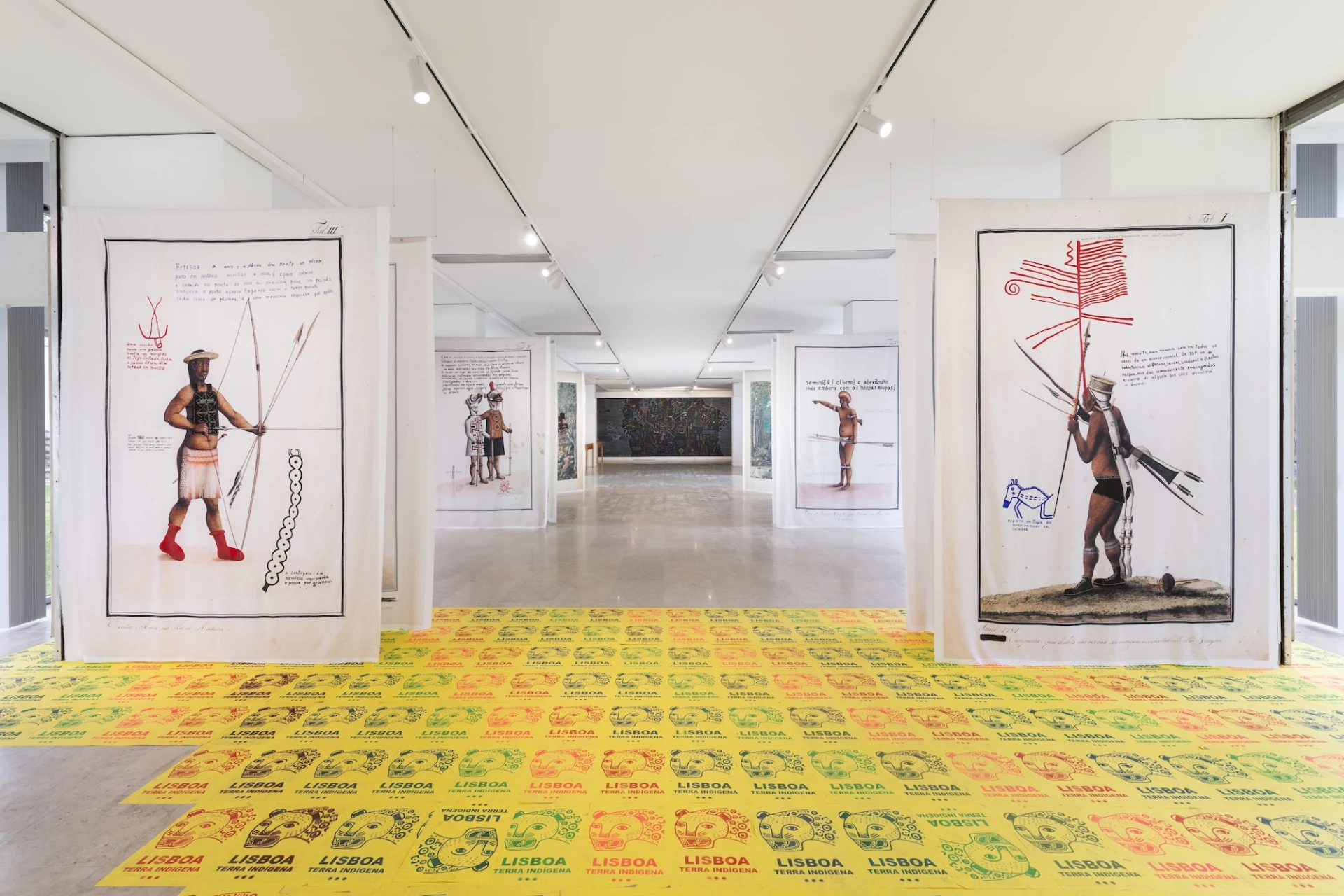
As we step into the exhibition space, several posters on the floor show the jaguar shouting “Lisboa, Terra Indígena” (Lisbon, Indigenous Land). This statement forces us to think about the rest of the exhibition based on the principle that Indigenous Land is extended across all its displaced elements. In this way, the stolen objects in the collections mentioned in Portugal can be Indigenous Land—demarcated by Denilson Baniwa's body. Eschewing the fetishization that Denilson knows is inherent in Western museology and exhibition practices, the artist does not limit himself to relocating the objects and texts he wishes to reinterpret from the collections to the gallery—although he also does so with a commentary that makes us question the scientific accuracy of material restitution. But what defines the exhibition is a timeless dialogue between Denilson himself and Alexandre Rodrigues Ferreira—a naturalist from Bahia who, in the 18th century, at the behest of the Portuguese crown, undertook an expedition to “collect” and document the indigenous populations of the Amazon, especially in the Upper Rio Negro, where Denilson was born. On large white cloths, which replicate Rodrigues Ferreira's illustrations and descriptions in the MUHNAC collection, Denilson responds to the naturalist by graffitiing and scribbling over these representations. A bulletproof vest, a Nike T-shirt, sunglasses, and sneakers under the drawn indigenous bodies make us think about the ongoing and current oppression and colonization under which they live. Flanking these interventions, Denilson also writes, interfering with the descriptions. Sometimes in Nheengatu, sometimes in Portuguese, we are challenged by a counter-narrative that takes over the description: “When Pedro Álvares arrived, / They heard ‘KILL’! / What a shame! / They didn't know the difference between a noun and a verb. Portuguese mistake” or “Look at Alexandre leaving with our clothes! / And that's how the legend that all indigenous people walk around naked was born.” More than social justice for his ancestral heritage, this exercise opens space for non-Western thinking in a history that calls itself Natural, but which until now has been little more than imperial-colonial validation.
Finally, a huge mural depicting an ocean filled with symbols drawn, this time by and for indigenous cultures, presents itself as a counter-cartography that imagines ways of reconnecting with what is still distant due to the extension of an entire body (of water) in denial. What still separates us is an ocean of decolonization. The spell against alienation has been cast!
I cannot fail to mention, even briefly, the extraordinary performance to which I have referred several times, and that greatly informed and facilitated the writing of this essay – since it set out to reveal the process of residencies in order to reflect on institutional and infrastructural neocolonization. Named Nosso Wayuri – which refers to the practice of doing things together – the performance exposes, with poetic and political precision, the silent but incendiary violence that persists in museums, archives, and historical narratives: the transformation of living communities into “collections,” of spirits into “artifacts,” and of knowledge into “names.” yet incendiary violence that persists in museums, archives, and historical narratives: the transformation of living communities into “collections,” of spirits into “artifacts,” and of knowledge into “common names,” under the seal of science. At the same time, the performance mobilizes a force of return. The indigenous voices that echo in the space—in letters, presences, songs, poems, and rituals—affirm an ancestral vitality that has never been fully captured. Showing that behind each climate-controlled drawer there are forced absences and kidnapped presences, which call on the viewer to recognize that what remains frozen in a warehouse still pulses—and demands return, listening, and reparation. Until this happens, Juão proposes a critical reversal of museological devices in his intervention entitled Branqueologya, in which he highlights the absurdity of the collections, classifications, and racial hierarchies that have structured Western institutions.
In a Wayuri unfolded in various presences, that is, various parts, historical silencing and erasure are summoned from freezing to burning: of collections, languages, and forests—guardians of knowledge and beings, Western and plural, respectively. Presented as a weapon and ontology, fire becomes the central scope of silencing throughout this event – as a weapon, we remember the libraries, museums, and forests that disappeared under the force of this element. But that which extinguishes also ignites. In other words, as ontology, fire can be thought of alongside the forest, in an analogy that understands transformation and becoming as openings to liberation from the colonial-capitalist empire and to regeneration. Indigenous art – as Wayuri, Denilson, and Terra Batida tell us – can do as much as fire and the forest. It can burn centuries-old choreographies, expose the perversion of colonial law, and continue to burn and burn!
And thus begins a new poem for the forest.4
1 Ritó Natálio (curator of Denilson Baniwa's exhibition, Contra-Feitiço [Counter-Spell]), in conversation with Ellen Pirá Wassu, in Cartas de Fogo (Letters of Fire) – part of the performance Nosso Wayuri (Our Wayuri), included in the exhibition.
2 Ellen Pirá Wassu, in conversation with Ritó Natálio, in Cartas de Fogo (Letters of Fire) – part of the performance Nosso Wayuri (Our Wayuri), included in the exhibition.
3 Cf. Viveiros de Castro, E. (2002). A Inconstância da Alma Selvagem e Outros Ensaios de Antropologia. São Paulo: Cosac & Naify.
4 Ellen Pirá Wassu, in conversation with Ritó Natálio, in Cartas de Fogo (Letters of Fire) – part of the performance Nosso Wayuri (Our Wayuri), included in the exhibition.
BIOGRAPHY
Benedita Salema Roby (b. Lisbon) has a degree in Art History (2019) and a master's degree in Aesthetics and Artistic Studies (2022) from the Faculty of Social Sciences and Humanities of Universidade Nova de Lisboa with the dissertation ‘Graffiti: Considerations on the Aesthetics of Transgression in the Public Space of the City’. She is currently doing her PhD in Artistic Studies - Art and Mediations at the same institution, where she is developing a research, with funding from the FCT, centred on the potential for societal and collective liberation around transgressive (artistic) practices such as graffiti and political graffiti. On this theme, she also participates in the making of documentaries and organises workshops on practice and thought for young people. Her thesis project, entitled ‘The Deconstruction of the (Experience of the) City and the Construction of the Counter-Public Sphere: Transgressive Creative Writing, Aesthetics and Politics’, is supervised by Cristina Pratas Cruzeiro and Joana Cunha Leal. As well as academic publications, he writes about emerging artists and visual and performing arts exhibitions for independent magazines such as Umbigo and Sem Título.
ADVERTISING
Previous
article
16 Jan 2026
About the reissue of the Osaka chair, by António Garcia
By Carla Carbone
Next
article

20 Jan 2026
Nature is eternal creation and recreation: Confluências, na Monitor
By Laurinda Branquinho
Related Posts
article
![How to [un]do Things with Words, Numbers, Flags, Maps and Signs:
A Jasper Johns Retrospective at the Guggenheim Bilbao](https://umbigo.s3.us-east-1.amazonaws.com/public/space/bilabo 4 -xnvdr.jpg)
06 JUL 2026
How to [un]do Things with Words, Numbers, Flags, Maps and Signs:
A Jasper Johns Retrospective at the Guggenheim Bilbao
By Benedita Salema Roby
article
20 FEB 2026
Avenida 211 at MAC/CCB – When will there be another 'occupation' action?
By Benedita Salema Roby
article
19 JAN 2026
One says “kill,” the other says “skin”—except that the first was misunderstood and was a noun.
Denilson Baniwa's Counter-Spell and everyone's Wayuri
By Benedita Salema Roby
article
30 OCT 2025
Weaves of Worlds Under Construction – Walk&Talk returns as a Biennial
By Benedita Salema Roby