article
Depois de Para Sempre, at Pavilhão Julião Sarmento
Depois de Para Sempre brings together works by Fernando Calhau and Rui Chafes, continuing the last exhibition featuring the former artist, who passed away in 2002. It is, therefore, an event that is explicitly dialogic: Depois de Para Sempre (After Forever) follows No Escuro (In the Dark), an exhibition held at Museu da Cidade in the very year of Fernando Calhau’s death. The exhibition, on display at the Julião Sarmento Pavilion, is curated by Isabel Carlos and features works in drawing, silkscreen, sculpture, etc.
There are certainly many possible angles from which to approach this exhibition and explore its meaning and expressive power, given that it brings together works from Julião Sarmento’s private collection and is thus naturally shaped by the personal taste of the artist-collector. In a sense, therefore, this is an exhibition by Fernando Calhau, Rui Chafes, and Julião Sarmento.
I understand the exhibition based on the principles of cutout and the weight-lightness dichotomy, brought to life by the attraction and magnetism of vertigo as a driving force for artistic creation. Consider the piece on display—a metallic knit jacket by Chafes, aptly titled Vertigo: the impression is one of a strangely light absence; the viewer almost censors themselves due to the delicate fragility that a displaced body, potentially dead or missing, conveys. Consequently, lightness becomes a threat, a cause for reproach—forbidden territory? And we realize that gravity precisely exposes our tendency, or our condemnation, to weight: are we free only if centered by a burden? Are we, after all, better off carrying some weight on our shoulders for the sake of our physical and moral uprightness? On the other hand, that coat stripped from a body seems to contain within itself the power of a story, and perhaps it is this suggestion that makes lightness pleasurable, as well as suspicious: what happened to that body? What kind of war did the one who inhabited that garment wage? (It is impossible not to think of the protective mesh of medieval military armor). The narrative, and the pleasure of witnessing and telling stories, reveals its profane face, and dances leaving no trace other than that of our desire, our fear, and travels redefining boundaries, accusing prohibitions, besieging closed spaces for future liberation.
In this exhibition, the concepts of gravity and weight take on various figurative and conceptual meanings. In a diptych by Fernando Calhau, the first panel reads “South East Noon” against a black background, dotted with white specks—of light, of chalk on a slate, of dust on a negative?—flanked by a second, gray panel that reads “South East Night,” also punctuated by the same specks. At noon, the sky, or the background, or whatever a veil it may be, is blacker than at night. One might conclude—more or less obviously—that at noon one sees less—the light is blinding—than at night; a night whose darkness is not so intense, even though it does, in fact, obliterate those white sparks, since the lower contrast does not allow for such sharp clarity. These white traces, the nature of which we cannot discern, seem to emerge as the precise error required to provoke a tonal discrepancy that enables vision. The ability to see is not, therefore, necessarily linked to the available light, but rather to the presence of bodies endowed with distinct luminous registers, allowing for a reading by contrast. These mysterious white bodies function as silhouetted forms, visible only in relation to another body, the background.
Weight can also be suggested by the presence of invisible forces, which make us the axis and the gravitas, in anticipation of a world we never come to inhabit, but which we sense exists. In another piece by Fernando Calhau, we read oãzar—razão (reason) spelled backward—in blue neon; a piece that invites us to enter a chamber, a sort of retreat or recess within the exhibition hall, where six steel plates, three on each side of the wall, are arranged symmetrically. On the opposite wall, in the center, stands another blue neon sign bearing the inscription ratio—reason in Latin. A return to the etymological origin of the word reason—and its civilizational empire, its very motive of faith—a morbid impression of the loneliness of death as inevitability; the fear of death that arrives despite all thought with its underlying logic(s). When confronted with these life-sized steel plates in a morgue’s refrigerated chambers, it is hard not to think of them as gateways to a past that was, in short, perfect—a past brought to a close by the beginning of decay. Or perhaps they are doors to nothing, a path to nowhere, the infinite universe.
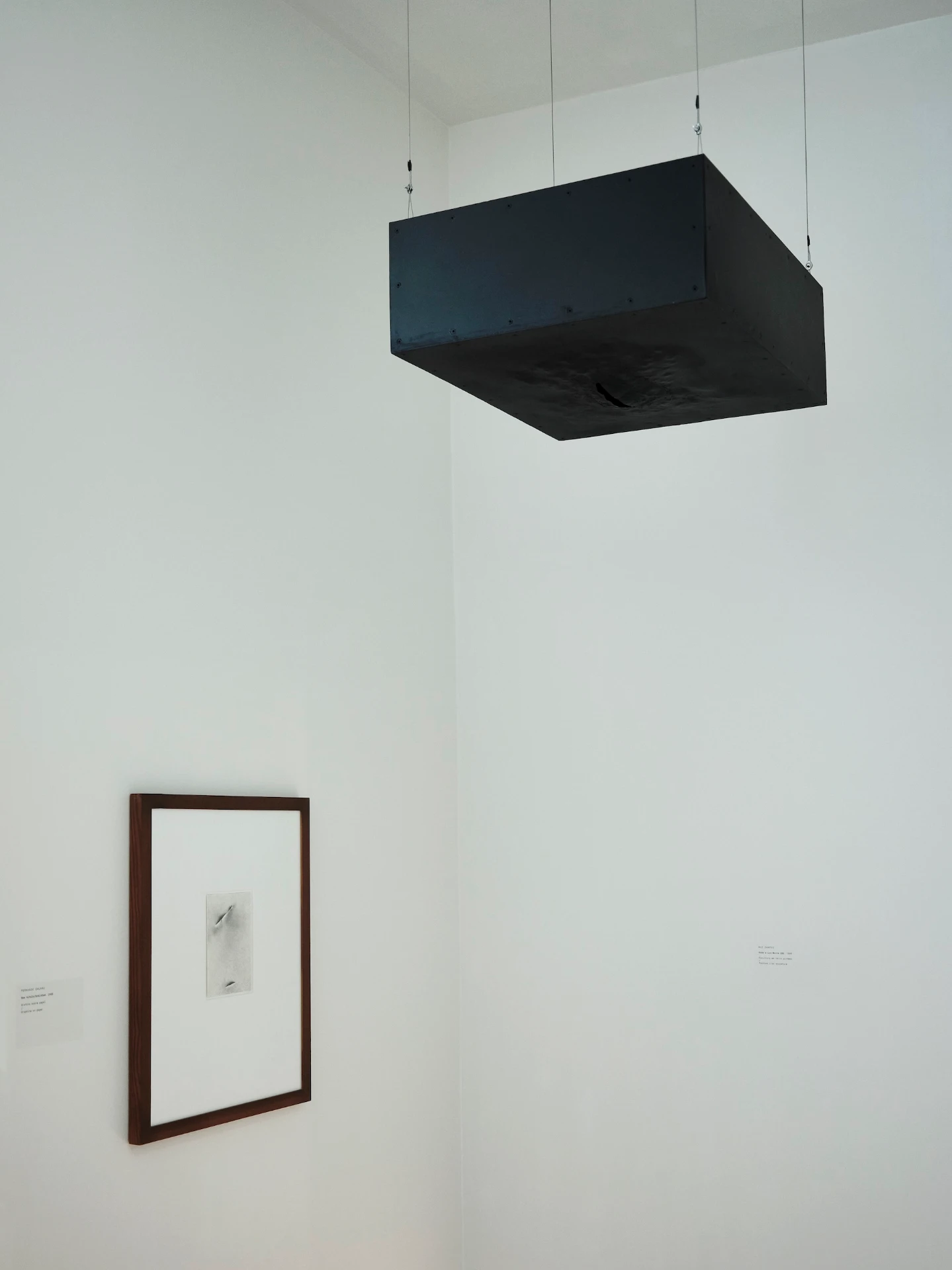
It is not necessarily important to summarize the exhibition. Perhaps the best approach would be to simply let it breathe within the fluidity it seeks to create—a fluidity of what tends to be heavy in everyday life, yet takes on a different weight, or aspires to a different lightness, when shifted into an art exhibition space. What is moving about this piece by Fernando Calhau—featuring the reverse side of an envelope printed with Andy Warhol’s famous silkscreen of Marilyn Monroe’s face—is, perhaps, the return to the greatest icon of the 20th century of the wholesome poverty of everyday life, not the lightness of anonymity, but the simple possibility of being something else, of entering another story: it is the interruption of an iconographic-normative correspondence to open up another possible constellation, one gathered not from the front but from the back, not from the public domain but from the acceptance of the secret underlying the more or less ingenious fabric of the story that each person constructs. Drawing on the simple material of an envelope, which serves as a means of communication between so many people, each with a face, and each a potential sender and/or recipient, Fernando Calhau hands a blank page to Marylin, making a vow to listen. Another piece that also serves as a sound box—notes for a song yet to come—is the sculpture by Rui Chafes, Onde a Luz Morre III (Where the Light Dies III). It is a black iron box, suspended from the ceiling, with a slit in the center, reminiscent of the female sexual organ: sex and birth; death, for which life is invariably a down payment. A mother lies there; there, a being is born—indefinitely, it is born. Lovers wait there, waiting. That is to say, another story begins there: a lowercase H, to be sure. Light curiously dies where our gaze reaches, and where it begins to glimpse other faunas and floras, other worlds, where the creation of a new language is urgent—a science of wind, a geography of silence—capable of bringing together opposing landscapes, rivers of salt, seas suddenly sweet, and not artificially sweetened. This is where light dies, and our gaze begins to be an arrow of fabulation. Goethe, in his Theory of Colors, writes: “We must still state a general quality of colors: they must be considered unconditionally as half light, half shadow, which is why a gray, a shading, arises when they combine two specific qualities that cancel each other out.” Based on Goethe's theory, the ambivalence reflected by colors is akin to the weight-lightness pair, as poles between which vertigo is generated. The undressing, not of the garment, but of the body itself; the journey of the gaze that an iconographic inversion compels, like an investment—if not passionate, certainly that of two friends reunited after a long time.
The exhibition is on view at Pavilhão Julião Sarmento until June 14, 2026.
BIOGRAPHY
Master's degree in Portuguese Studies from Universidade Nova de Lisboa, with a thesis on Nuno Bragança. She is currently writing a doctoral thesis on Agustina Bessa-Luís and Manoel de Oliveira and melancholy. FCT scholarship holder, she has contributed to anthologies and has published poetry and essays in national and international magazines. She has published two books of poetry: “E o Coração de Soslaio a Todo o Custo” (2025) and “Penhasco” (2025). She is co-editor of Lote magazine. She writes literary criticism for the Observador newspaper.
ADVERTISING
Previous
article
18 May 2026
God and the Devil in the Land of the Biennial
By Matteo Bergamini
Next
article
19 May 2026
Flaming Bodies, by Pedro Valdez Cardoso
By Tomás Gorjão
Related Posts
article
21 JUL 2026
On Desisto – o que não vejo imagino (I give up – what I can’t see I imagine), by Nuno Sousa Vieira
By Maria Brás Ferreira
article
18 MAY 2026
Depois de Para Sempre, at Pavilhão Julião Sarmento
By Maria Brás Ferreira
article
17 APR 2026
About "antes de subir à tona", by Cristina Robalo: to set the stage for a shipwreck, to know how to love the otherside of a portrait
By Maria Brás Ferreira
article
27 JAN 2026
Annie Leibovitz's apples and faces in Wonderland, at the MOP Foundation
By Maria Brás Ferreira