article
Sarab, by Mohammed Ahmed Ibrahim: The Stripped Form
I walked through Alfama, passing the small tascas that line the street, on my way to see Sarab, the exhibition by Mohammed Ahmed Ibrahim - one of the first-generation contemporary artists of the United Arab Emirates - at Perve Gallery.
The exhibition curator, Mo Reda, approaches the artist's work through the concept of sarab – which means mirage – allowing the uncertainty embedded in the brushstrokes to open a dual mode of perception, both essential and formal. Sarab, the first chapter of the triptych And Thus He Crossed Over establishes a direct connection between migration and the re-creation of the self.
Mo Reda’s statement “Migration is not the opposite of settlement, but its origin” frames identity as something not given as a finished product, but unfolding as an ongoing task.
These days, I have been reading Paul Klee’s diaries. At a moment of intense struggle between music and painting, his unexpected encounter with his own reflection beautifully articulates the process of self-construction. He writes: “I took my sketchbooks again. I felt that certain hopes were beginning to awaken within me. By chance, I saw myself reflected in a windowpane, and at that moment, I began to form thoughts about this person looking back at me. I had often observed him before, but today I understood him.” Human existence, in this sense, remains partially concealed from itself, always in search of its own essence.
Mohammed Ahmed Ibrahim pursues the bare essence of form. He does not seek to construct an alphabet or a system, but rather to perceive form in its stripped-down state. It is like seeing, in an automobile, two circles and a rectangle or reducing flowers to linear strokes and circular shapes, shedding them of their forms.
The method through which Mohammed Ahmed Ibrahim sharpens and gives definition to form is rooted, at a subconscious level, in the engravings he saw as a child on stone surfaces. These symbols are nothing more than rough markings carved into rock, and they signify something: they carry a voice.
While listening to the sounds of the past within his work, Ibrahim does not approach the past as an instrument of nostalgia. Instead, he recalls a sort of “knowledge” that emerges from childhood itself. The best guide, he suggests, is childhood. Instead, interested in a "reservoir of memory," he evokes a kind of "knowledge" that emerges from his own childhood, which, as he suggests, is the best guide.
To me, the rainbow is one of the most beautiful forms of sarab. At the beginning of its arc, there are stories of a treasure chest filled with gold, or a jar of sweet honey waiting to be found, but it is never reached. It is, ultimately, hope. Perhaps it is precisely this kind of “hope” that gives rise to the artist’s freedom in the use of color.
Mohammed Ahmed Ibrahim’s universe is so vibrant that it stands in contrast to the qualities of sarab that might otherwise be considered negative, such as ambiguity or unattainability. It is no coincidence that his work is also deeply loved by children. Especially in his sculptures and paper-mâché pieces, there is a childlike spirit, a sense of play embedded within clearly defined geometric forms.
The reflection of color upon things directly shapes the way we see. Even when we close our eyes, vision does not entirely cease. There is a small space between the eyelid and the eye itself. The artist draws upon the forms perceived within this interval.
In his collage works, Mohammed Ahmed Ibrahim paints the paper himself, tearing and dividing it by hand without using scissors or any cutting tool. He produces his own colors, working with organic materials such as paper pulp, leaves, tobacco, coffee, and tea. The edges of the paper he tears with his hands produce, once again, a sarab effect, an unstable boundary, one that resembles neither a fixed nor a fully defined limit.
When looking at the series Two Flowers in a Vase, the mind is already prepared to associate it with multiple images. Yet the artist has given it a title that confines interpretation: “You are seeing two flowers in a vase, nothing more than that.” Similarly, in the Doors in Amsterdam series, as we observe the layered colors, images of Amsterdam’s architecture, its canals, and its small, chaotic order begin to appear before our eyes. We could say that the titles deliberately hold thought within a specific frame.
This also resonates with Jean-Paul Sartre’s logic: “Man is nothing other than what he makes of himself.” Indeed, we construct ourselves within certain limits. Even if these limits appear as trembling, mirage-like images, at their core there is a burning, erupting volcano of “reality” and we are nothing beyond that.
A second layer follows the conceptual image offered by the artist. What is presented here is not a ready-made definition; even though the titles of the works aim to guide thought, they simultaneously generate in the viewer an instinctive desire to lose that meaning.
Our way of perceiving the world is ultimately deciphered through the language of creation. Within the context of Sarab, an even more compelling question emerges: how can we both create ourselves and become the selves we have created? Is creative force not, in essence, born from a profound affinity with ambiguity?
Sarab can be visited at Perve Gallery until June 6, 2026.
BIOGRAPHY
Ayşenur Tanrıverdi is an Istanbul-based writer, living in Lisbon since September 2022. She studied at Istanbul University and is the author of two published works of literary fiction. A regular contributor to Cumhuriyet, a major Turkish newspaper, where she focuses on Portuguese culture. Her essays and critical texts on theatre, literature, and contemporary art have also been featured in various art magazines.
ADVERTISING
Previous
article
09 May 2026
Mesa-Paisagem (1973), by Ana Vieira, at Brotéria
By Carla Carbone
Next
article
11 May 2026
Brief notes on Art Brussels 2026
By Maria Inês Mendes
Related Posts
article
18 JUN 2026
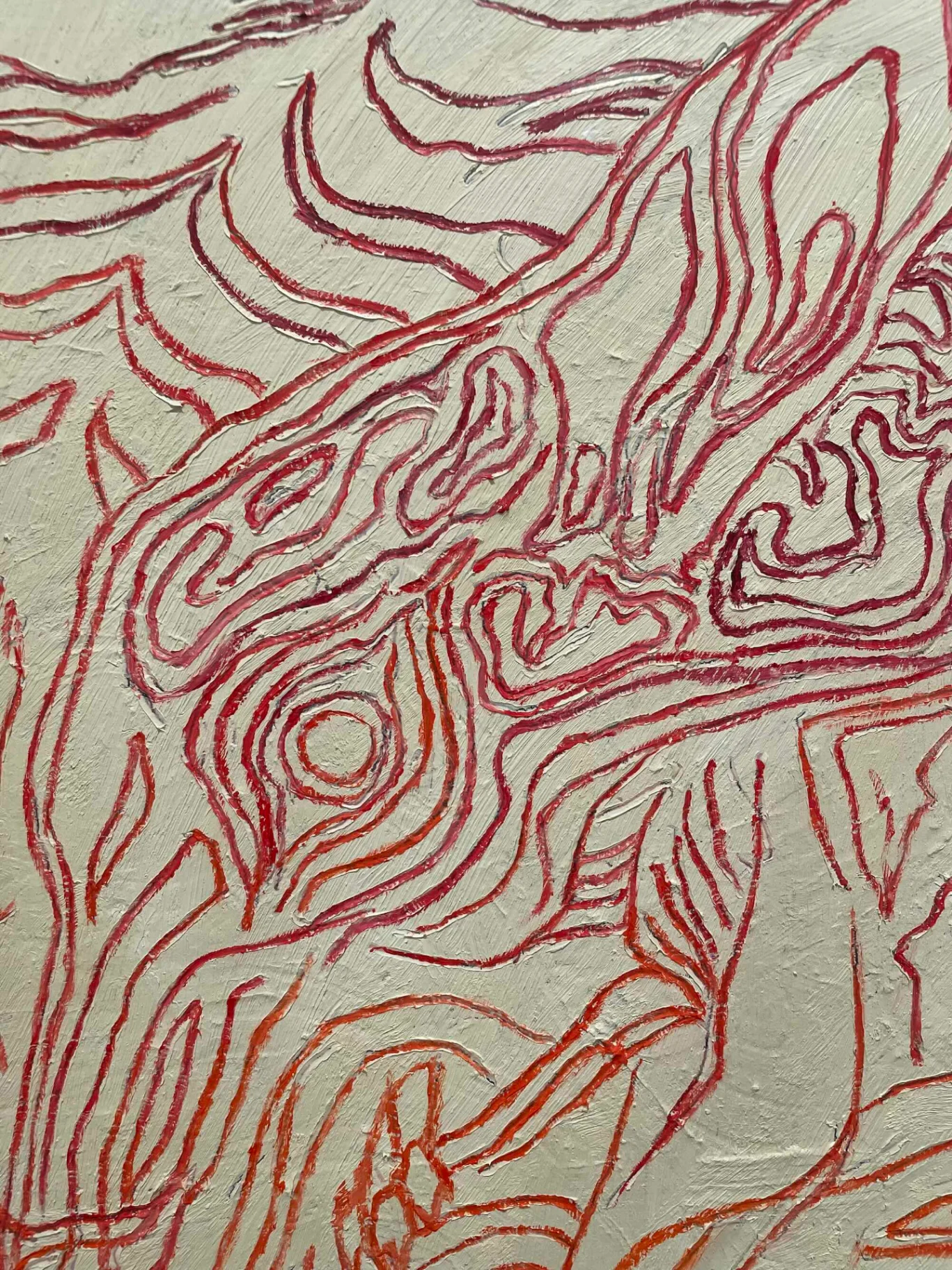
Olho de Vidro, by Pedro Barassi: The Gravity of the Gaze
By Ayşenur Tanrıverdi
article
15 JUN 2026
Notes on ARCO Lisboa 2026
By Ayşenur Tanrıverdi
article

08 JUN 2026
Língua Turva: The Aesthetic Unconscious
By Ayşenur Tanrıverdi
article
02 JUN 2026
On Wandering Among Beings: "Entre Seres" by Susanne Themlitz
By Ayşenur Tanrıverdi