article
Tabique, by Rita Gaspar Vieira
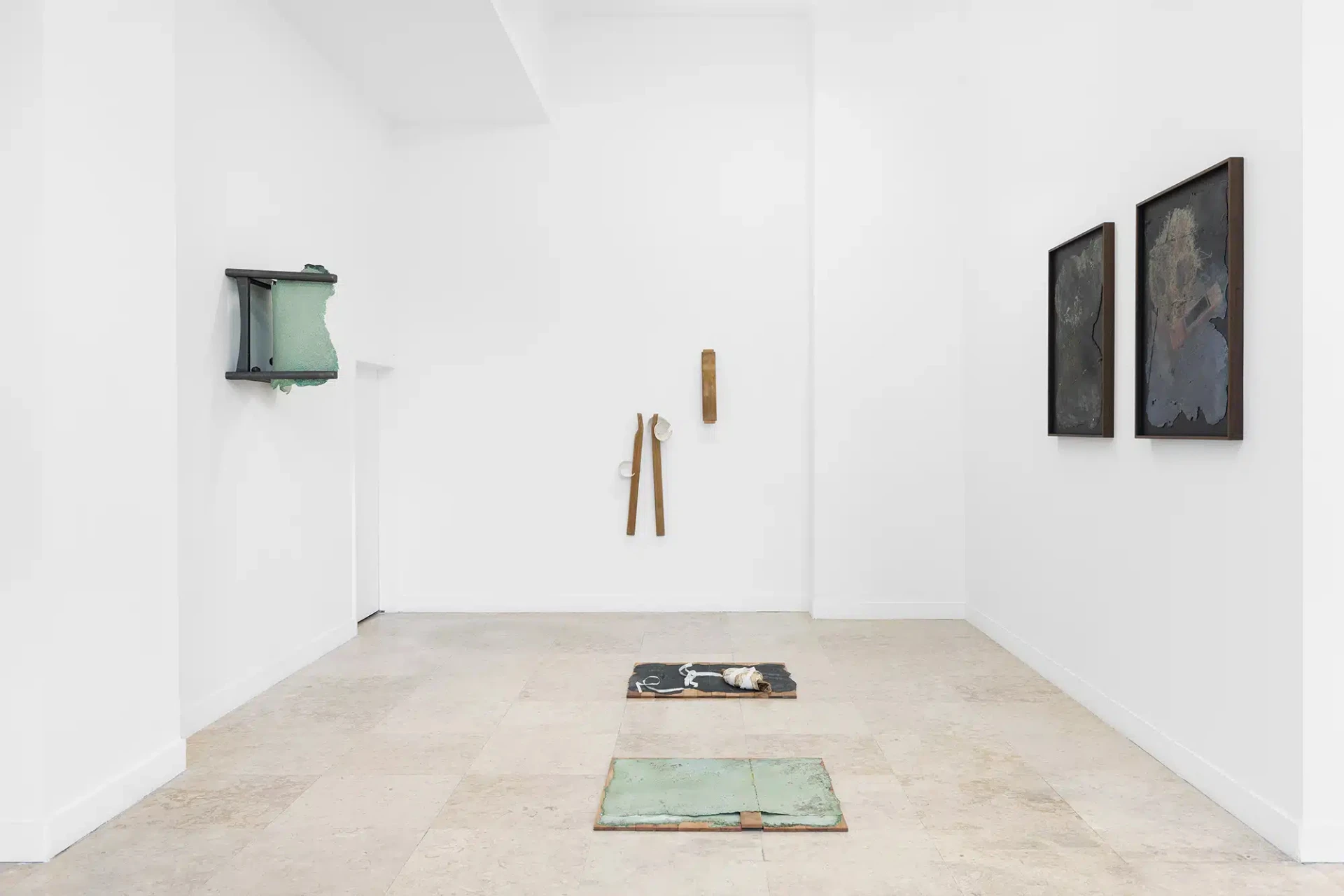
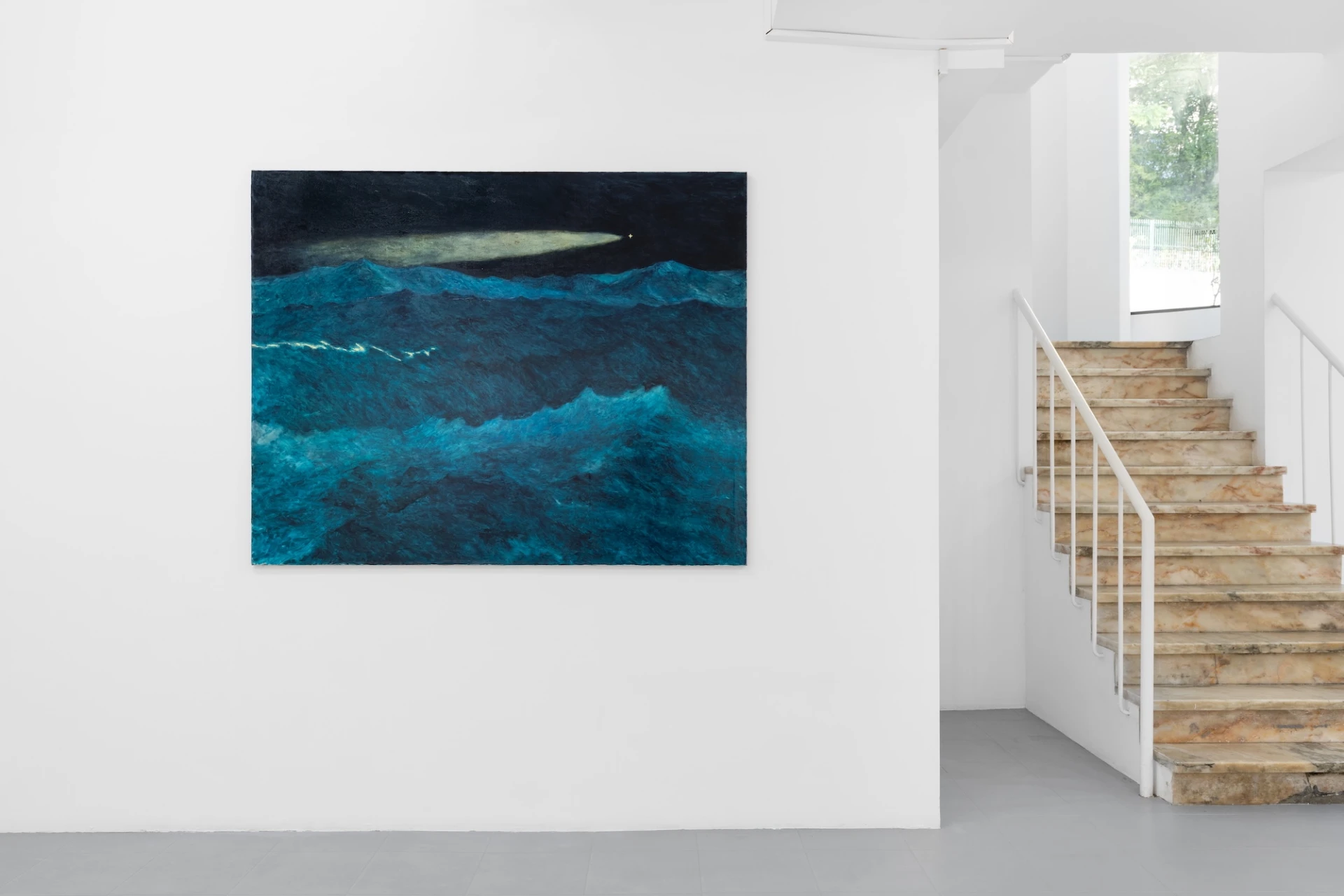
Tabique, on display at Salgadeiras Arte Contemporânea, extends throughout the gallery, creating a space for exploring processes. Rita Gaspar Vieira presents us with a system of thought in which matter, gesture, time, and trace coexist in a state of inscription but also, I would say, divination. Between archive and memory, the attempt to name and the awareness that all naming is precarious construct an experimental dimension, distancing the work from any fixed understanding. Revelation emerges here as a process of knowledge, as a method of sensory investigation, a trace of embodied thought.
In this sense, the exhibition evokes an idea of thought organized not exclusively through language, but emerging equally from bodily experience, gesture, and direct engagement with matter. Through repetition, material friction, contact with unstable surfaces, error, delay, and suspension, different textures, fissures, and compositions emerge—black from graphite and green from copper sulfate. All of this indicates a process permeated by a tactile intelligence that runs through the entire exhibition and shifts it into the realm of the imagination of experience .
The relationship between sign and gesture becomes particularly evident in the emphasis on the mark. Each inscription seems to contain the duration of its own appearance. The work seems to accumulate pressure, speed, and interruption. This processual dimension brings the artist’s practice closer to an investigation of the sensible, as if exploring a possible system for inscribing memory, a form of unstable and permeable archive. Surfaces become repositories of time, places of transitory signs. Each layer contains residues of previous actions, minimal sedimentations, traces of contact.
It is precisely at this point that water takes on decisive importance; it constitutes a true operative and conceptual method. In the artistic practice presented in the exhibition, water directly interfered in the processes of constructing what we see, becoming an agent of transformation of matter and of visual thought itself, as if a drawing tool. Rather than completely controlling the surface, the artist accepts the unpredictable action of the liquid on paper and on the materials. That openness to the accidental and to adjustment is central to the exhibition. Water produces deviations, alters densities, dissolves boundaries, and creates zones of indeterminacy. However, I believe we should not view these accidents as purely random. Control is exercised over chaos, insofar as the artist creates conditions for the material to respond and for the process to reveal its own behaviors. The work unfolds as a continuous negotiation between intention and material autonomy. We can see how the material retains a memory of its transformations. Everything seems to exist in a transitory state, vulnerable to change, evoking an almost pre-linguistic dimension. The marks, the stains, the wood, the papers that run through them, and the accumulations function almost as signs of a primordial attempt at inscription that reveal maps of possible shelters and cotton scars, as if the artist were seeking to rediscover a more direct relationship between body, material, and world, before the separation between subject and object. I therefore see the work as part of a relational system. Objects produced from elements of the artist’s home, the studio floor, contribute to an expanded perception of what the work can be.
Our body, the observer's body, becomes part of the process as well. We move, we draw near, we adapt our gaze to the material subtleties, to what is hidden and pushed into crevices. The very title of the exhibition becomes particularly revealing in this context. It is neither absolute closure nor total openness. It inhabits a zone of tension between revealing and concealing, between protecting and exposing. This condition runs through the entire exhibition and finds a subtle echo in the presence of the walnut shells that the artist scatters—more or less conspicuously—throughout the exhibition space and in the representation of the nests. These are small structures of containment, bodies that hold a memory of what was once present. As with the surfaces worked by the artist, perhaps the evidence of transformation is of greater interest than the finished work.
Perhaps Tabique is precisely that, an attempt to sustain. Sustaining the material at the moment of its transformation, sustaining the trace before its disappearance, sustaining the tension between concealment and revelation. These works hold onto something that never fully reveals itself, inhabiting that fragile space between what was and what is.
There is also a rejection of contemporary visual speed. This decelerated relationship—where one must sometimes look again to discover the differences, to be certain that it is not what we have just seen—asserts itself as resistance. Resistance to the fixation of meaning, to the separation between the everyday and the artistic, to accelerated productivity. There seems to be no intention to dominate the material, but rather to listen to it. And it is perhaps in this slow, bodily, permeable listening that the exhibition finds its greatest critical and poetic strength.
The exhibition can be visited until June 20, 2026.
BIOGRAPHY
Maria Inês Augusto, 34, has a degree in Art History. She worked at the Museum of Contemporary Art (MNAC) in the Educational Services department as a trainee and for 9 years at the Palácio do Correio Velho as an appraiser and cataloguer of works of art and collecting. She took part in the Postgraduate Programme in Art Markets at the Faculty of Social Sciences and Humanities of Universidade Nova de Lisboa as a guest lecturer for several editions and collaborated with BoCA - Bienal de Artes Contemporâneas in 2023. She is currently working on an Art Advisory and curatorial project, collaborating with Teatro do Vestido in production assistance and has been producing different types of text.
ADVERTISING
Previous
article
09 Jun 2026
Vivian Maier – Anthology at the Centro Português de Fotografia
By Ana Martins
Next
article
![Regenera, volta a criar [Regenerate, (re)create]](https://umbigo.s3.us-east-1.amazonaws.com/public/space/Im-F-191oc.jpg)
12 Jun 2026
Regenera, volta a criar [Regenerate, (re)create]
By Umbigo
Related Posts
article
29 SEP 2026
Multiple Eyes, to unlearn how to see
By Maria Inês Augusto
article
25 JUN 2026
Scrolls, at Buraco: The Two Sides of the Same Coin
By Maria Inês Augusto
article
12 JUN 2026
Tabique, by Rita Gaspar Vieira
By Maria Inês Augusto
article
12 MAY 2026
Phantom Tales, by Pedro Zhang
By Maria Inês Augusto