article
Radical Gestures, by Tatiana Macedo, at Rialto6
There is a kind of subliminal self-referencing in the first act of Tatiana Macedo's exhibition project, Radical Gestures, something I find very pleasing. The exhibition presented at Rialto6 is, this time, a subtle but truly critical theme that focuses on the multiple issues surrounding museums, their policies, and their spaces that provide experiences or, supposedly, relationships.
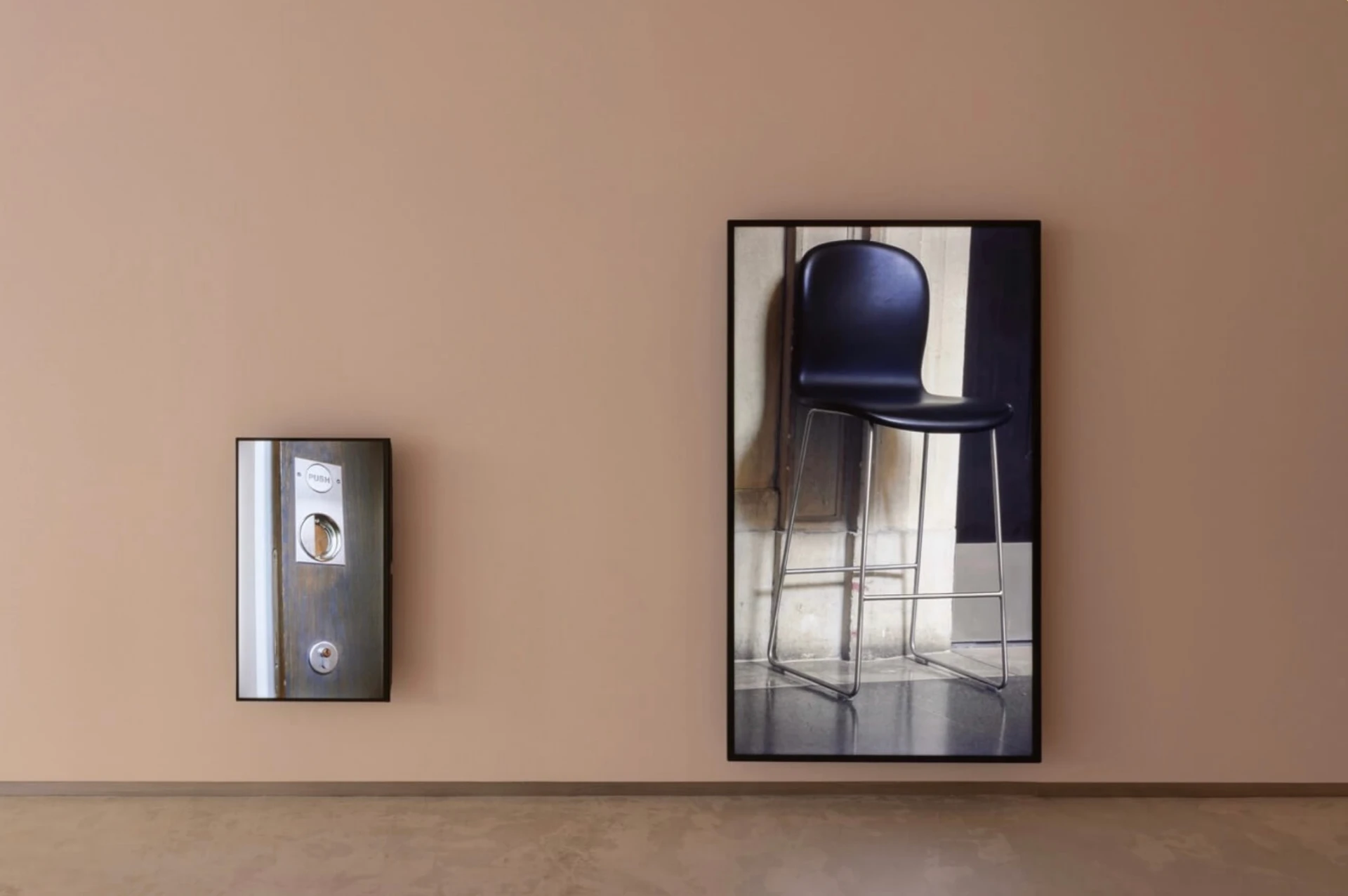
But, before we go into revealing these details, let's look at the brilliant refinement of the artist's work, a set of videos recorded in 2012 at Tate Britain and Tate Modern, but only now shown — with the exception of the film Seems So Long Ago, Nancy —, through a lesson in montage work that is, continually, a concern of the artist in relation to the way she displays her work. Tangent to the qualities of a curatorial gesture, Tatiana thinks about the positions of the images through the lens of a site sensitive perspective, which allows her to produce not only an encouraging visual spectacle, but also a spatial continuation of the screens she uses1, something that ends up diluting the separating line between places and translating a certain duality of things, a reality and a fiction given by the body-camera 2 and its gaze.
All this fictional aspect, crafted through the masterful use of the camera and post-production processes—not forgetting all the impetus given by Tatiana—will be deconstructed, transforming the artist's images into raw relation. From there, this fictional equation disappears, and everything becomes very, very real. However, this so-called reality is not handed to us on a silver platter. It's not immediately apparent that what we glimpse there are not paintings of brutal technique, but rather images that contain very subtle movements. But, much more than that, what is present in them is an entire museological anatomy given not only by some architectural components, but by what underpins it: the people who work in the gallery assistance, or, as they are called by the Tate, the Visitor Experience Assistants. With hands caressing the passage of time, feet swinging erratically, and reflections a little further from the present, we are importantly reminded that the hands of the clock detach themselves when attention demands its own attention. That radicalism.
This is what Tatiana Macedo desires for all her work, a prolonged pause, but one that becomes especially evident here, in Radical Gestures. If the work of the ushers is precisely that, attention (albeit a strange kind of attention…), then we, as visitors here, are placed both face to face with that same position. And it is in Seems So Long Ago, Nancy — whose title comes from a Leonard Cohen song that had stuck in the head of a Tate3 usher — that we find the epitome of this. Through shots that fix our gaze on something for some time, we are unexpectedly confronted, in a breaking of the so-called cinematic fourth wall, by a look into the eyes of one of the ushers being filmed.
I won't want to describe that feeling to you, as I'm afraid of disrupting the authenticity of your experience… I say this because in this project, the artist, even if it wasn't her primary intention, was able to bring to the table a range of issues that, in my humble opinion, require immediate solutions. Having worked as a room assistant in Portuguese cultural institutions, this exhibition made me feel seen and, even more so, makes me feel that it's a great premise for denouncing the attention problems that plague museum spaces. Here, attention is entirely part of the vocabulary of care policies and, especially, self-care, which museums lack in relation to the people who make them function on a daily basis 4. We cannot forget that these places are also workplaces and, in that sense, need to be thought of as such. In this exhibition we don't find the answer to these problems, but I know we've found one of their possible starting points. Again with Seems So Long Ago, Nancy, one of the last shots is the exterior of the museum. Together with the wonderful large window of Rialto6, they seem to point the way forward for the solution. One outside, redoubled attention that will surely cure the virus that's going around here…
This was a text that deserved a longer and much clearer exploration, but all that remains for me is to extend the invitation to all those who work or have worked as classroom assistants to come and see this project, to feel their own existence, and to find a critical force that does not give up.
Radical Gestures, by Tatiana Macedo, is open at Rialto6 until October 3rd, with several screenings of films she has directed.
1 The coloring of the videos, especially when looking at the walls of the filmed locations, is reminiscent of the color of the walls in the Rialto6 space, which was reused from the previous exhibition—an equally interesting challenge.
2 From the program notes, in a very well-written text by Manuel Bogalheiro.
3 Interestingly, the pun is self-evident. The title of the album where this track appears is Songs from a Room.
4 Visitors are also included in the lack of care. Just like the other teams, whether they are cleaning staff, security personnel, or others.
BIOGRAPHY
Tomás Saraiva (b. 2002) has a bachelor's degree in Art and Heritage Sciences from the Faculty of Fine Arts in Lisbon and a master's degree in Curatorial Studies at the College of Arts of the University of Coimbra. His work focuses on the intersectionality between the practice of the visual arts and the practice of curation and mediation, through an exploration of relational mechanisms and their impact on the apparatus of thought and action. At the same time, he has been organizing and participating in various exhibitions both nationally and internationally.
ADVERTISING
Previous
article
02 Sep 2026
Serapinas and Ourahmane at the Porto Municipal Gallery
By Mafalda Teixeira
Next
article
03 Sep 2026
Terra Crua at MAC/CCB - Architecture Centre
By João Pedro Soares
Related Posts
article
03 SEP 2026
Radical Gestures, by Tatiana Macedo, at Rialto6
By Tomás Saraiva
article
13 AUG 2026
Reaching the fata morgana, by Inês Mendes Leal, at the Boavista Gallery
By Tomás Saraiva
article
13 MAY 2026
itede, itepe, by Dorota Jurczak, at Rialto6
By Tomás Saraiva
article

16 MAR 2026
Espaço Intermédio, by Cristina Ataíde
By Tomás Saraiva