article
Traslados, by Marcelo Moscheta
"Following Camus, it may make sense to say that absurdity lies in the attempt to establish meaning when that meaning can only be affirmed unilaterally. The operations proposed by Moscheta insist on this limit: displacing, comparing, knowing that the material does not respond. The other side remains silent, and it is this silence that sustains the insistence. After all, every stone is a small mountain."
It is well known that the gods condemned Sisyphus to push a boulder up a mountain, from where it would roll back down again, as a result of its weight. They had thought, somewhat rightly, that there is no more terrible punishment than useless and hopeless work. However, they forgot that this universe, without an owner, never seemed sterile or futile to him. Each grain of that stone, each mineral splinter of that mountain, the very struggle to reach the peaks was enough to fill his heart. (Camus, 2016)
And so the meaning of the word punishment was lost.
It was not about redemption or progress, only the persistence of a gesture that became a measure: not the measure of a result, but the measure of a relationship. A continuous, albeit unstable, relationship between body and space, between displacement and re-signification.
Let us ask ourselves: how can we measure a body's amplitude in space when the task does not lead to an end, but is affirmed in repetition? What is measured when something is displaced? Is it the space that has been left empty, the matter that has changed place, or the relationship that has been transformed between the two?
Drawing on an approach that makes space and landscape the locus of work and thought, Marcelo Moscheta revisits these questions in his latest exhibition, Traslados. As homo faber, we find ourselves involved in an operation on matter: extracting, separating, transporting, rewriting. But this gesture, common to all visitors, is not subordinate to a construction logic or an assertion of dominance; it remains within a framework of attention and measure. The stone, a central figure presented from different perspectives, strips the homo faber of the Promethean promise of the world: he does not build, he does not lay foundations, he does not stabilize.
The photograph that opens the exhibition captures a moment of rest: the body, lying on the ground, measures itself against the stone's verticality, without touching it; distance and scale establish the relationship. This initial movement reappears later in the form of a moving image. In one of the videos that form part of the collection presented on the upper floor of the museum, the artist-subject approaches the stone, touches it, goes around it, and returns to the starting point. It should be noted that this movement does not appear as an extension of the still image, it reinscribes it in time, repeating what remained imminent in it. There is no narrative progress, so much as a variation in regime. If photography retains this coexistence between body and matter, video exposes the testing of meaning: understanding oneself in the given, in what already exists. An empirical approach to determining the effective dimensions of the body based on its approximate relationship with displaced masses.
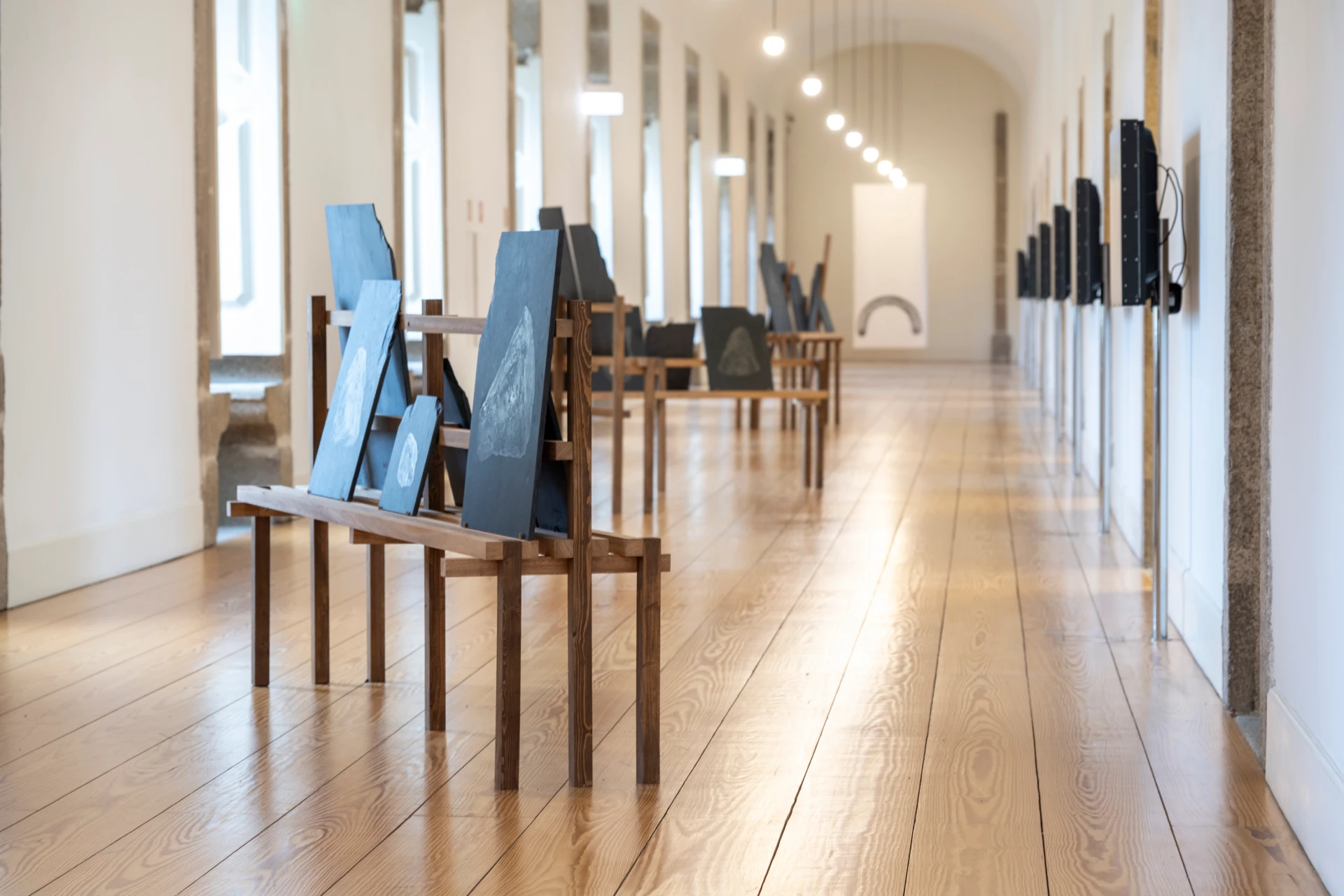
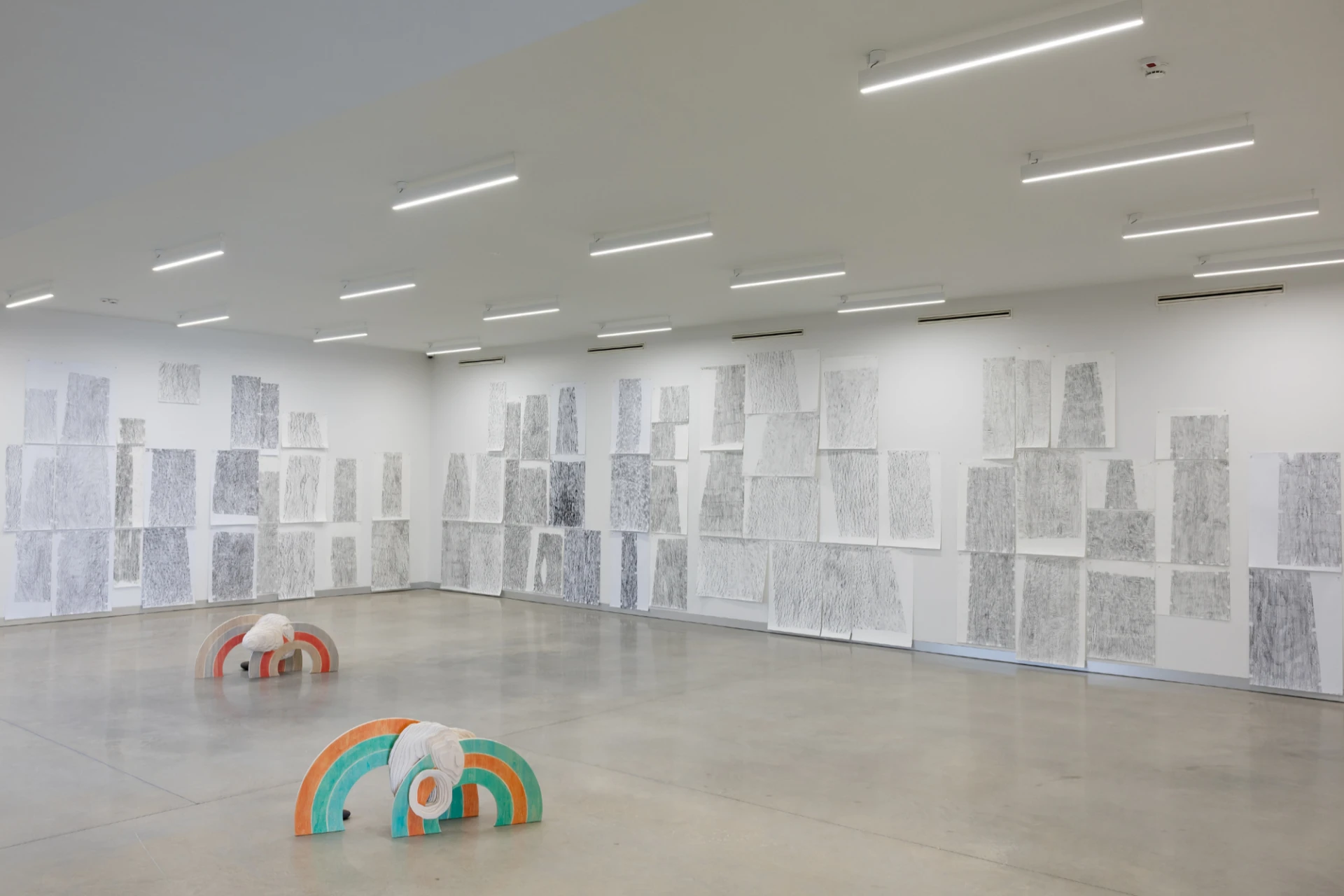
Still on the exhibition's top floor, this relationship grows more precise with every step. The easels, arranged like observation stations, their blackness imposing as a device for attention, complement this set of videos, in which the contact between body and matter is shown in minute detail. Each approximation made between the two elements, to which a third is added, seems to test a hypothesis: measuring the surface, recognizing the weight, understanding the scale. The path of the third element, the one that observes, echoes this same movement, in which each step introduces a difference. Territory does not change status, the body conquers nothing; what changes is the relationship of measurement itself.
On the exhibition's lower floor, the stone, stated in the singular but exhibited as part of a series, no longer presents itself as a unit to be confronted. It appears as a displaced, accumulated, reiterated whole. The weight, the quantity, the exhaustion of the relationship now impose themselves. The displacement of territories is displayed sequentially: the photograph of the landscape, crossed by the dotted line; the isolated image of the stone; the stone itself. This sequence, displayed on the lower floor, makes it clear that the transfer is not a linear movement, but an operation that produces ontological discontinuity. The territory ceases to be a whole, and the object ceases to have a stable place.
Following Camus, it may make sense to say that absurdity lies in the attempt to establish meaning when that meaning can only be affirmed unilaterally. The operations proposed by Moscheta insist on this limit: displacing, comparing, knowing that the material does not respond. The other side remains silent, and it is this silence that sustains the insistence. After all, every stone is a small mountain.
Traslados, by Marcelo Moscheta, is on display at the International Museum of Contemporary Sculpture in Santo Tirso until March 29.
References:
Camus, A. (2016). The Myth of Sisyphus, Essay on the Absurd. Porto: Livros do Brasil.
BIOGRAPHY
Débora Valeixo Rana (b. 1990, Lisbon, Portugal) is a philosophy teacher living in Porto. She graduated in Philosophy from the Faculty of Letters of the University of Porto (2011) and has a Master's degree in Teaching Philosophy in Secondary Education (2019). Her academic and professional career reflects a deep interest in the intersection between Art and Philosophy, a dialogue that led her, in 2022, to take up a master's degree in Artistic Studies and Art Criticism at the Faculty of Fine Arts of the University of Porto.
ADVERTISING
Previous
article
05 Feb 2026
Trunfo ou Triunfo: A Deconstructive Approach to the Concept of Power
By Ayşenur Tanrıverdi
Next
article

09 Feb 2026
O chão na cabeça, by João Timóteo
By Laurinda Branquinho
Related Posts
article
17 SEP 2026
It´s a pink area, by Marc Kokopeli and Sydneys Schrader
By Débora Valeixo Rana
article
01 APR 2026
Meteorizações, by Filipa César
By Débora Valeixo Rana
article
06 FEB 2026
Traslados, by Marcelo Moscheta
By Débora Valeixo Rana
article
07 JAN 2026
A Morte Escreve a Floresta, by Nuno Henrique
By Débora Valeixo Rana