article
About Cynara Complex: Diana Policarpo at VNBM Arte Contemporânea
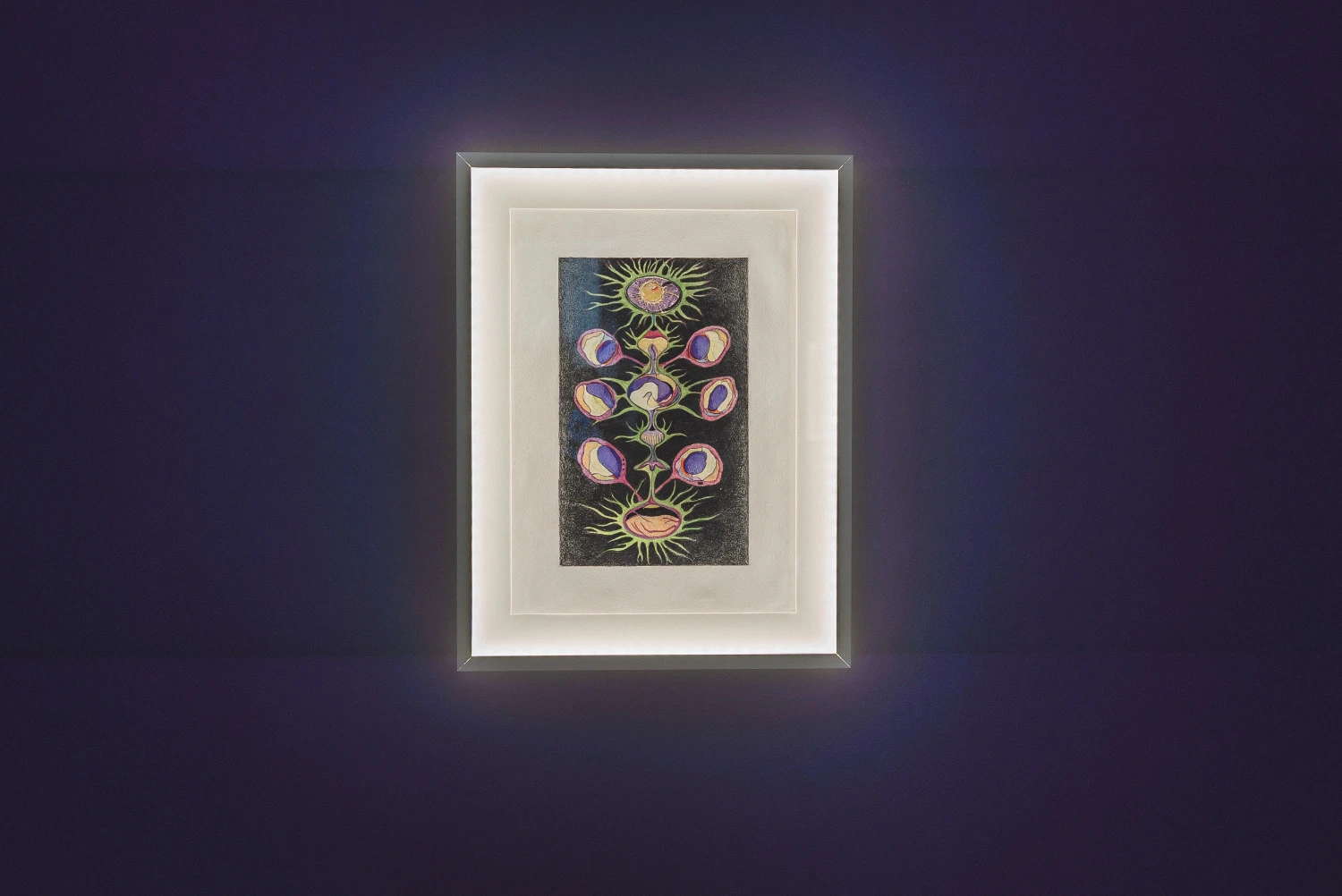
It is from the thistle — Cynara cardunculus — that Diana Policarpo constructs the result of an artistic residency at the Viseu-based gallery VNBM Arte Contemporânea (Venha a Nós a Boa Morte). Cynara Complex brings together in its title the ambiguity necessary for us to examine its different segments. The exhibition comprises a sound installation of the same name and three mixed-media drawings: Flower-Mountain, Seedblings and Root Song.
The thistle appears in the artist's research by a happy coincidence, at a time when she was working on the theme of soil contamination and regeneration. At the same institution with which she collaborated—the Higher School of Agriculture of Viseu—researcher Paulo Barracosa was studying the plant's regenerative capabilities. Thus, the project gained multiple ramifications.
Between the idea of symbiosis between human and plant life and soils contaminated by mining, a tension emerges: these soils reflect a dimension that underscores the breakdown of the initial symbiotic idea, which, however, persists in the very narrative of the sound installation. Cynara is a hybrid being: animal and plant, human and thistle.
In the installation, in addition to the oral, written, and read narrative by Diana Policarpo, typically bucolic gestures and movements are audible. The visitor is placed in this hybrid field reserved for Cynara—a porous space where the sensed word succeeds the read word and is clothed in the sounds of the field, placing them in a place of doubt, as if they could, temporarily, unite with the soil and share the experience that the artist narrates.
The three drawings present in the space allow us to intuit plant life, in the indefiniteness necessary to the very process of intuition. In her composition, the artist includes paper made from the thistle itself, in addition to the usual Fabriano paper. Thus, the process of representation recedes before the presence of the represented. We are, once again, faced with a hybrid body, a symbiosis. The exhibition space reinforces this ambiance through its purplish hue.
The thistle reveals itself as a salvific plant, regenerating the soil. Awareness of this capacity leads humankind to its use, making the plant an extension of itself. Following the research of biologist Lynn Margulis, symbiosis is shown as a driving force of evolution, propelling more robust life forms. Through the work of Diana Policarpo, we understand the potential of symbioses; Cynara Complex focuses on this. Cynara, the one in the story, claims empathy and otherness, despite its hybridity. We think of her in relation to the contaminated soil and appreciate her effort. Cynara is a symbiotic metaphor that, like art itself, operates in difficult territories.
The reason for the soil contamination—mining—demands reflection. It is a hybrid method of exploitation, this time in a negative sense, that simultaneously destroys nature and affects humankind. These actions highlight not only the ecological impact, but also the social and cultural impact, leaving deep and lasting marks on the territory, on collective memory, and on ways of inhabiting the space.
Cynara Complex, by Diana Policarpo, can be visited until December 7th.
ADVERTISING
Previous
article
26 Nov 2025
A(na)tomic unity: Vieira da Silva at the Guggenheim Museum Bilbao
By Maria Inês Mendes
Next
agenda
28 Nov 2025
3rd Edition of Centro Mutável, in Montemor-o-Novo
By Umbigo
Related Posts
article
22 JAN 2026
Sopro Luminar - Obras da Colecção dos Encontros de Fotografia
By Daniel Madeira
article
27 NOV 2025
About Cynara Complex: Diana Policarpo at VNBM Arte Contemporânea
By Daniel Madeira
article
24 NOV 2025
About "Intruso no Labirinto" by Jorge Queiroz, and "Pele de Barro" by Flávia Vieira
By Daniel Madeira
article
16 OCT 2025
About Sonho Manifesto! Em Leiria, todas as árvores são pinheiros
By Daniel Madeira