article
ANOZERO’26 – Bienal de Arte Contemporânea de Coimbra: Segurar, Dar, Receber (To hold, to give, and to receive)
It is in the balance and symbiotic relationship between Art and Architecture – a discipline that took a central place in the first edition of Anozero-Bienal de Arte Contemporânea de Coimbra [Um lance de dados, 2015] – that the Anozero’26 program asserts itself. Curated by Hans Ibelings, John Zeppetelli, and with Daniel Madeira as assistant curator, the presence of architecture in the 6th edition of the Coimbra Biennial of Contemporary Art leads to an exploration of the relationship between exhibition spaces and habitats. In this regard, it is worth highlighting the etymological origin, in the Indo-European word ghabh, meaning exhibition and habitat, the same as the verbs that serve as the theme of the biennial: To hold, to give, and to receive.
Inspired by the principle of mutual aid of the philosopher Piotr Kropotkin and Lynn Margulis' vision of symbiosis as central forces in civilizational evolution and progress, the curatorial team of Anozero proposes a reflection on forms of sharing in art and architecture, and on the meaning of giving and receiving today. Hospitality, generosity, symbiosis, and the way we inhabit the world—and its wounds—are concepts addressed in the biennial, whose theme is defined by the curators as an implicit act of resistance against the politics of seizing and taking.
Spread across eight distinct spaces in the city of Coimbra, the exhibitions that make up this edition of Anozero, featuring works by sixty national and international artists, should not be understood as independent shows, but, according to Daniel Madeira, as a rhizomatic exhibition whose core is the Santa-Clara Monastery. It is precisely in the monastic space that we are confronted with the wounds of the world and its laments as we hear cries and prayers, sung in different languages, by professional mourners. Again the Lament (2024), a sound installation by Taryn Simon, envelops us in an immersive and sensory experience that explores the relationship with space, our bodies, and senses as we walk through the long, dark corridor. Leading us to a small light – a sign of hope – the voices of the musical composition created by the artist, which evoke prayers of the nuns who once inhabited the monastery, lament and weep for the "death" of the current world, in a relationship between sacredness and conflict that we find again in Charles Stankievech's Desert Turned to Glass. In a moment of suspended time, the sculptural installation of a floating meteorite on a sandy floor reveals the period before the cataclysmic impact that will turn the sand into glass. Reflections on the planet and human action on the territory continue in Controlled Burn (2023), by Julian Charrière, a film that confronts us with landscapes marked by the extraction of natural resources. Violence, domination, and also affection in the relationship between man and nature are portrayed in the film O Peixe (2016), by Jonathas de Andrade, as we observe a ritual in a fishing village in northeastern Brazil: embracing captured prey in an ambiguous gesture of power and care from the predator.
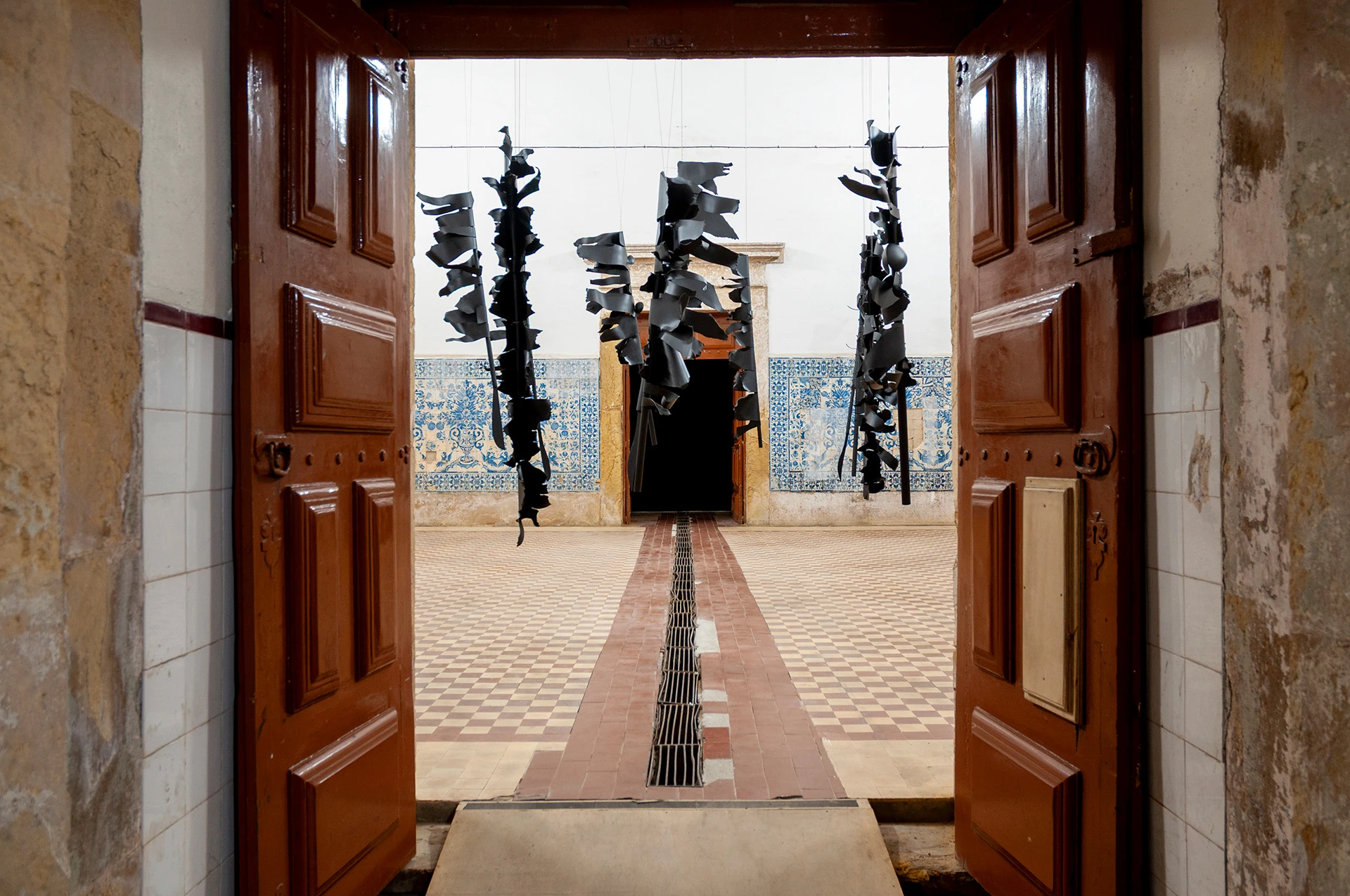
The importance attributed to space and architecture in Anozero is revealed to us in works such as Acredito em tudo (2025), by Rui Chafes, a set of sculptures in black iron, simultaneously dense and light, which, suspended in the Lavatory Room, share the space with the visitor, in a game of scales and positions, evoking through their forms of moving flags an unbalanced structure. A transformative experience of space and works, revealing architecture as a discipline of experimentation, which we observe in the three installations of the Centrala collective, observatories located in the monastery and in the garden that allow connecting and reconnecting with the cosmos. It is also in the garden that Monument to the Ordinary (2026), by the KOSMOS collective, is presented, a monumental sculptural structure conceived from old military cabinets, through which it questions what deserves to be remembered.
The image as an agent of transformation, metamorphosis, and healing is revealed to us in Nan Goldin's Stendhal Syndrome (2024), a video work that, like a cartography of human pathos, combines images from art history with intimate photographs of the artist's friends, accompanied by her voice and music from Soundwalk Collective.
Outside the Monastery grounds, the relationship between body and landscape is explored in the works of Fina Miralles, Alberto Carneiro, and Pedro Vaz, on display at Círculo Sede. Through drawings, sculptures, and film, the works of the three artists develop from the rhythms of nature, making visible the energies contained in natural materials and the landscape, as if embodying the sonic design described and verbalized by Luisa Cunha in Words for Gardens (2004), of a garden in transformation, which echoes like a mantra in the Estufa Fria of the Botanical Garden of the University of Coimbra.
In the Círculo Sereia, highlights include the section dedicated to the genocide in Gaza. Just in Case (2024), by Taysir Batniji, brings together, in a work about memory and erasure, photographs of keys belonging to Palestinians forced to flee and leave their homes during bombings. Adam Broomberg and Rafael Gonzalez present photographs of centuries-old olive trees in the occupied territories of the West Bank, testimonies of resistance in the face of destruction. Also on display in this section are three photographs by Thomas Demand that address crisis and aggression, and the research films by the Forensic Architecture collective, which reveal the scars of war and political violence.
The political dimension of war is once again present in the Chapter Room of the Convent of São Francisco with the sculptural and sound installation Se estas pedras falassem (2026) by Maria Trabulo. Of an archaeological nature, promoting a reflection on the looting and destruction of Syrian cultural heritage based on the case of the Raqqa Museum, we observe artifacts on the floor – reconstructed by the artist – surrounded by fragments of ruins, while we hear the voices of those who remember the museum.
We return to the Monastery, where, around an old tank converted into a long table by Inside Outside, covered in bright pink tiles that reflect the trees and the sky, we are invited to sit in the arranged chairs, either to chat with strangers or to contemplate the land where the collective planted orange trees that will grow in the coming years. It is in this moment of rest and introspection that we recall the graffiti from Arquivo Mangue on one of the Monastery's walls: Vende-se Tabu (Taboo for Sale), words of a manifesto at a time when the future of Anozero-Bienal de Arte Contemporânea de Coimbra is still uncertain.
The activation and contamination of the city of Coimbra through Anozero-Bienal of Contemporary Art, and its role as a structure of social cohesion and creation of spaces, is reflected in the elaboration of a convergent program whose plurality of proposals is assumed as a gesture of encounter around the theme Holding, giving, receiving.
In a welcoming gesture among the city's various cultural institutions, agents, and artists, the following exhibitions are presented as part of the biennial's convergent programming: CUIDADORIA, by the artist-curator duo Ana Rito & Hugo Barata, at the Casa Museu Bissaya Barreto, a project that expands care as an aesthetic and ethical practice, in which the act of healing becomes an exercise in attention, hospitality, and affection; Mapas do Olhar III – Ancestralidades, migrações e desportos, by art students from Colégio Estadual Avelar Brotero; Volátil, by André Silva, at Galeria 7, as a field of tension between memory, matter, and the world; Os Trópicos têm poros, by Lilian Walker, at the Museum of the Geophysical and Astronomical Observatory of the University of Coimbra; and Bálsamo (Balm) with Gil Maia, at Galeria 7.
Another highlight is the expansion of the programme through the Convergente Open Call, which is dedicated to promoting artistic practices that explore sensory and participatory experiences. The initiative invites artists, collectives and mediators who, through performances and participatory experiences, will use the city as a stage, a meeting place and a field of experimentation, opening paths for new forms of exchange between those who create, those who participate, and those who inhabit Coimbra.
BIOGRAPHY
Mafalda Teixeira, Master’s Degree in History of Art, Heritage and Visual Culture from the Faculty of Letters of the University of Porto. She has an internship and worked in the Temporary Exhibitions department of the Museu d’Art Contemporani de Barcelona. During the master’s degree, she did a curricular internship in production at the Municipal Gallery of Oporto. Currently, she is devoted to research in the History of Modern and Contemporary Art, and publishes scientific articles.
ADVERTISING
Previous
article
15 Jun 2026
Notes on ARCO Lisboa 2026
By Ayşenur Tanrıverdi
Next
article
18 Jun 2026
Olho de Vidro, by Pedro Barassi: The Gravity of the Gaze
By Ayşenur Tanrıverdi
Related Posts
article
02 SEP 2026
Serapinas and Ourahmane at the Porto Municipal Gallery
By Mafalda Teixeira
article
07 JUL 2026
Interview with Silvestre Pestana, author of the Umbigo.space cover
By Mafalda Teixeira
article
15 JUN 2026
ANOZERO’26 – Bienal de Arte Contemporânea de Coimbra: Segurar, Dar, Receber (To hold, to give, and to receive)
By Mafalda Teixeira
article
02 JUN 2026
Submundo, de Paulo Wirz, at Teodoro W.
By Mafalda Teixeira