article
God and the Devil in the Land of the Biennial
“But what emerged from this mayonnaise-Biennale, perhaps the final edition as we have known it until now? First, a show-off by the galleries: unbelievable – some national pavilions whose artists are represented by the biggest companies in the world – carrying out such ordinary projects: a true exercise in smoothing the fur of power, to go directly from Venice to the home of any collector. Very few were the courageous ones, that is, those who treated their own spaces as places of research and not to assemble walls to be sold: Japan, Canada, Portugal, Germany, Belgium, and Austria.”
«So with you, with that impressive resume and that big speech about your so-called work ethic, I thought you could be different. I said to myself, go ahead, take a chance, hire the smart, fat girl. I had a hope. My God, I live on hopes. But in the end, you disappointed me more than...more than any of the other silly girls».
(Miranda, The Devil Wears Prada, 2006)
I live for hope, like Miranda Priestly herself. I had high expectations, a lot of enthusiasm even, to attend the sixty-first Venice Biennale, In Minor Keys. I know, Koyo Kouoh died just as he had finished finalizing the guest list; it was easy to imagine a crippled Biennale – "minor" like the title. But no, I wanted to believe. In fact, I hoped: 110 artists (including duos, collectives, organizations), most of whom are between 40 and 50 years old, that is, in their mature years. What a relief! Enough of child prodigies and enough of the dead, since the last editions were closer to a cemetery inventory than a contemporary art exhibition.
Looking at the list of artists, after the project was presented by the curatorial team – last February in Venice – she was optimistic as she read the names: Kader Attia, Carsten Höller, Alfredo Jaar, Dan Lie, Eustaquio Neves, Uriel Orlow, Walid Raad...
However, everything can happen. Firstly: the disappointment of Italian art workers at not having – for the first time in the history of the Biennale – any representation. It would never have happened anywhere else in the world, but here it did. Secondly: politics kicking down the door, fully entering the demonstration, poisoning the atmosphere of the eve in a way never experienced, or perhaps only in the Biennales of 1968 and 1977, the most heated of the post-war period, mirrors of the years of protests in Europe.
Furthermore, following the events: after the curator's death, Russia announced its own return to Venice. It's a shame that the Italian Minister of Culture, Alessandro Giuli, didn't like the independence emphasized by the Biennale Foundation in allowing all countries in the world to participate freely. In response, Giuli himself aligned himself with the Israeli pavilion, promising maximum visibility in Italy to the artist Belu-Simion Fainaru. He even promised him an invitation to Rome.
It would be a joke if it weren't all documented by a press release issued by the same Ministry.
There's more: announced on April 22nd, the jury composed of Solange Oliveira Farkas, Zoe Butt, Elvira Dyangani Ose, Marta Kuzma, and Giovanna Zapperi – whose role was to choose and award the Golden Lions – announced on the 27th that it would not consider the participation of countries whose leaders are accused of crimes against humanity (Russia and Israel, specifically). Three days later, the group signed their own resignations. The Russian pavilion, however, was closed after four days of opening, while Israel complained about the "false political indoctrination" involving the Biennale. Evidently, in a Europe that threatened to cut the annual funding to the Venice Biennale if Russia were invited (two million euros, equivalent to the price of a coffee for us), there are both A-list and B-list genocidal figures.
It is no coincidence that on Friday the 8th, the last day of the Biennale preview, on the occasion of the art workers' strike – 27 national pavilions supporting the initiative and consequently closing their doors – the police (the political establishment) once again showed their true colors: confronting the pro-Palestinian demonstrators and attempting to disrupt the procession.
For supporters, the laws (states) that foment war have everything to do with the austerity programs that are annihilating culture across Europe: the Biennial, in this disgrace, is neither impartial nor indifferent to the issue.
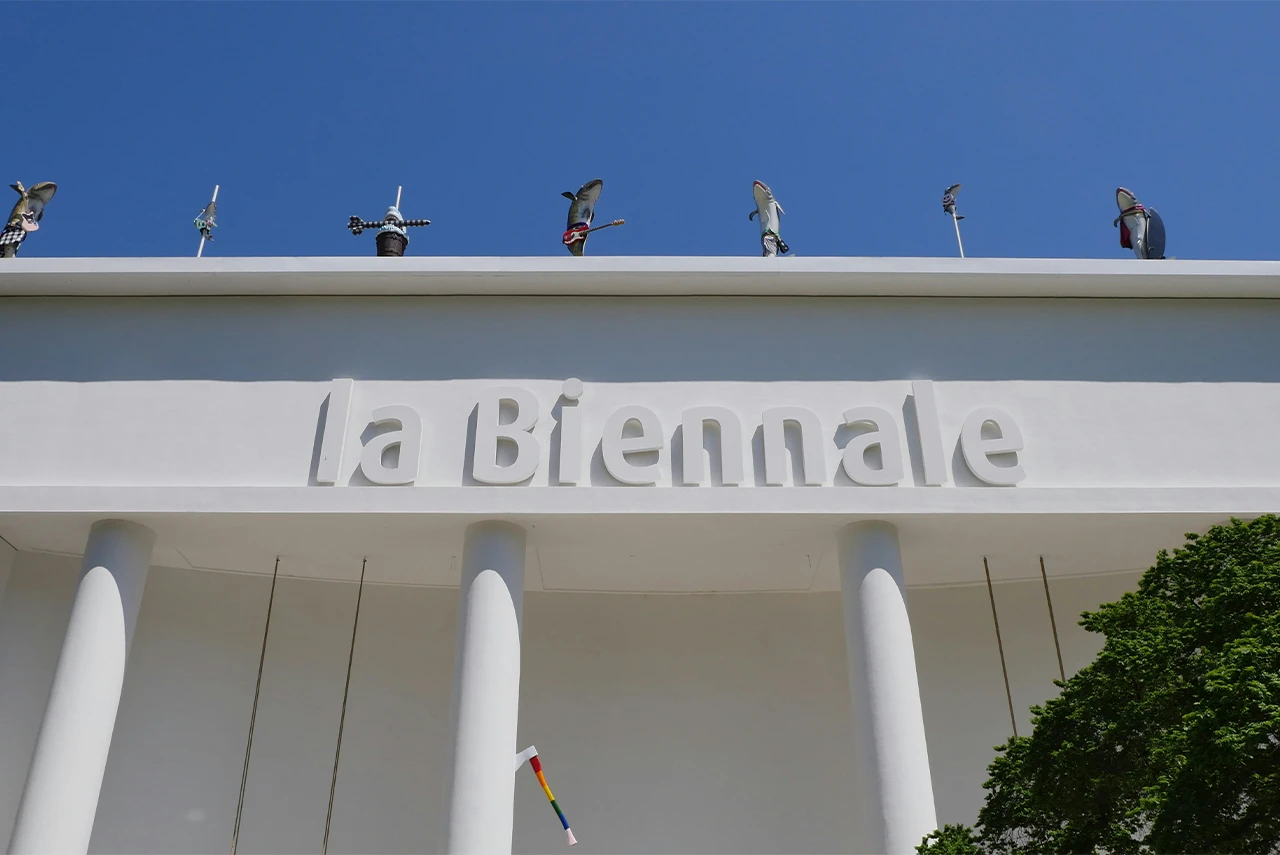
But what emerged from this mayonnaise-Biennale, perhaps the final edition as we have known it until now? First, a show-off by the galleries: unbelievable – some national pavilions whose artists are represented by the biggest companies in the world – carrying out such ordinary projects: a true exercise in smoothing the fur of power, to go directly from Venice to the home of any collector. Very few were the courageous ones, that is, those who treated their own spaces as places of research and not to assemble walls to be sold: Japan, Canada, Portugal1, Germany, Belgium, and Austria.
The Biennale itself, especially the In Minor Keys section presented at the Arsenale, is more like a fair: no deviation from the usual route. Really, in years, since Ralph Rugoff in 2019 (his edition was May you live in interesting times), no one has thought to shake things up in this routine? In fact, this "inclusive" and hegemonic approach – typical of exhibition design – leads us to the same experience as visiting Art Basel: chic stands divided by cardboard and curtains; the size of the artworks aligned with that of large living rooms.
We are light-years away from Biennales of large-scale installations, of environments: Alfredo Jaar's red room dedicated to the exploration of rare earths is a déjà-vu of Light Art; Kader Attia's intervention was already seen in 2025 at the São Paulo Biennial (for those who will say "Ah, but it was different": it was, only not really. Even the perspective, often, is more relevant than the concept); the photos of the marvelous Eustaquio Neves and the installation by Walid Raad? Nothing we haven't already seen in other Biennales or in galleries around the world.
It will be argued that this problem only affects those who travel the world in search of contemporary art. Yes and no: the issue here enters the conceptual realm. How can the frequency of works that have already been included in Biennales around the world, from Brazil to Diriyah, Saudi Arabia, be considered "less frequent"? How can one fail to see a market dynamic in the global reiteration of artists and topics?
Finally, In Minor Keys, theorized as a celebration of silences, of the forgotten, and of otherness, stumbles in practice: it celebrates what once was and no longer is, completely absorbed by the economies of post-cultural capitalism. The rescue of art and themes from Africa and its diasporas is fashionable: not a rupture, but a repetition. This understanding shines crystal clear in those who experience In Minor Keys after the editions of the rescued works of Gioni, Alemani, Macel, and Pedrosa.
Allow me one more irony: to speak of Africa today by placing the Senegalese artist Seyni Awe Camara (1945-2026) – already included in the historic exhibition "Les Magiciens de la terre", curated by Jean-Hubert Martin at the Centre Pompidou in Paris in 1988 – to open the central pavilion's main room? Groundbreaking, Miranda would say.
Furthermore, the curatorial team (Gabe Beckhurst Feijoo, Marie Hélène Pereira, Rasha Salti, Siddhartha Mitter, and Rory Tsapayi) reported a Biennial more focused on artists than on objects. Thus, the transfer of art to the biographical question, to psychological possibility, was complete: visual practices as remedy and cure in the sanitary sense of the term, a century after Arthur Bispo do Rosário.
In a way, this trend makes perfect sense: beyond the political controversies, the FOMO (Fear of Missing Out) of art workers and those involved on opening days has never been so overwhelming: willing to do anything (long queues for hours) to take a picture of a naked woman immersed in a tank of reusable water (urine) (Austrian pavilion); disjointed hysterias in the party crowds. Artnews even published an article dedicated to the large yachts anchored at the dock in front of the Arsenale and Giardini entrances: who are the billionaire collectors who slept in their own floating mansions during the Biennale?
Art? It's outline and dessert.
In the middle, Venice: increasingly crowded, more isolating, more disconnected from its monstrous creature, the oldest and most institutional in the world.
To top it all off: VIP tickets sold for 500 euros, schoolchildren on field trips on opening days – shocking!, and the last vestiges of dignity: more than 70 artists (between the guests of the main exhibition and the representatives of national pavilions) refused to receive the Lions that the same public will decide through anonymous voting, in November.
Around us, there is also the frightening naiveté that still believes that Minor Tones belong to a style or even to a reparation of lost dignity.
The Biennale can be visited until November 22, 2026.
1 Interview with Alexandre Estrela about RedSkyFalls, the Portuguese Pavilion at the Venice Biennale, available here.
ADVERTISING
Previous
article
15 May 2026
Writing the Crystalline Field of Collectivity: The Second Shadow at ICA Milano
By Josseline Black
Next
article
18 May 2026
Depois de Para Sempre, at Pavilhão Julião Sarmento
By Maria Brás Ferreira
Related Posts
article
18 MAY 2026
God and the Devil in the Land of the Biennial
By Matteo Bergamini
article
-6qspq.jpg)
07 APR 2026
RedSkyFalls, Portugal at the Venice Biennale: An Interview with Alexandre Estrela
By Matteo Bergamini
article
12 FEB 2026
Stories of shadows and worlds: Francisco Tropa in Bologna
By Matteo Bergamini
article
04 FEB 2026
The landscape in Rodamoinho: Marina Rheingantz at the ICA in Milan
By Matteo Bergamini